

Introduction
Every physical quantity tells two stories simultaneously. The first is numerical — the speed of a car is 72. The second is structural — that number represents a length divided by a time. The dimensional formula is how physics makes the second story explicit and permanent.
Most students learn dimensional formulas as a table to memorize: velocity is \( LT^{-1} \), force is \( MLT^{-2} \), energy is \( ML^2T^{-2} \). The memorization is straightforward. What is less often taught — and what actually makes the concept useful — is how each formula is derived from a physical definition, what it reveals about the quantity it describes and precisely where its power ends. This article covers all three: derivation, application and the honest limits of the technique.
What Is a Dimensional Formula?
A dimensional formula is an expression that shows how a physical quantity is related to the fundamental (base) dimensions of physics. It expresses the quantity as a product of these base dimensions, each raised to an appropriate power.
The standard notation uses square brackets around the quantity symbol:
\[ [Q] = M^a L^b T^c \cdots \]
Where:
- \( M \) = mass dimension
- \( L \) = length dimension
- \( T \) = time dimension
- \( a, b, c \) = rational numbers (integers in most cases) called dimensional exponents
- The ellipsis indicates that additional base dimensions (A for current, K for temperature, mol for substance, cd for luminous intensity) may appear when needed
The dimensional formula does not tell you the numerical value of a quantity. It tells you what kind of quantity it is — how it is built from the most fundamental measurable properties of the physical world.
Dimensional Formula vs Dimensional Equation vs Dimensional Analysis
These three terms are related but distinct:
| Term | What It Is | Example |
| Dimensional Formula | The expression showing dimensions of a quantity | \( [F] = MLT^{-2} \) |
| Dimensional Equation | An equation equating a quantity to its dimensional formula | \( [Force] = MLT^{-2} \) |
| Dimensional Analysis | The technique of using dimensional formulas to solve problems | Checking \( v = u + at \) for homogeneity |
The dimensional formula is the raw material. The dimensional equation states it formally. Dimensional analysis is what you do with it.
The Seven Fundamental Dimensions
Every dimensional formula is built from combinations of the seven base dimensions of the SI system:
| Dimension | Symbol | Physical Quantity | SI Unit |
| Mass | M | Inertia, gravitational source | kilogram (kg) |
| Length | L | Spatial extent | metre (m) |
| Time | T | Duration | second (s) |
| Electric Current | A (or I) | Rate of charge flow | ampere (A) |
| Temperature | K (or θ) | Thermal energy per degree of freedom | kelvin (K) |
| Amount of Substance | N (or mol) | Count of entities | mole (mol) |
| Luminous Intensity | J (or cd) | Perceived light power | candela (cd) |
In mechanics — which covers the majority of Class 11 and most of the Units and Measurements chapter — only M, L and T are needed. Electromagnetism adds A. Thermodynamics adds K. Physical chemistry adds mol. Photometry adds J.
Learn more about SI Units Explained: The 7 Base Units Every Physics Student Must Know
How to Derive a Dimensional Formula: The Method
The method for deriving a dimensional formula is always the same, regardless of the quantity. It has three steps.
Step 1: Write the defining equation or formula for the quantity.
Step 2: Substitute the dimensional formulas of every quantity on the right-hand side.
Step 3: Simplify using the rules of algebra to get the dimensional formula of the left-hand side.
The only inputs you need are:
- The defining equation (which you should know from the physics)
- The dimensional formulas of the base quantities on the right (which follow from their definitions)
Starting Points: What You Always Know
These dimensional formulas follow directly from the SI definitions and never need to be derived:
\[ [\text{Length}] = L, \quad [\text{Mass}] = M, \quad [\text{Time}] = T \]
\[ [\text{Area}] = L^2, \quad [\text{Volume}] = L^3 \]
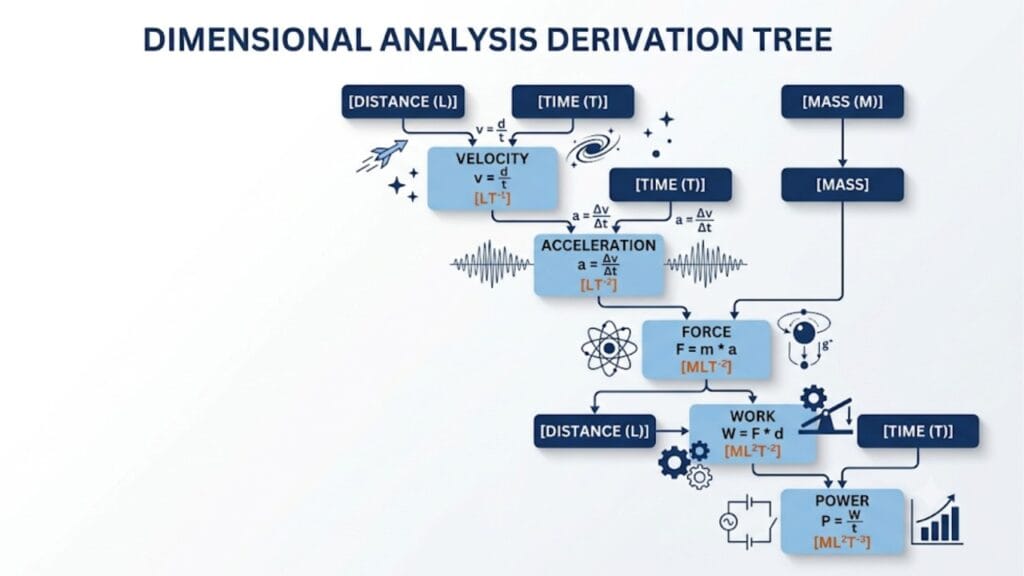
\[ [\text{Velocity}] = \frac{L}{T} = LT^{-1}, \quad [\text{Acceleration}] = \frac{LT^{-1}}{T} = LT^{-2} \]
These five — length, mass, time, velocity and acceleration — are the foundation from which almost every other mechanical dimensional formula is built.
Derivations: Mechanics
Force
Defining equation: Newton’s Second Law: \( F = ma \)
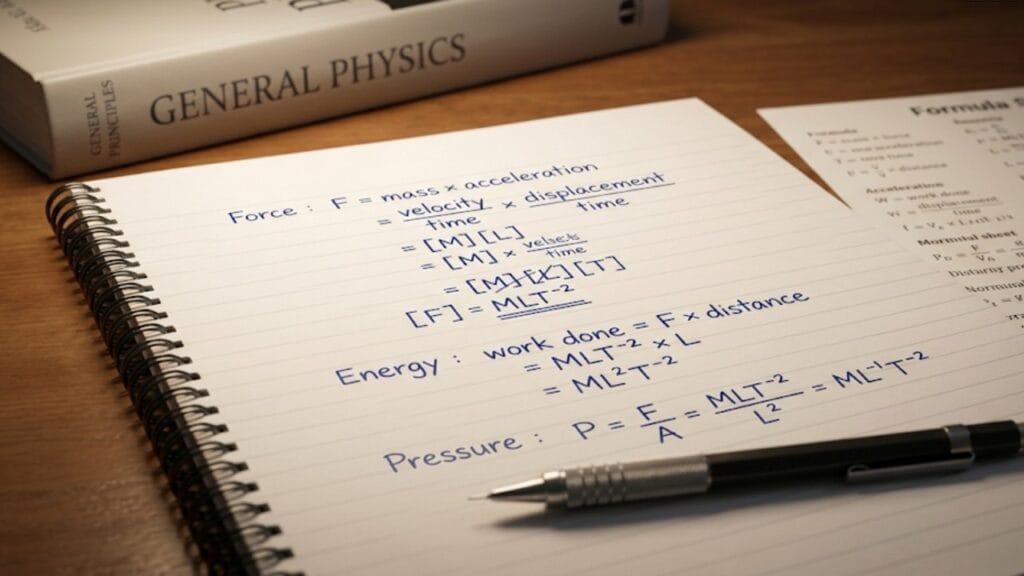
\[ [F] = [m][a] = M \cdot LT^{-2} \]
\[ \boxed{[F] = MLT^{-2}} \]
The unit is the Newton (N) = kg·m·s⁻².
Momentum and Impulse
Defining equation for momentum: \( p = mv \)
\[ [p] = [m][v] = M \cdot LT^{-1} \]
\[ \boxed{[p] = MLT^{-1}} \]
For impulse: \( J = F \cdot t \)
\[ [J] = [F][t] = MLT^{-2} \cdot T = MLT^{-1} \]
Impulse and momentum have the same dimensional formula — confirming the impulse-momentum theorem \( J = \Delta p \) is dimensionally valid.
Work and Energy
Defining equation: \( W = F \cdot s \)
\[ [W] = [F][s] = MLT^{-2} \cdot L = ML^2T^{-2} \]
\[ \boxed{[W] = ML^2T^{-2}} \]
Since energy and work are physically equivalent: \( [E] = ML^2T^{-2} \)
Verification through kinetic energy: \( KE = \frac{1}{2}mv^2 \)
\[ [KE] = M \cdot (LT^{-1})^2 = ML^2T^{-2} \quad \checkmark \]
Verification through potential energy: \( PE = mgh \)
\[ [PE] = M \cdot LT^{-2} \cdot L = ML^2T^{-2} \quad \checkmark \]
All three routes give the same dimensional formula — a good sign that the physics is consistent.
Power
Defining equation: \( P = \frac{W}{t} \)
\[ [P] = \frac{[W]}{[t]} = \frac{ML^2T^{-2}}{T} = ML^2T^{-3} \]
\[ \boxed{[P] = ML^2T^{-3}} \]
Pressure
Defining equation: \( P = \frac{F}{A} \)
\[ [P] = \frac{[F]}{[A]} = \frac{MLT^{-2}}{L^2} = ML^{-1}T^{-2} \]
\[ \boxed{[P] = ML^{-1}T^{-2}} \]
This same dimensional formula applies to stress (force per unit area), bulk modulus, shear modulus and Young’s modulus — all of which are forms of force per unit area.
Gravitational Constant G
Defining equation: Newton’s Law of Gravitation: \( F = \frac{Gm_1m_2}{r^2} \)
Rearranging for G:
\[ G = \frac{Fr^2}{m_1 m_2} \]
\[ [G] = \frac{[F][r]^2}{[m]^2} = \frac{MLT^{-2} \cdot L^2}{M^2} = \frac{ML^3T^{-2}}{M^2} = M^{-1}L^3T^{-2} \]
\[ \boxed{[G] = M^{-1}L^3T^{-2}} \]
Torque
Defining equation: \( \tau = r \times F \)
\[ [\tau] = [r][F] = L \cdot MLT^{-2} = ML^2T^{-2} \]
\[ \boxed{[\tau] = ML^2T^{-2}} \]
Note: Torque has the same dimensional formula as energy. They are dimensionally identical but physically distinct — a crucial subtlety that dimensional analysis alone cannot resolve.
Angular Momentum
Defining equation: \( L = I\omega \), where \( I = mr^2 \) and \( \omega \) has dimensions \( T^{-1} \)
\[ [L] = [I][\omega] = ML^2 \cdot T^{-1} = ML^2T^{-1} \]
\[ \boxed{[L] = ML^2T^{-1}} \]
Surface Tension
Defining equation: \( \gamma = \frac{F}{l} \) (force per unit length)
\[ [\gamma] = \frac{[F]}{[l]} = \frac{MLT^{-2}}{L} = MT^{-2} \]
\[ \boxed{[\gamma] = MT^{-2}]} \]
Coefficient of Viscosity
Defining equation (Newton’s viscosity law):
\[ F = \eta A \frac{dv}{dy} \]
Where \( \frac{dv}{dy} \) is the velocity gradient (velocity per unit distance): \( [LT^{-1}/L] = T^{-1} \)
\[ [\eta] = \frac{[F]}{[A][dv/dy]} = \frac{MLT^{-2}}{L^2 \cdot T^{-1}} = \frac{MLT^{-2}}{L^2T^{-1}} = ML^{-1}T^{-1} \]
\[ \boxed{[\eta] = ML^{-1}T^{-1}} \]
Derivations: Physical Constants
Universal Gas Constant R
Defining equation: Ideal gas law: \( PV = nRT \), so \( R = \frac{PV}{nT} \)
\[ [R] = \frac{[P][V]}{[n][T]} = \frac{ML^{-1}T^{-2} \cdot L^3}{N \cdot K} = \frac{ML^2T^{-2}}{NK} \]
\[ \boxed{[R] = ML^2T^{-2}K^{-1}N^{-1}} \]
Where N is the dimension of amount of substance (mole).
Planck’s Constant h
Defining equation: \( E = h\nu \), where \( \nu \) is frequency with dimensions \( T^{-1} \)
\[ [h] = \frac{[E]}{[\nu]} = \frac{ML^2T^{-2}}{T^{-1}} = ML^2T^{-1} \]
\[ \boxed{[h] = ML^2T^{-1}]} \]
Note that this is identical to the dimensional formula of angular momentum \( [ML^2T^{-1}] \) — a connection that is not coincidental. In quantum mechanics, angular momentum is quantized in units of \( \hbar = h/2\pi \) and the identification of these dimensions with the quantum of action reflects something deep about the structure of quantum theory.
Boltzmann Constant k
Defining equation: \( E = kT \) (thermal energy per degree of freedom)
\[ [k] = \frac{[E]}{[T_\text{temp}]} = \frac{ML^2T^{-2}}{K} = ML^2T^{-2}K^{-1} \]
\[ \boxed{[k] = ML^2T^{-2}K^{-1}]} \]
Derivations: Electromagnetism
For electromagnetic quantities, the ampere (A) dimension enters.
Electric Charge
Defining equation: \( q = It \)
\[ [q] = [I][t] = AT \]
\[ \boxed{[q] = AT} \]
Electric Field
Defining equation: \( E = F/q \) (force per unit charge)
\[ [E_\text{field}] = \frac{[F]}{[q]} = \frac{MLT^{-2}}{AT} = MLT^{-3}A^{-1} \]
\[ \boxed{[E_\text{field}] = MLT^{-3}A^{-1}} \]
Electric Potential
Defining equation: \( V = W/q \) (work per unit charge)
\[ [V] = \frac{[W]}{[q]} = \frac{ML^2T^{-2}}{AT} = ML^2T^{-3}A^{-1} \]
\[ \boxed{[V] = ML^2T^{-3}A^{-1}} \]
Electrical Resistance
Defining equation: \( R = V/I \)
\[ [R] = \frac{[V]}{[I]} = \frac{ML^2T^{-3}A^{-1}}{A} = ML^2T^{-3}A^{-2} \]
\[ \boxed{[R] = ML^2T^{-3}A^{-2}} \]
Capacitance
Defining equation: \( C = q/V \)
\[ [C] = \frac{[q]}{[V]} = \frac{AT}{ML^2T^{-3}A^{-1}} = M^{-1}L^{-2}T^4A^2 \]
\[ \boxed{[C] = M^{-1}L^{-2}T^4A^2} \]
Magnetic Field (B)
Defining equation: Lorentz force: \( F = qvB \), so \( B = F/(qv) \)
\[ [B] = \frac{[F]}{[q][v]} = \frac{MLT^{-2}}{AT \cdot LT^{-1}} = \frac{MLT^{-2}}{AL} = MT^{-2}A^{-1} \]
\[ \boxed{[B] = MT^{-2}A^{-1}} \]
Complete Dimensional Formula Reference Table
| Physical Quantity | Dimensional Formula |
| Mechanics | |
| Velocity | \( [LT^{-1}] \) |
| Acceleration | \( [LT^{-2}] \) |
| Force | \( [MLT^{-2}] \) |
| Momentum / Impulse | \( [MLT^{-1}] \) |
| Work / Energy (all types) | \( [ML^2T^{-2}] \) |
| Torque | \( [ML^2T^{-2}] \) |
| Power | \( [ML^2T^{-3}] \) |
| Pressure / Stress / Bulk Modulus | \( [ML^{-1}T^{-2}] \) |
| Density | \( [ML^{-3}] \) |
| Angular Velocity / Frequency | \( [T^{-1}] \) |
| Moment of Inertia | \( [ML^2] \) |
| Angular Momentum | \( [ML^2T^{-1}] \) |
| Surface Tension / Spring Constant | \( [MT^{-2}] \) |
| Coefficient of Viscosity | \( [ML^{-1}T^{-1}] \) |
| Gravitational Constant G | \( [M^{-1}L^3T^{-2}] \) |
| Constants | |
| Planck’s Constant h | \( [ML^2T^{-1}] \) |
| Boltzmann Constant k | \( [ML^2T^{-2}K^{-1}] \) |
| Universal Gas Constant R | \( [ML^2T^{-2}K^{-1}N^{-1}] \) |
| Electromagnetism | |
| Electric Charge | \( [AT] \) |
| Electric Field | \( [MLT^{-3}A^{-1}] \) |
| Electric Potential | \( [ML^2T^{-3}A^{-1}] \) |
| Resistance | \( [ML^2T^{-3}A^{-2}] \) |
| Capacitance | \( [M^{-1}L^{-2}T^4A^2] \) |
| Inductance | \( [ML^2T^{-2}A^{-2}] \) |
| Magnetic Field B | \( [MT^{-2}A^{-1}] \) |
| Magnetic Flux | \( [ML^2T^{-2}A^{-1}] \) |
| Permittivity \( \varepsilon_0 \) | \( [M^{-1}L^{-3}T^4A^2] \) |
| Permeability \( \mu_0 \) | \( [MLT^{-2}A^{-2}] \) |
Pairs of Quantities Sharing the Same Dimensional Formula
This is tested directly in board exams and competitive exams. The table below lists all important pairs (and groups) that students are expected to recognize.
| Dimensional Formula | Quantities |
| \( [ML^2T^{-2}] \) | Work, All forms of energy, Torque, Heat |
| \( [MLT^{-1}] \) | Momentum, Impulse |
| \( [ML^2T^{-1}] \) | Angular Momentum, Planck’s Constant h |
| \( [MT^{-2}] \) | Surface Tension, Spring Constant (k) |
| \( [ML^{-1}T^{-2}] \) | Pressure, Stress, Strain Moduli (Y, B, η) |
| \( [T^{-1}] \) | Frequency, Angular Velocity, Decay Constant |
| \( [ML^2T^{-3}] \) | Power, Intensity of radiation |
| \( [MLT^{-2}] \) | Force, Weight, Tension |
| \( [M^0L^0T^0] \) | All dimensionless quantities (strain, refractive index, relative density, angles) |
Dimensionless Quantities: A Special Case
A quantity is dimensionless when all its dimensional exponents are zero:
\[ [Q] = M^0L^0T^0 \]
Dimensionless quantities play a special role in physics. They are the fundamental quantities that characterize the behavior of physical systems independently of unit choice. The Reynolds number, Mach number, fine structure constant and strain are all dimensionless — they describe pure ratios that have the same numerical value regardless of the unit system used.
This is why the argument of any trigonometric or exponential function must be dimensionless: the function itself is dimensionless and the argument must carry the same character.
Dimensional Formula in Exam Context
Board Exams (CBSE Class 11)
Dimensional formula questions appear in three forms:
- Derive the dimensional formula of a given quantity — typically 2 marks
- Check the dimensional validity of a given equation — typically 2–3 marks
- Find the dimensions of a constant in a given formula — typically 3 marks
JEE Main and NEET
In competitive exams, dimensional formulas appear:
- As direct questions — “Which of the following has the same dimensional formula as Planck’s constant?”
- As elimination tools — one of four options fails the dimensional check
- As embedded components of error propagation numericals
The most frequently asked dimensional formulas in competitive exams are G, h, k (Boltzmann), R, η (viscosity) and the Van der Waals constants a and b.
Learn more about Units and Measurements for JEE Main: Important Topics, Formulas & PYQs
How to Memorize Dimensional Formulas Efficiently
The honest answer is: do not memorize them directly. Derive them.
Once you have derived force as \( MLT^{-2} \) from \( F = ma \) three or four times, you will never forget it — not because you memorized it, but because you understand it. And if you ever doubt it in an exam, you can re-derive it in ten seconds.
The derivation chain to practice:
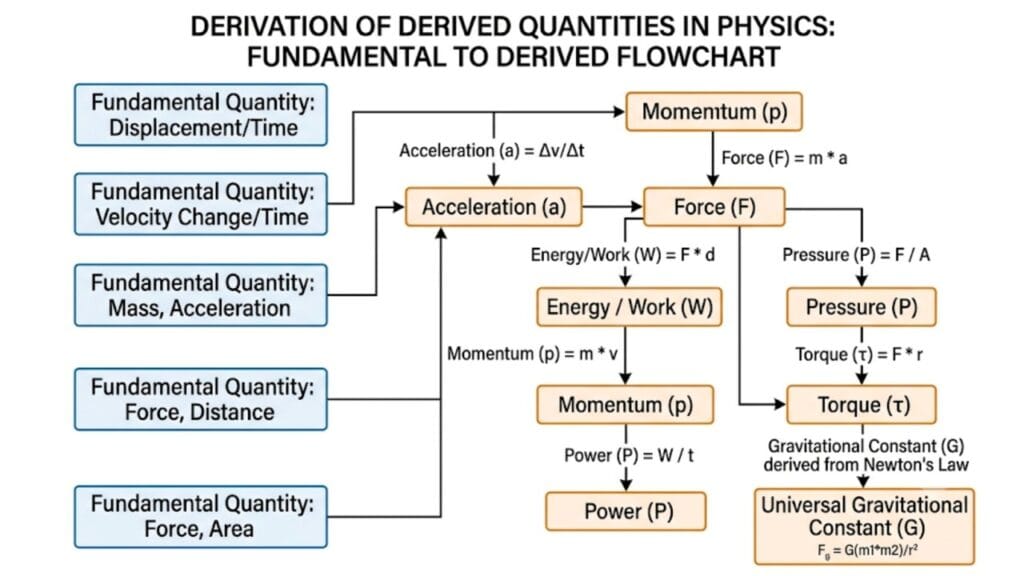
\[ \text{velocity} \rightarrow \text{acceleration} \rightarrow \text{force} \rightarrow \text{momentum} \rightarrow \text{energy} \rightarrow \text{power} \rightarrow \text{pressure} \]
Each step is one formula application. Running through this chain once a day for a week builds permanent fluency that cannot be lost the way memorized tables can be.
For the constants (G, h, k, R), practice deriving from their defining formulas — \( F = Gm_1m_2/r^2 \), \( E = h\nu \), \( E = kT \), \( PV = nRT \) — until the derivation is automatic.
Conclusion
The dimensional formula of a physical quantity is not a label or a mnemonic. It is a precise statement about the physical structure of that quantity — what kind of thing it is, how it is built from the most fundamental measurable properties of nature and how it must relate to other quantities in any valid physical equation.
Deriving dimensional formulas from first principles, rather than reading them from a table, builds exactly the kind of structural physical understanding that competitive exams test and that genuine physics education demands. The derivation method is always the same: write the defining equation, substitute known dimensional formulas, simplify. Thirty seconds of focused work produces a result that is understood rather than merely remembered.
The limitations of dimensional analysis are specific and important. Knowing them precisely — cannot find dimensionless constants, cannot handle transcendental functions, cannot distinguish physically different quantities with identical dimensions — prevents overreach and identifies exactly when a deeper theoretical or experimental approach is needed.
Together, the power and the limits define what dimensional formula analysis is: a sharp, focused instrument with clear range and clear boundaries. Within that range, there is nothing in introductory physics more reliably useful.
Learn more about Most Important Formulas in Units & Measurements for Board Exams
Frequently Asked Questions
What is the dimensional formula of a physical quantity?
The dimensional formula expresses a physical quantity in terms of the fundamental dimensions — mass (M), length (L), time (T) and others — each raised to appropriate powers. For example, the dimensional formula of force is \( [MLT^{-2}] \), meaning force has dimensions of mass to the power 1, length to the power 1 and time to the power −2. It is written inside square brackets by convention.
What is the difference between dimensional formula and dimensional equation?
A dimensional formula is the expression of a quantity in terms of base dimensions: \( MLT^{-2} \). A dimensional equation equates a quantity to its dimensional formula: \( [Force] = MLT^{-2} \). The dimensional formula is the right-hand side of the dimensional equation. In practice, both terms are often used interchangeably in Indian physics education.
How do you derive the dimensional formula of any quantity?
Write the defining equation for the quantity. Substitute the known dimensional formulas of all quantities on the right-hand side. Simplify using algebraic rules for powers. The result is the dimensional formula. For example, for pressure: \( P = F/A \), so \( [P] = [F]/[A] = MLT^{-2}/L^2 = ML^{-1}T^{-2} \).
Which physical quantities have the same dimensional formula?
Several important pairs share dimensional formulas: work and torque both have \( [ML^2T^{-2}] \); momentum and impulse both have \( [MLT^{-1}] \); angular momentum and Planck’s constant both have \( [ML^2T^{-1}] \); surface tension and spring constant both have \( [MT^{-2}] \). Sharing a dimensional formula does not mean the quantities are physically equivalent.
What are the limitations of dimensional formula analysis?
The main limitations are: (1) it cannot determine dimensionless constants like \( 2\pi \) or \( \frac{1}{2} \); (2) it cannot be applied to equations involving trigonometric, logarithmic, or exponential functions; (3) it cannot distinguish between physically different quantities sharing the same dimensional formula; (4) it fails when more than three unknown exponents exist in a mechanics problem; (5) it confirms dimensional consistency but not physical correctness.
Why does torque have the same dimensional formula as energy?
Both torque (\( \tau = r \times F \)) and energy (\( W = F \cdot s \)) involve the product of a force and a length, giving \( [ML^2T^{-2}] \). The dimensional identity reflects the mathematical similarity of their definitions, not physical equivalence. Torque is a rotational concept (force times perpendicular distance) while energy is a scalar quantity representing the capacity to do work. Dimensional analysis cannot capture this physical distinction.
Is the dimensional formula of Planck’s constant the same as angular momentum?
Yes. Both Planck’s constant (\( h \)) and angular momentum (\( L \)) have the dimensional formula \( [ML^2T^{-1}] \). This is not a coincidence — in quantum mechanics, angular momentum is quantized in units of \( \hbar = h/2\pi \) and the fact that they share dimensions is a reflection of the role Planck’s constant plays as the fundamental quantum of action, which is the same physical dimension as angular momentum.
Leave a Comment