

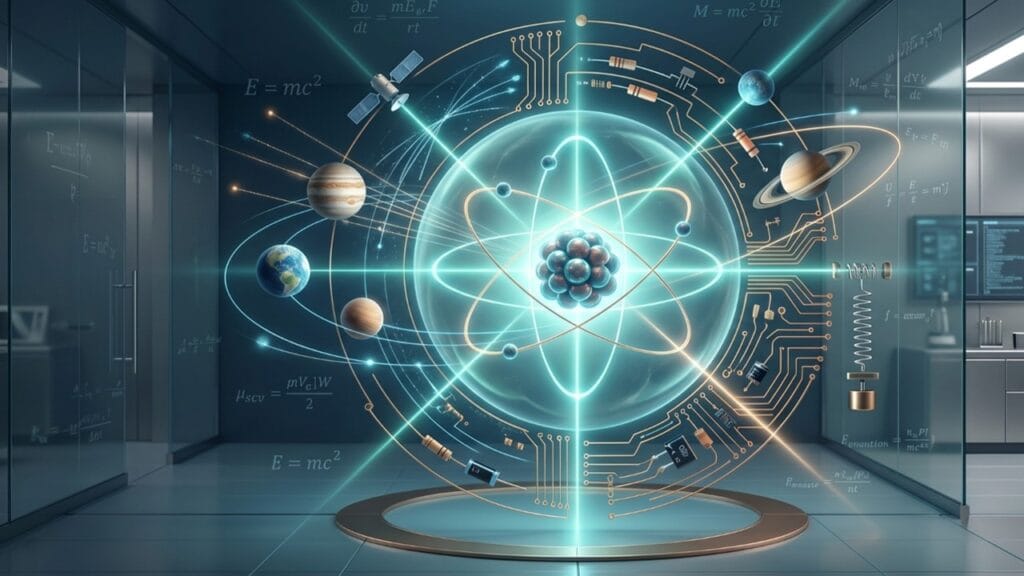
Introduction: Why Physics Fundamentals Matter
Physics is, in many ways, the language the universe uses to explain itself. Everything around you — the chair you are sitting on, the light in your room, the phone in your hand — exists and behaves the way it does because of the rules physics has established over centuries of careful observation and experimentation.
Understanding physics fundamentals is not just about passing your next exam. It is about training your mind to observe, question and reason. Students who build strong foundations in basic physics concepts tend to think more clearly, solve problems more systematically and perform better not just in science, but across disciplines that demand logical thinking.
If you are starting your journey into physics, or returning to fill gaps in your knowledge, this guide is for you. We will walk through the core ideas, explain them in plain language and connect them to the world you live in every day.
What Are the Fundamentals of Physics?
At its core, physics is the scientific study of matter, energy and the forces that govern how they interact. The term “fundamentals of physics” refers to the foundational concepts and principles that all other areas of physics are built upon.
Think of it like constructing a building. You cannot raise walls without a solid floor and you cannot lay the floor without a proper foundation. In physics, that foundation includes understanding what matter is, how objects move, what causes that movement, how energy flows and how waves and fields behave.
Without a clear grip on these basics, advanced topics like quantum mechanics or thermodynamics become confusing. With them, those same advanced topics start to feel like natural extensions of ideas you already understand.
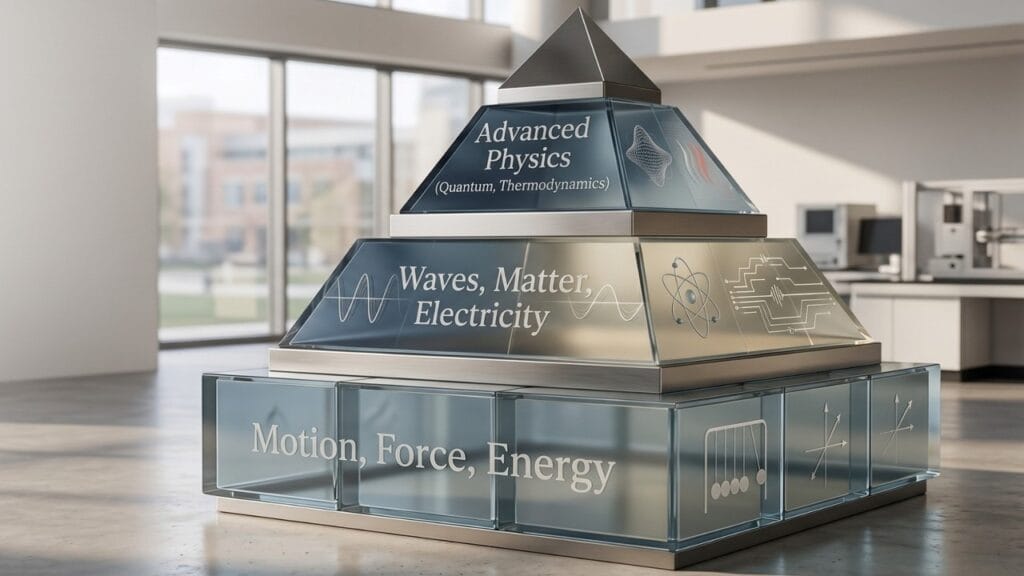
Important Note: Physics is not a collection of unrelated facts to memorize. It is a set of deeply connected ideas. Once you understand one concept clearly, several others often start to make intuitive sense.
The Core Branches of Physics
Physics is a vast subject and over time it has branched into several specialized areas. Here is a quick overview of the major branches and what they study.
Branches of Physics and Their Real-World Applications
| Branch | What It Studies | Real-World Application |
| Mechanics | Motion, force and energy | Engineering, vehicle design, sports physics |
| Thermodynamics | Heat, temperature and energy transfer | Engines, refrigerators, climate science |
| Electromagnetism | Electric and magnetic fields | Electronics, power grids, MRI machines |
| Optics | Behavior of light | Cameras, glasses, fiber optic cables |
| Wave & Sound | Sound and its properties | Music, hearing aids, sonar |
| Modern Physics | Behavior of particles at the atomic level | Semiconductors, lasers, atomic clocks |
| Astrophysics | Space, time and gravity at extreme scales | GPS systems, black hole research |
As a beginner, you will spend most of your time in classical mechanics and foundational electromagnetism. That is perfectly fine. These branches cover the lion’s share of what appears in school and entrance exam syllabi.
Essential Physics Concepts Explained Simply
Motion
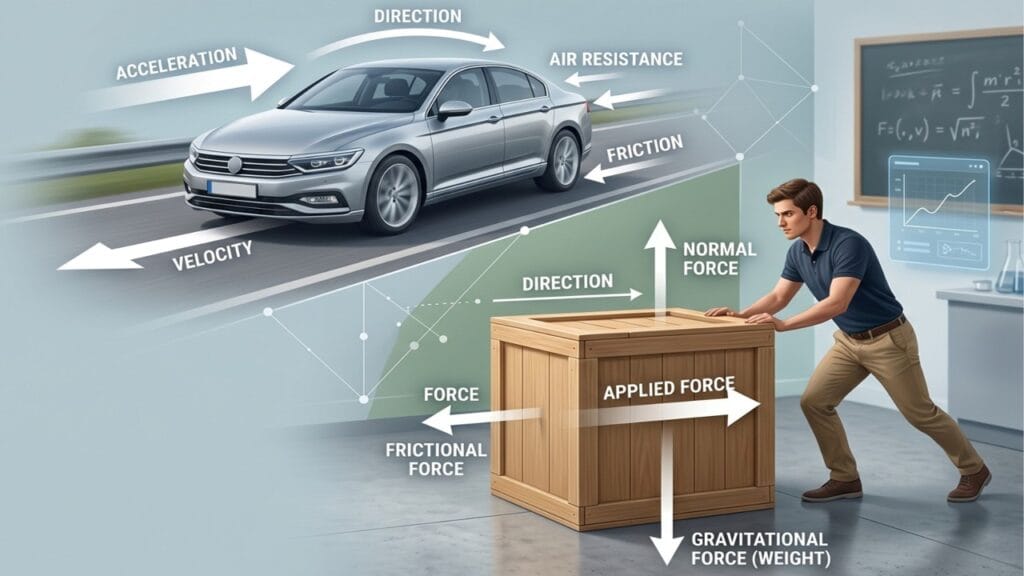
Motion is one of the first concepts you encounter in an introduction to physics and for good reason. It describes how objects change their position over time.
Key ideas under motion include:
- Speed and Velocity — Speed tells you how fast something is moving. Velocity adds direction to that. A car moving at 60 km/h is a speed; the same car moving at 60 km/h toward the north is a velocity.
- Acceleration — This is the rate at which velocity changes. Speeding up, slowing down, or changing direction all count as acceleration.
- Displacement vs. Distance — Distance is the total path covered; displacement is how far you are from your starting point, in a straight line.
A simple analogy: Imagine walking around a circular track and returning to where you started. You have covered a certain distance, but your displacement is zero.
For deeper reading, see our related article on Motion in One Dimension.
Force
A force is simply a push or a pull. It is what causes objects to change their state of motion — or resist changing it. Isaac Newton’s three laws of motion define the relationship between force and motion so clearly that they have remained essentially unchallenged for over three centuries.
- Newton’s First Law (Inertia): An object at rest stays at rest and an object in motion stays in motion, unless acted upon by a net external force. This is why you jerk forward when a car brakes suddenly.
- Newton’s Second Law: Force equals mass times acceleration (F = ma). The heavier something is, the more force you need to accelerate it.
- Newton’s Third Law: For every action, there is an equal and opposite reaction. Rockets move upward because gases are expelled downward with great force.
These laws form the backbone of what is often called the core physics principles of classical mechanics. Understanding them deeply makes every other mechanics problem significantly more approachable.
Explore further: Laws of Motion — Complete Guide
Energy and Work
Energy is the capacity to do work. Work, in the physics sense, is done when a force moves an object over a distance. These two concepts are inseparable.
The major types of energy include:
- Kinetic Energy (KE): Energy of motion. A moving ball has kinetic energy.
- Potential Energy (PE): Stored energy due to position. A book sitting on a shelf has gravitational potential energy.
- Thermal Energy: Energy associated with temperature and heat.
- Chemical Energy: Stored in chemical bonds, released in reactions (like burning fuel or digesting food).
- Electrical Energy: Energy from moving electric charges.
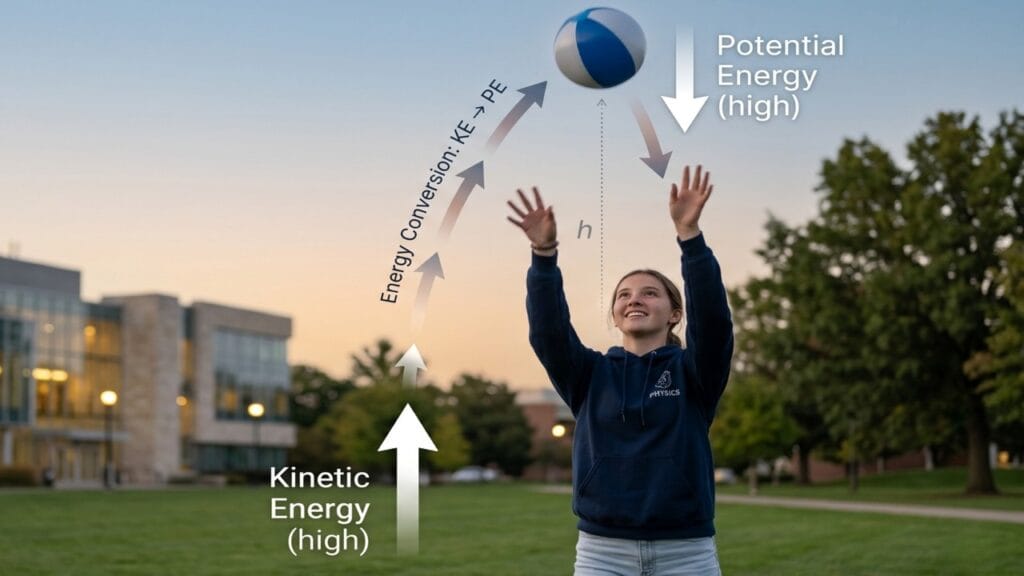
One of the most powerful ideas in all of science is the Law of Conservation of Energy: energy cannot be created or destroyed, only converted from one form to another. When you throw a ball upward, kinetic energy converts to potential energy. When it falls back down, potential energy converts to kinetic energy again. The total stays the same.
Related reading: Work, Power and Energy — Explained with Examples
Matter
Matter is anything that has mass and occupies space. In physics, we study matter in terms of its properties, its states and how it responds to forces and energy.
The classical states of matter are:
- Solid — Fixed shape, fixed volume.
- Liquid — Fixed volume, takes the shape of its container.
- Gas — No fixed shape or volume; expands to fill available space.
- Plasma — An ionized gas found in stars and lightning.
At a deeper level, quantum mechanics tells us that matter behaves in ways that seem strange from a human perspective. Electrons do not orbit nuclei like planets around a star — they exist in probability clouds. But for beginners learning physics for beginners, the classical understanding of matter is a perfectly solid starting point.
Related reading: Modern Physics — Physics of atoms, nuclei and modern technology
Waves
Waves are disturbances that transfer energy from one place to another without transferring matter. Sound is a wave. Light is a wave. Ocean waves are waves, obviously. Understanding waves is essential across multiple branches of physics.
Key wave properties:
- Wavelength (λ): The distance between two consecutive crests.
- Frequency (f): The number of complete waves passing a point per second.
- Amplitude: The height of the wave (related to energy).
- Speed: The rate at which the wave travels through a medium.
Sound travels through air at roughly 343 meters per second. Light travels through vacuum at approximately 300,000 kilometers per second. Why the enormous difference? It comes down to the nature of the wave and the medium it moves through.
Check out: Waves — Types, Properties and Applications

Electricity and Magnetism
Electricity and magnetism are two aspects of the same fundamental force — electromagnetism. Electric charges create electric fields. Moving charges (electric currents) create magnetic fields. This connection, described mathematically by Maxwell’s equations, is one of the great unifying achievements in physics.
Practical concepts to understand:
- Electric Current: The flow of electric charge (measured in Amperes).
- Voltage: The potential difference that drives current (measured in Volts).
- Resistance: Opposition to current flow (measured in Ohms).
- Ohm’s Law: V = IR. This single equation underlies virtually all basic circuit analysis.
The fact that your phone charges, your house lights up and MRI machines can see inside your body — all of that traces back to the fundamentals of electromagnetism.
Check out: Electromagnetism — Forces of Electricity and Magnetism
How Physics Connects to Everyday Life
One mistake students often make is treating physics as something that only lives inside textbook problems. It does not. Consider these everyday examples:
- Driving a car: Involves concepts of velocity, friction, inertia and braking force.
- Cooking food: Thermodynamics governs how heat transfers from a flame to a pot to the food inside.
- Using a smartphone: Relies on semiconductors (quantum physics), GPS signals (relativity corrections) and wireless signals (electromagnetic waves).
- Playing a sport: Projectile motion, friction, collision physics — basketball, cricket and tennis all involve serious physics.
- Medical imaging: X-rays, ultrasounds and MRIs all operate on physics principles — specifically wave behavior and electromagnetic radiation.
When you start noticing physics around you, studying it becomes much more engaging. The subject shifts from abstract equations on paper to a living description of your world.

Why Strong Fundamentals Improve Problem-Solving
Here is something experienced physics teachers know well: students who struggle with advanced problems almost always have gaps in the basics. Not because they lack intelligence, but because somewhere along the way, a foundational concept was memorized rather than understood.
When you truly understand Newton’s second law — not just the formula, but why force, mass and acceleration relate the way they do — you can apply it to an almost unlimited range of situations. You are not relying on pattern-matching a problem to a memorized template. You are reasoning from principles.
This is why investing time in learning physics basics deeply is never wasted. It pays dividends across every physics topic you encounter later.
Common Mistakes Beginners Make When Learning Physics
Being aware of these pitfalls can save you months of frustration:
- Memorizing formulas without understanding derivations. Formulas are compressed logic. If you understand where a formula comes from, you will rarely forget it and you will know when and how to apply it correctly.
- Skipping mathematics practice. Physics is a quantitative science. Comfort with algebra, trigonometry and eventually calculus is not optional. Build this skill alongside your physics understanding.
- Ignoring units. A speed without a unit is meaningless. Always carry units through calculations — dimensional analysis will often tell you whether your answer makes sense before you even check the numbers.
- Treating each chapter as separate. Chapters in a physics textbook are not isolated islands. Force connects to energy, energy connects to waves, waves connect to electromagnetism. Keep looking for those connections.
- Avoiding diagram-drawing. Drawing a free body diagram or a wave sketch before solving a problem dramatically reduces errors. It takes thirty extra seconds and saves enormous time in the long run.
Best Methods to Study Physics Effectively
There is no single correct way to study, but certain approaches have proven consistently effective:
- Understand before you memorize. Read a section, close the book and try to explain the concept in your own words. If you cannot, you have not understood it yet.
- Solve problems daily. Physics is learned by doing, not reading. Work through problems every day, even if it is just a few.
- Review your mistakes actively. When you get a problem wrong, do not just copy the correct solution. Identify exactly where your reasoning broke down.
- Use multiple resources. Textbooks, video lectures, educational websites and practice papers each offer something different. Variety prevents tunnel vision.
- Teach what you learn. Explaining a concept to someone else (or even to yourself out loud) is one of the most powerful ways to consolidate understanding.
For structured learning, our site offers dedicated guides on Units and Measurements, Gravitation, Thermodynamics and more — all designed to build your knowledge systematically.
Conclusion
Physics is not a subject to be feared. It is a subject to be explored — one idea at a time, with curiosity and patience. The physics fundamentals covered in this guide — motion, force, energy, matter, waves, electricity and magnetism — are not just examination topics. They are the conceptual tools that allow human beings to understand, engineer and improve the world around them.
Every physicist, engineer, or scientist you admire built their expertise on exactly the same foundations you are starting with today. The difference is time, practice and a genuine commitment to understanding rather than merely memorizing.
Start with the basics. Understand them deeply. And trust that the more clearly you see the simple things, the more easily the complex ones will reveal themselves.
Explore our full library of physics guides at physicsfundamentals.in and begin building the foundation your future self will thank you for.
Frequently Asked Questions
What are the fundamentals of physics?
The fundamentals of physics are the core concepts and principles that form the foundation of the entire subject. These include the study of motion, force, energy, work, matter, waves, electricity and magnetism. A solid understanding of these basics allows students to approach more advanced topics in physics with confidence and clarity.
Why is physics important in daily life?
Physics is deeply woven into everyday experiences. When you drive a car, cook food, use a smartphone, play a sport, or receive medical treatment, you are interacting with physical principles. Understanding physics helps you appreciate how the world works, make better engineering decisions and think more critically about cause-and-effect relationships in any context.
How can beginners learn physics easily?
Beginners can learn physics most effectively by prioritizing understanding over memorization, practicing problems every day, drawing diagrams before solving, connecting each topic to real-life examples and building mathematical skills alongside conceptual knowledge. Starting with basic physics concepts like motion and force, then progressively moving to energy, waves and electromagnetism, is the most structured approach.
What is the difference between speed and velocity in physics?
Speed is a scalar quantity that describes how fast an object is moving, regardless of direction. Velocity is a vector quantity that describes both the speed and the direction of motion. For example, “40 km/h” is a speed, while “40 km/h heading east” is a velocity. This distinction is important in kinematics and forms a core part of any introduction to physics.
What are the main branches of physics?
The main branches of physics include classical mechanics, thermodynamics, electromagnetism, optics, acoustics, quantum mechanics, nuclear physics and the theory of relativity. Each branch focuses on a specific aspect of how matter and energy behave. For beginners, classical mechanics and basic electromagnetism are typically studied first.
How does understanding physics fundamentals help in problem-solving?
A deep understanding of physics fundamentals trains the mind to reason systematically from first principles rather than relying on pattern-matching. Students who understand why formulas work — not just that they work — can adapt their knowledge to unfamiliar problems, apply concepts across different domains and identify errors in their reasoning much more effectively. This transferable thinking skill benefits academic and professional life alike.
What is the Law of Conservation of Energy?
The Law of Conservation of Energy states that energy cannot be created or destroyed; it can only be converted from one form to another. The total energy in a closed system remains constant. For example, a ball rolling down a hill converts potential energy into kinetic energy. This is one of the most fundamental principles in all of physics and underpins everything from engine design to understanding stars.