

Introduction
On 20 May 2019, the International System of Units underwent its most fundamental revision since its establishment in 1960. The change was quiet in the public sphere — no headlines, no dramatic announcements — but its significance for the foundations of measurement was profound. On that day, the kilogram ceased to be defined by a physical object and became defined by a number: the fixed numerical value of Planck’s constant.
The same revision redefined the ampere, the kelvin and the mole in terms of the elementary charge, the Boltzmann constant and Avogadro’s constant respectively. All seven SI base units were formally redefined — even those like the metre and the second, whose definitions were already tied to physical constants, received updated formal language to align with the new conceptual framework.
What changed, why it changed and what it means for the physics of measurement is the subject of this article.
The Problem With Physical Artefacts
To understand why the 2019 revision was necessary, it is essential to understand why the old system was inadequate.
The International Prototype Kilogram
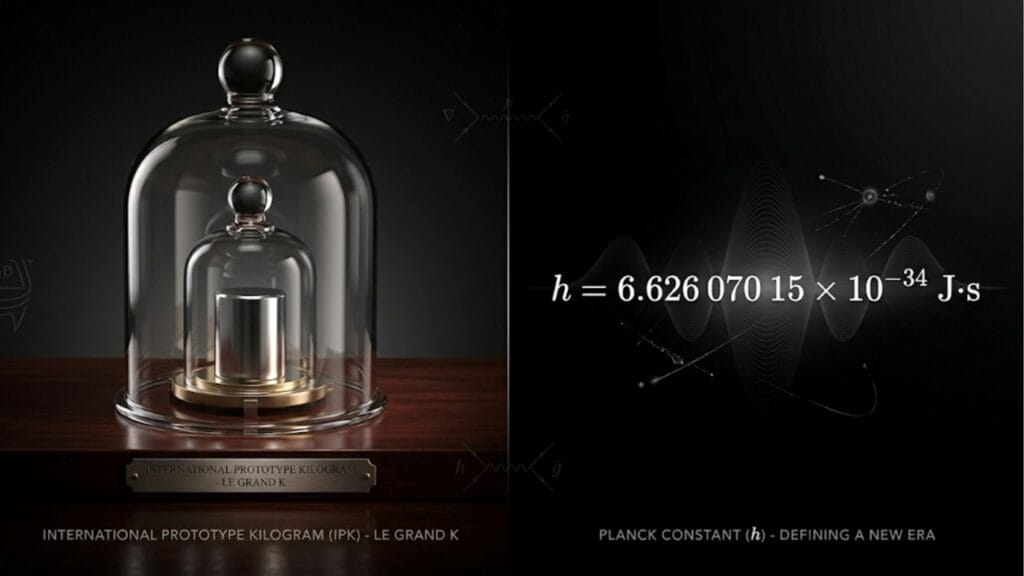
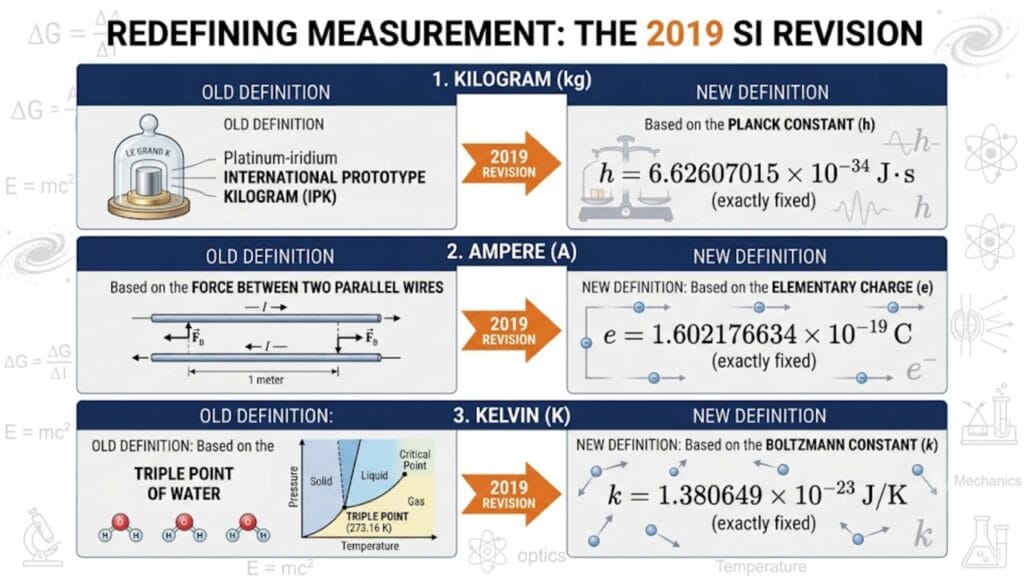
For 130 years — from 1889 to 2019 — the kilogram was defined by a physical object: the International Prototype Kilogram (IPK), a cylinder of platinum-iridium alloy approximately 39 mm in diameter and 39 mm tall, stored in a vault at the Bureau International des Poids et Mesures (BIPM) in Sèvres, France.
By definition, the IPK weighed exactly 1 kilogram. It had no uncertainty. It was the kilogram.
National metrology institutes around the world held official copies of the IPK — called national prototypes — which were periodically returned to Sèvres for comparison against the original. These calibration campaigns revealed something disturbing.
When the copies were compared to the IPK, the differences measured in micrograms — but those differences changed over time. By the third verification campaign in 1988–1992, the mass of the national prototypes had drifted from the IPK by up to 70 micrograms over a century. More troublingly: it was impossible to determine whether the copies had drifted, or the IPK had, or both. Since the IPK was the definition of the kilogram, its mass was always, by definition, exactly 1 kg — any drift was invisible in the reference itself.
This is the fundamental flaw of artefact-based definitions: the artefact cannot be checked against anything more fundamental than itself. If the IPK gained mass by contamination or lost mass by wear, the kilogram — by definition — changed with it and no one could know.
A unit of mass whose value could silently drift at the tens-of-micrograms level is a serious problem for precision science, pharmaceutical dosing, semiconductor manufacturing and any field where mass measurements at the microgram scale matter.
The Solution: Fixing the Values of Fundamental Constants
The elegant solution, developed over decades of metrology research and formally adopted on 20 May 2019, was to redefine all SI base units in terms of fixed exact values of fundamental physical constants.
The key insight: physical constants do not drift. The elementary charge of an electron has been the same since the universe was a fraction of a second old. The speed of light has been the same. Planck’s constant has been the same. These quantities are features of the laws of physics themselves — not of any object that can corrode, expand, contract, or contaminate.
By fixing the numerical values of seven fundamental constants, the SI system anchors all seven base dimensions to the unchanging structure of physical law.
The Seven Fixed Constants
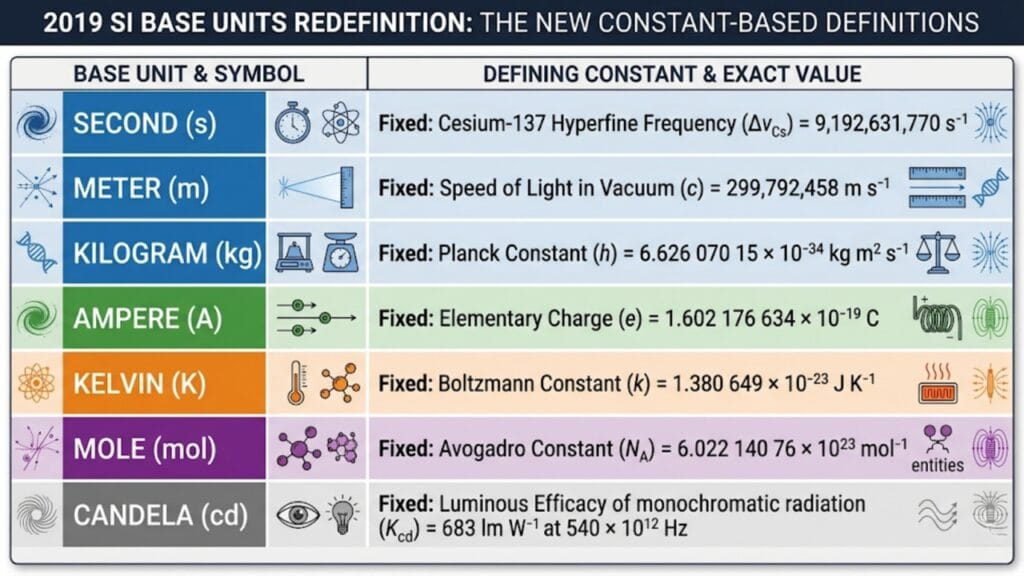
The 2019 SI revision fixes the following constants to exact numerical values:
1. Hyperfine Transition Frequency of Caesium-133 — Defines the Second
\[ \Delta\nu_{\text{Cs}} = 9{,}192{,}631{,}770 \text{ Hz (exactly)} \]
This constant was already the basis of the second’s definition since 1967 — the 2019 revision retained it with updated formal language. One second is defined as exactly 9,192,631,770 periods of the radiation corresponding to the hyperfine transition of the ground state of the caesium-133 atom.
Why this constant: The caesium hyperfine transition is extraordinarily stable and reproducible. Atomic clocks based on this transition are accurate to approximately 1 part in \( 10^{16} \) — they would neither gain nor lose a second in 300 million years. No mechanical, electrical, or optical standard comes close to this stability.
2. Speed of Light in Vacuum — Defines the Metre
\[ c = 299{,}792{,}458 \text{ m/s (exactly)} \]
The metre has been defined this way since 1983. One metre is the distance light travels in vacuum in \( 1/299{,}792{,}458 \) of a second.
Why this constant: The speed of light is a universal constant in Maxwell’s theory of electromagnetism and in special relativity. By fixing \( c \) and the second, the metre is determined uniquely. Interferometric length measurements can now achieve sub-nanometre precision, far beyond what was possible with the old metre bar definition.
Consequence: Before this definition, the speed of light was a measured quantity with experimental uncertainty. Now it is exact by definition — any experiment that “measures” the speed of light is, technically, calibrating its length and time standards.
3. Planck’s Constant — Defines the Kilogram
\[ h = 6.62607015 \times 10^{-34} \text{ J·s (exactly)} \]
This is the heart of the 2019 revision. The kilogram is now defined so that \( h \) has exactly this value. Given that \( h \) has dimensions of J·s = kg·m²·s⁻¹ and since the metre and second are already fixed, this uniquely determines the kilogram.
How the kilogram is realized from \( h \): The practical realization uses a Kibble balance (formerly called a watt balance). This instrument compares the weight of a mass against the electromagnetic force on a current-carrying coil in a magnetic field. Through careful design, the comparison ultimately links the mass to \( h \), \( c \) and \( \Delta\nu_\text{Cs} \) — all of which are now fixed. The Kibble balance can therefore realize the kilogram to better than 1 part in \( 10^8 \) precision.
Why Planck’s constant: Planck’s constant governs quantum mechanics — it is the quantum of action, the fundamental scale of quantum phenomena. The Josephson effect (relating voltage to frequency through \( h \) and \( e \)) and the quantum Hall effect (relating resistance to \( h/e^2 \)) both provide extraordinary precision electrical measurements. By fixing \( h \), the SI system connects the kilogram to quantum physics — the most precisely tested framework in all of science.
4. Elementary Charge — Defines the Ampere
\[ e = 1.602176634 \times 10^{-19} \text{ C (exactly)} \]
The ampere is now defined as the flow of exactly \( 1/e \) elementary charges per second — equivalently, the flow of approximately \( 6.241 \times 10^{18} \) elementary charges per second.
The old definition: Before 2019, the ampere was defined in terms of the force between two parallel current-carrying conductors — a definition that was practically difficult to realize, required knowledge of the magnetic permeability of vacuum \( \mu_0 \) and had uncertainty at the level of parts per million.
The new definition: By fixing \( e \), the ampere is connected to the most fundamental unit of electric charge in nature. The Josephson and quantum Hall effects, which involve \( h \) and \( e \), can now be used to realize extremely precise voltage and resistance standards — and since both \( h \) and \( e \) are now fixed, these standards are exact by definition.
Consequence for \( \mu_0 \) and \( \varepsilon_0 \): In the old SI, the magnetic permeability of vacuum \( \mu_0 \) was defined to be exactly \( 4\pi \times 10^{-7} \) H/m and the permittivity \( \varepsilon_0 = 1/\mu_0 c^2 \) was also exact. In the new SI, \( e \) is fixed instead and \( \mu_0 \) and \( \varepsilon_0 \) become measured quantities with small experimental uncertainties. Their values remain very close to the old defined values but are no longer exact.
5. Boltzmann Constant — Defines the Kelvin
\[ k_B = 1.380649 \times 10^{-23} \text{ J/K (exactly)} \]
The kelvin is now defined so that the Boltzmann constant has exactly this value. One kelvin is the temperature change that corresponds to a thermal energy change of \( k_B = 1.380649 \times 10^{-23} \) J.
The old definition: The kelvin was defined as \( 1/273.16 \) of the thermodynamic temperature of the triple point of water — a physically reproducible but impractical standard. The triple point temperature of water depends on isotopic composition, dissolved gases and pressure — sources of variability that limited precision.
The new definition: By fixing \( k_B \), temperature is connected to energy at the fundamental level. Any device that can measure energy can in principle measure temperature. Practical realizations include acoustic gas thermometry, noise thermometry and Doppler broadening thermometry — each linking temperature to \( k_B \) through different physical mechanisms and providing independent consistency checks.
Physical interpretation: The Boltzmann constant is the bridge between macroscopic thermodynamics (temperature, heat) and microscopic statistical mechanics (kinetic energy of particles). Fixing \( k_B \) to an exact value acknowledges the fundamental status of this bridge.
6. Avogadro’s Constant — Defines the Mole
\[ N_A = 6.02214076 \times 10^{23} \text{ mol}^{-1} \text{ (exactly)} \]
The mole is now defined as the amount of substance containing exactly \( N_A = 6.02214076 \times 10^{23} \) specified elementary entities.
The old definition: The mole was defined as the amount of substance containing as many elementary entities as there are atoms in exactly 12 grams of carbon-12. This linked the mole to the atomic mass unit and to the kilogram — a somewhat circular arrangement that became problematic once the kilogram itself was being redefined.
The new definition: By fixing \( N_A \) to an exact value, the mole becomes a pure counting unit. One mole contains exactly 6.02214076 × 10²³ entities, full stop. No reference to carbon-12, no mass comparison required.
Consequence for atomic mass unit: The atomic mass unit (u) is no longer exactly \( 1/12 \) the mass of a carbon-12 atom in the new SI. Instead, \( 1\text{ u} = 1\text{ g/mol} / N_A \), which is now an exact value. The mass of a carbon-12 atom in kilograms is no longer exactly \( 12\text{ u} \) — it is a measured quantity with small uncertainty, but the difference is at the parts-per-billion level and irrelevant for all practical chemistry.
7. Luminous Efficacy — Defines the Candela
\[ K_\text{cd} = 683 \text{ lm/W at } 540 \times 10^{12} \text{ Hz (exactly)} \]
The candela is defined so that monochromatic light at 540 × 10¹² Hz (green light near the eye’s peak sensitivity wavelength) has a luminous efficacy of exactly 683 lumens per watt.
Context: The candela was already defined in terms of a fixed luminous efficacy before 2019 — the 2019 revision updated its formal definition to align with the new framework without changing its practical value. The 540 × 10¹² Hz standard frequency corresponds to a wavelength of approximately 555 nm — exactly where the human eye’s photopic sensitivity function reaches its maximum.
The Complete 2019 SI Definition: All Seven Constants
| Base Unit | Defined By | Fixed Value |
| Second (s) | Hyperfine frequency of Cs-133, \( \Delta\nu_\text{Cs} \) | 9,192,631,770 Hz exactly |
| Metre (m) | Speed of light, \( c \) | 299,792,458 m/s exactly |
| Kilogram (kg) | Planck’s constant, \( h \) | \( 6.62607015 \times 10^{-34} \) J·s exactly |
| Ampere (A) | Elementary charge, \( e \) | \( 1.602176634 \times 10^{-19} \) C exactly |
| Kelvin (K) | Boltzmann constant, \( k_B \) | \( 1.380649 \times 10^{-23} \) J/K exactly |
| Mole (mol) | Avogadro’s constant, \( N_A \) | \( 6.02214076 \times 10^{23} \) mol⁻¹ exactly |
| Candela (cd) | Luminous efficacy, \( K_\text{cd} \) | 683 lm/W (at 540 THz) exactly |
What Stayed the Same
An important point for students: the numerical values of the units themselves did not change on 20 May 2019.
One kilogram on 19 May 2019 was the same mass as one kilogram on 21 May 2019. The metre was the same length. The second was the same duration. The practical scales of measurement were preserved with extraordinary care. The 2019 revision was designed so that the change in any unit’s realization was smaller than the best measurement uncertainty at the time — meaning no previously calibrated instrument needed recalibration.
What changed was the conceptual foundation. The question “what is a kilogram defined to be?” received a different answer — but the practical answer to “what does a kilogram weigh?” was identical to many decimal places.
Why This Matters for Physics and Measurement
1. Permanence and Universality
A unit system defined by the values of fundamental constants is genuinely universal. The Planck constant, the speed of light and the elementary charge are the same everywhere in the universe — on Earth, on Mars, in the Andromeda Galaxy and at any point in cosmic history (assuming the constants do not vary, which is itself a deep and tested assumption of physics).
Before 2019, the kilogram was defined by a specific object in a specific vault in France. An alien civilization with no access to that object could not, in principle, verify what a kilogram was. Now, any civilization with the capacity to do quantum electrodynamics experiments can determine the kilogram independently.
2. Stability Without Artefacts
The drift problem of the IPK is solved definitively. The kilogram can now be realized fresh at any time by any national metrology institute with a Kibble balance and the ability to measure \( h \), \( c \) and \( \Delta\nu_\text{Cs} \). If the BIPM and all national prototypes were destroyed simultaneously, the kilogram could be fully recovered from first principles within months.
3. Practical Impact on High-Precision Science
For most everyday applications — weighing food, manufacturing industrial parts, calibrating scales in shops — the 2019 revision makes no detectable difference. The changes at the practical level are in the parts per billion or smaller.
For cutting-edge precision work, however, the difference is significant:
- Pharmaceutical manufacturing: Drug dosing at the microgram level now has a more stable mass reference.
- Semiconductor fabrication: Nanoscale deposition processes require mass measurements at the nanogram level — the old IPK drift was uncomfortably large at this scale.
- Metrology research: The quantum Hall resistance standard and the Josephson voltage standard, previously in slight tension with the old SI electrical definitions, now align perfectly with the new SI.
- Tests of fundamental physics: Any experiment searching for variation in fundamental constants over time or space can now distinguish “the constant changed” from “our unit definition drifted” — because the unit is anchored to the constant itself.
The Kibble Balance: How the Kilogram Is Now Realized
The Kibble balance (named after physicist Bryan Kibble, who invented it in 1975) is the primary practical instrument for realizing the kilogram in the new SI.
Principle of operation:
The balance operates in two phases:
Phase 1 (Weighing mode): A coil carrying current \( I \) is placed in a magnetic field. The electromagnetic force on the coil is balanced against the gravitational force \( mg \) on a test mass:
\[ mg = BLI \]
Where \( B \) is the magnetic field, \( L \) is the effective length of the coil and \( m \) is the mass being measured.
Phase 2 (Velocity mode): The same coil is moved through the same magnetic field at a measured velocity \( v \), generating an EMF \( \mathcal{E} \):
\[ \mathcal{E} = BLv \]
Combining the two phases:
\[ mg = \frac{\mathcal{E} \cdot I}{v} \]
Power balance: \( mgv = \mathcal{E} I \)
The electrical quantities \( \mathcal{E} \) and \( I \) are measured using the Josephson effect (relating voltage to frequency through \( h \) and \( e \)) and the quantum Hall effect (relating resistance to \( h/e^2 \)). Since \( h \) and \( e \) are now fixed and the velocity and gravitational acceleration can be measured to high precision, the mass \( m \) can be determined in terms of the fixed constants.
Modern Kibble balances achieve uncertainties of 1 part in \( 10^8 \) — far better than the drift uncertainties in the old artefact system.
How the New Definitions Changed \( \mu_0 \) and \( \varepsilon_0 \)
One subtle but important consequence of the 2019 revision deserves special mention, particularly for electromagnetism students.
In the old SI, the magnetic permeability of free space was defined to be exactly:
\[ \mu_0 = 4\pi \times 10^{-7} \text{ H/m (exact, old SI)} \]
This was a consequence of the old ampere definition, which defined the force between conductors in a way that fixed \( \mu_0 \).
In the new SI, the ampere is defined by fixing \( e \) instead. This means \( \mu_0 \) is no longer exact — it becomes a measured quantity:
\[ \mu_0 = 1.25663706212 \times 10^{-6} \text{ H/m (with small uncertainty, new SI)} \]
Similarly, \( \varepsilon_0 = 1/(\mu_0 c^2) \) is no longer exact.
The numerical values are extremely close to the old defined values — the differences are in the eleventh significant figure. For all practical calculations in electromagnetism at school and undergraduate level, the old values can continue to be used without any significant error. But the conceptual status has changed: these are now experimentally determined quantities, not defined ones.
The Philosophical Shift: What the 2019 Revision Tells Us About Measurement
The 2019 revision represents a deep philosophical shift in how the SI system thinks about units.
The old philosophy: A unit is defined by a standard — an artefact, a procedure, or a phenomenon that is chosen as the reference and called, by definition, equal to 1 unit.
The new philosophy: A unit is defined by a physical constant — the unit is whatever value makes a particular constant come out to a particular fixed number. The unit emerges from the constant, rather than the constant being measured in units.
This is a reversal of the traditional relationship. In the old SI, you defined the kilogram, then measured Planck’s constant in terms of it. In the new SI, you define Planck’s constant and the kilogram is whatever mass makes that definition consistent.
The practical difference is stability. The conceptual difference is more profound: the new SI is built on the assumption that the fundamental constants of physics are the most reliable and reproducible quantities available to measurement science. More reliable, more reproducible and more universal than any physical object — however carefully it is stored.
Learn more about Why Does the SI System Use 7 Base Units? The Physics Behind the Choice
Impact on Indian Physics Education and Examinations
For students in Class 11 and Class 12 and those preparing for JEE or NEET, the 2019 revision has the following practical implications:
What you need to know:
- The 2019 revision redefined all seven SI base units in terms of fixed values of fundamental constants
- The kilogram is now defined by a fixed value of Planck’s constant \( h \)
- The ampere is now defined by a fixed value of the elementary charge \( e \)
- The kelvin is now defined by a fixed value of the Boltzmann constant \( k_B \)
- The mole is now defined by a fixed value of Avogadro’s constant \( N_A \)
- The numerical values of the units themselves did not change
What appeared in JEE/NEET:
Questions about the 2019 revision have appeared in JEE Main asking which constant defines which unit and requesting students to identify which previously-defined constant (like \( \mu_0 \)) is now a measured quantity rather than an exact one.
What to memorize:
The seven fixed constants and which base unit each one defines — the table provided earlier in this article covers this completely.
Learn more about Units and Measurements for JEE Main: Important Topics, Formulas & PYQs
Summary: Key Facts About the 2019 SI Revision
- Date of effect: 20 May 2019 (World Metrology Day)
- Scope: All seven SI base units redefined
- Method: Seven fundamental constants fixed to exact numerical values
- Most significant change: The kilogram, previously defined by the IPK artefact, now defined by Planck’s constant
- Practical impact: Units themselves unchanged in value; only the conceptual foundation changed
- Technical impact: Eliminates artefact drift; enables universal reproducibility; aligns with quantum measurement standards
- Consequences: \( \mu_0 \) and \( \varepsilon_0 \) are now measured quantities, not defined exact values
- Key instrument: Kibble balance realizes the kilogram from \( h \), \( c \) and \( \Delta\nu_\text{Cs} \)
Conclusion
The 2019 revision of the SI system is the culmination of a century of metrology research and represents the highest ambition of measurement science: to anchor the units of physics not to objects that can be lost, damaged, or changed, but to the constants of nature themselves.
When Planck discovered his constant in 1900, it was a mathematical trick to fix the blackbody radiation problem. When Einstein explained the photoelectric effect in 1905, it confirmed that \( h \) was a real feature of nature. When quantum mechanics was built in the 1920s, \( h \) became the central quantity governing atomic structure. When the Josephson and quantum Hall effects were discovered in the 1960s and 1980s, \( h \) became the basis of the world’s most precise electrical standards. And when the 2019 revision fixed its value exactly, \( h \) became the definition of the kilogram itself.
The journey from a mathematical convenience to the anchor of the world’s mass standard is one of the most remarkable arcs in the history of physics. It is a story about how deeply a constant can be trusted — and how far that trust can be extended.
Learn more about Planck Units: The Natural Unit System That Defined the Universe’s Scale
Frequently Asked Questions
What changed in the 2019 SI revision?
All seven SI base units were redefined in terms of fixed exact values of seven fundamental physical constants. The most significant change was the redefinition of the kilogram — no longer defined by a physical artefact (the International Prototype Kilogram) but by fixing the numerical value of Planck’s constant to exactly \( 6.62607015 \times 10^{-34} \) J·s. The ampere, kelvin and mole were also fundamentally redefined, while the second, metre and candela received updated formal definitions consistent with the new framework.
Did the size of the kilogram change in 2019?
No. The kilogram’s physical size was intentionally preserved. The revision was designed so that any change in the realized value of the kilogram was smaller than the best measurement uncertainty at the time — meaning the transition was seamless for all practical applications. One kilogram after 2019 is the same mass as one kilogram before 2019, to better than 1 part in \( 10^8 \).
Why was Planck’s constant chosen to define the kilogram?
Because Planck’s constant \( h \) connects mass, length and time through its dimensions (J·s = kg·m²·s⁻¹). Since the metre and second are already defined by \( c \) and the caesium frequency, fixing \( h \) uniquely determines the kilogram. Planck’s constant is also central to quantum mechanics and can be measured to extraordinary precision through quantum electrical effects (Josephson effect, quantum Hall effect), making it an ideal anchor for the mass unit.
What is a Kibble balance and how does it realize the new kilogram?
A Kibble balance is a precision instrument that compares a mechanical power (mass times gravitational acceleration times velocity) with an electrical power, linking the mass to Planck’s constant, the speed of light and the caesium frequency — all now fixed values. By measuring the balance’s electrical quantities using quantum standards, the mass of any object can be determined in terms of the fixed constants to better than 1 part in \( 10^8 \).
Is the mole still connected to carbon-12 after the 2019 revision?
No longer directly. Before 2019, the mole was defined as the amount of substance containing as many entities as there are atoms in exactly 12 grams of carbon-12. After 2019, the mole is defined by fixing Avogadro’s constant to exactly \( 6.02214076 \times 10^{23} \) mol⁻¹. One mole now simply contains exactly this many entities. The connection to carbon-12 is severed — the mass of a carbon-12 atom is now a measured (not defined) quantity, though it differs from \( 12\text{ u} \) by an experimentally negligible amount.
Leave a Comment