

Introduction
Every unit system humans have ever built reflects human experience. The metre was originally defined as one ten-millionth of the distance from the equator to the North Pole — a geological quantity chosen because it was measurable and reproducible. The second was based on the day, which is based on Earth’s rotation — a planetary quantity that happens to match the scale of human activity. Even the kilogram, now defined through Planck’s constant, was originally calibrated to the mass of a cubic decimetre of water.
All of this is contingent. A civilization elsewhere in the universe with different biology, different planet, different technology would arrive at different numbers for the same physical constants. They might measure the speed of light as 1,000,000 of their length units per their time unit, or as 7.3 of them — depending entirely on how they chose to define their units.
Max Planck saw this as a problem. In 1899, the year before his revolutionary work on blackbody radiation, he proposed a unit system that is not contingent on any human-scale phenomenon whatsoever. His system is built from the fundamental constants of nature alone — and it reveals something profound about the scales at which the universe’s deepest physics operates.
What Are Planck Units?
Planck units form a system of natural units derived entirely from fundamental physical constants. By setting five specific constants equal to 1, a complete unit system emerges — one in which every physical quantity has a numerical value determined by the laws of physics rather than by human convention.
The five constants set to 1 in the Planck system are:
| Constant | Symbol | Physical Meaning | SI Value |
| Speed of light in vacuum | \( c \) | Relativity, causality limit | \( 2.998 \times 10^8 \) m/s |
| Reduced Planck’s constant | \( \hbar = h/2\pi \) | Quantum mechanics, action quantum | \( 1.055 \times 10^{-34} \) J·s |
| Gravitational constant | \( G \) | Gravity, spacetime curvature | \( 6.674 \times 10^{-11} \) N·m²/kg² |
| Coulomb constant | \( k_e = 1/4\pi\varepsilon_0 \) | Electrostatics | \( 8.988 \times 10^9 \) N·m²/C² |
| Boltzmann constant | \( k_B \) | Statistical mechanics, thermodynamics | \( 1.381 \times 10^{-23} \) J/K |
Setting these five constants to 1 is not a mathematical trick — each one reflects a deep physical principle:
- \( c = 1 \) means space and time are measured in the same units (the relativity insight)
- \( \hbar = 1 \) means action is measured in natural quantum units
- \( G = 1 \) means mass curves spacetime at a rate determined by the unit mass
- \( k_e = 1 \) means electric charge is measured in units where Coulomb’s law has no numerical prefactor
- \( k_B = 1 \) means temperature and energy are measured in the same units (statistical mechanics insight)
Deriving the Planck Units: The Dimensional Analysis Method
The Planck units are derived through dimensional analysis — the same technique used throughout this chapter, now applied to the constants of nature rather than to experimental data.
The key insight: the three constants \( c \), \( \hbar \) and \( G \) have dimensional formulas that span the three mechanical base dimensions M, L and T. By combining them with appropriate powers, you can construct unique quantities with the dimensions of length, mass, time and any other mechanical quantity.
Dimensional Formulas of the Three Core Constants
\[ [c] = LT^{-1} \]
\[ [\hbar] = ML^2T^{-1} \]
\[ [G] = M^{-1}L^3T^{-2} \]
Deriving the Planck Length
We seek \( \ell_P = c^a \hbar^b G^c \) such that \( [\ell_P] = L \).
\[ L = (LT^{-1})^a (ML^2T^{-1})^b (M^{-1}L^3T^{-2})^c \]
\[ L^1 M^0 T^0 = M^{b-c} L^{a+2b+3c} T^{-a-b-2c} \]
Comparing exponents:
- M: \( b – c = 0 \Rightarrow b = c \)
- T: \( -a – b – 2c = 0 \Rightarrow a = -3c \) (using \( b = c \))
- L: \( a + 2b + 3c = 1 \Rightarrow -3c + 2c + 3c = 1 \Rightarrow 2c = 1 \Rightarrow c = \frac{1}{2} \)
Therefore \( a = -\frac{3}{2} \), \( b = \frac{1}{2} \), \( c = \frac{1}{2} \).
\[ \ell_P = c^{-3/2} \hbar^{1/2} G^{1/2} = \sqrt{\frac{\hbar G}{c^3}} \]
\[ \boxed{\ell_P = \sqrt{\frac{\hbar G}{c^3}} \approx 1.616 \times 10^{-35} \text{ m}} \]
Deriving the Planck Time
\( t_P = c^a \hbar^b G^c \) such that \( [t_P] = T \):
Following the same procedure:
- M: \( b – c = 0 \)
- T: \( -a – b – 2c = 1 \)
- L: \( a + 2b + 3c = 0 \)
Solving: \( a = -5/2 \), \( b = 1/2 \), \( c = 1/2 \)
\[ \boxed{t_P = \sqrt{\frac{\hbar G}{c^5}} \approx 5.391 \times 10^{-44} \text{ s}} \]
Deriving the Planck Mass
\( m_P = c^a \hbar^b G^c \) such that \( [m_P] = M \):
Solving the exponent equations:
\( a = 1/2 \), \( b = 1/2 \), \( c = -1/2 \)
\[ \boxed{m_P = \sqrt{\frac{\hbar c}{G}} \approx 2.176 \times 10^{-8} \text{ kg}} \]
All Planck Units: The Complete Set
Starting from the three core Planck units (length, mass, time), all other mechanical Planck units follow from their definitions:
Planck Length
\[ \ell_P = \sqrt{\frac{\hbar G}{c^3}} \approx 1.616 \times 10^{-35} \text{ m} \]
This is approximately \( 10^{-20} \) times the diameter of a proton. It is the scale below which the classical concept of space is expected to break down under the combined effects of quantum mechanics and general relativity.
Planck Time
\[ t_P = \sqrt{\frac{\hbar G}{c^5}} \approx 5.391 \times 10^{-44} \text{ s} \]
The Planck time is the time it takes light to travel one Planck length. It is the shortest meaningful time interval in current physics — the scale at which the smooth flow of time, as described by general relativity, may lose meaning.
Note the relation:
\[ t_P = \frac{\ell_P}{c} \]
This is exactly what you expect when \( c = 1 \) in Planck units — length and time have the same numerical value, confirming the relativistic insight that space and time are aspects of a unified spacetime.
Planck Mass
\[ m_P = \sqrt{\frac{\hbar c}{G}} \approx 2.176 \times 10^{-8} \text{ kg} \]
At first glance this seems surprisingly large — about \( 10^{19} \) times the mass of a proton, or about the mass of a flea egg. But it is the mass at which a particle’s Schwarzschild radius (the size it would need to be to form a black hole) equals its Compton wavelength (the quantum wavelength characterizing its uncertainty in position). Below this mass, quantum effects dominate over gravitational self-collapse. Above it, classical gravity dominates. The Planck mass is the crossover point.
Planck Energy
\[ E_P = m_P c^2 = \sqrt{\frac{\hbar c^5}{G}} \approx 1.956 \times 10^9 \text{ J} \approx 1.22 \times 10^{19} \text{ GeV} \]
The Planck energy is \( 10^{19} \) times the rest-mass energy of a proton. It is far beyond anything achievable by any human-built particle accelerator — the Large Hadron Collider reaches approximately 13 TeV = \( 1.3 \times 10^4 \) GeV, a factor of \( 10^{15} \) below the Planck energy.
Planck Temperature
\[ T_P = \frac{m_P c^2}{k_B} = \sqrt{\frac{\hbar c^5}{G k_B^2}} \approx 1.417 \times 10^{32} \text{ K} \]
The hottest temperature at which known physics applies. The universe is thought to have briefly reached temperatures near the Planck temperature in the first Planck-time interval after the Big Bang. Above this temperature, current physics has no validated description.
Planck Charge
\[ q_P = \sqrt{4\pi\varepsilon_0 \hbar c} = \frac{e}{\sqrt{\alpha}} \approx 1.876 \times 10^{-18} \text{ C} \]
Where \( e \) is the elementary charge and \( \alpha \approx 1/137 \) is the fine structure constant. The Planck charge is approximately \( \sqrt{137} \approx 11.7 \) times the elementary charge of the electron.
Summary Table
| Planck Unit | Symbol | SI Value | Ratio to Human-Scale |
| Length | \( \ell_P \) | \( 1.616 \times 10^{-35} \) m | \( 10^{-20} \times \) proton diameter |
| Time | \( t_P \) | \( 5.391 \times 10^{-44} \) s | \( 10^{-27} \times \) shortest atomic process |
| Mass | \( m_P \) | \( 2.176 \times 10^{-8} \) kg | \( 10^{19} \times \) proton mass |
| Energy | \( E_P \) | \( 1.956 \times 10^9 \) J | \( 10^{19} \) GeV |
| Temperature | \( T_P \) | \( 1.417 \times 10^{32} \) K | \( 10^{32} \times \) temperature of Sun’s core |
| Charge | \( q_P \) | \( 1.876 \times 10^{-18} \) C | \( \sim 11.7 \times \) elementary charge |
Why Planck Units Are “Natural”
The word “natural” in natural units has a specific technical meaning: the numerical value of a physical quantity in natural units reflects the genuine physical scale of that quantity relative to the fundamental constants of the theory.
In SI units, the statement “the fine structure constant \( \alpha \approx 1/137 \)” is meaningful — but it requires knowing what \( e \), \( \hbar \), \( c \) and \( \varepsilon_0 \) are in SI units and that their combination happens to equal approximately \( 1/137 \).
In Planck units:
\[ \alpha = \frac{e^2}{4\pi\varepsilon_0 \hbar c} = \frac{q_P^2 \alpha}{q_P^2} = \alpha \approx \frac{1}{137} \]
The fine structure constant is the same dimensionless number in any unit system — it is a genuine physical ratio, not a consequence of unit choice. Similarly, the ratio of the proton mass to the Planck mass (\( m_p / m_P \approx 10^{-19} \)) is a genuine dimensionless number that any civilization anywhere in the universe would compute identically.
Planck units isolate the genuinely physical information — the dimensionless ratios — from the contingent information about what scale human civilization happened to find convenient.
The Physical Significance of Each Planck Unit
The Planck Length: Where Spacetime Granularity Begins
Below the Planck length, the combination of quantum uncertainty and gravitational effects becomes so extreme that the smooth fabric of spacetime — as described by general relativity — may no longer be a valid concept.
To see why, consider measuring a length smaller than \( \ell_P \). To resolve such a small distance, Heisenberg’s uncertainty principle requires a momentum uncertainty so large that the corresponding energy \( E \sim \hbar c / \ell_P \) would exceed the Planck energy. But an energy concentration of the Planck energy within the Planck length would create a black hole with a Schwarzschild radius equal to the Planck length itself — swallowing the very information you were trying to extract.
This is not just a technological limitation — it is a fundamental argument that the concept of distance below \( \ell_P \) may be physically meaningless in any operationally definable sense. The Planck length is where quantum mechanics and gravity simultaneously become important and where current physics reaches its limit.
Many approaches to quantum gravity — string theory, loop quantum gravity, causal set theory — predict that spacetime has a granular or discrete structure at or near the Planck scale, though the specific predictions differ significantly.
The Planck Time: The Shortest Meaningful Interval
The Planck time \( t_P \approx 5.4 \times 10^{-44} \) s is the time it takes for light to cross one Planck length. It is to time what the Planck length is to space.
The universe itself is thought to have begun in a state of such extreme density and temperature that Planck-scale physics was directly relevant. The period from the Big Bang to \( t = t_P \) is sometimes called the Planck epoch — and it is entirely opaque to current theory. Our best theories of gravity (general relativity) and quantum mechanics both break down at this scale and no experimentally confirmed theory of quantum gravity exists to describe what happened during the Planck epoch.
Beyond this, the Planck time represents the finest meaningful temporal resolution in physics — a kind of natural “clock tick” for the universe.
The Planck Mass: The Boundary Between Quantum and Classical Gravity
The Planck mass \( m_P \approx 2.2 \times 10^{-8} \) kg sits at an interesting intersection. It is simultaneously:
- The mass at which a particle’s Schwarzschild radius equals its de Broglie wavelength
- The mass at which gravitational self-interaction energy equals the particle’s rest-mass energy
- The mass scale at which gravity becomes as strong as the other fundamental forces in quantum field theory
Particles much lighter than \( m_P \) (like electrons, protons, even the Higgs boson at 126 GeV/c²) are firmly in the quantum regime — gravity is negligible for their quantum behaviour. Macroscopic objects much heavier than \( m_P \) are in the classical gravity regime.
Nothing in nature has been observed near the Planck mass. Black holes are far heavier (even the lightest hypothetical primordial black holes are thought to be far above Planck mass). Individual elementary particles are far lighter. The Planck mass is a theoretical threshold, not an observed scale.
The Planck Energy: The Grand Unification Scale
The Planck energy \( E_P \approx 1.22 \times 10^{19} \) GeV is the energy at which quantum gravity effects become important. It is also related to the energy scale at which the three non-gravitational fundamental forces (electromagnetic, weak, strong) are expected to unify in grand unified theories.
The ratio of the electroweak unification scale to the Planck scale — why the electroweak scale is \( 10^{16} \) times smaller than the Planck scale — is known as the hierarchy problem and is one of the deepest unsolved problems in theoretical physics.
The Fine Structure Constant: What Planck Units Reveal
One of the most elegant aspects of the Planck unit framework is what it reveals about dimensionless constants — quantities that are the same regardless of unit choice.
The fine structure constant:
\[ \alpha = \frac{e^2}{4\pi\varepsilon_0 \hbar c} \approx \frac{1}{137.036} \]
This number appears everywhere in physics. It governs the strength of electromagnetic interactions, the spacing of atomic energy levels, the probability of photon emission and absorption and the structure of the periodic table.
In Planck units (\( \hbar = c = 4\pi\varepsilon_0 = 1 \)):
\[ \alpha = e^2 \approx 0.0073 \]
The charge of the electron in Planck units is approximately 0.085. This is genuinely small — and its smallness is what makes perturbation theory in quantum electrodynamics (QED) work so well. If \( \alpha \) were of order 1, the electromagnetic force would be as strong as the nuclear force and atoms as we know them could not exist.
The dimensionless ratio between the proton mass and Planck mass:
\[ \frac{m_p}{m_P} = \sqrt{\frac{G m_p^2}{\hbar c}} \approx 10^{-19} \]
This tiny number reflects the extraordinary weakness of gravity compared to the other forces at atomic scales — the same weakness that allows protons and electrons to form stable atoms without being crushed by their own gravitational attraction. Why this number is so small is the hierarchy problem, still unsolved.
Planck Units in Theoretical Physics
Professional theoretical physicists use Planck units (or closely related natural unit systems) routinely because they dramatically simplify equations.
In Quantum Field Theory
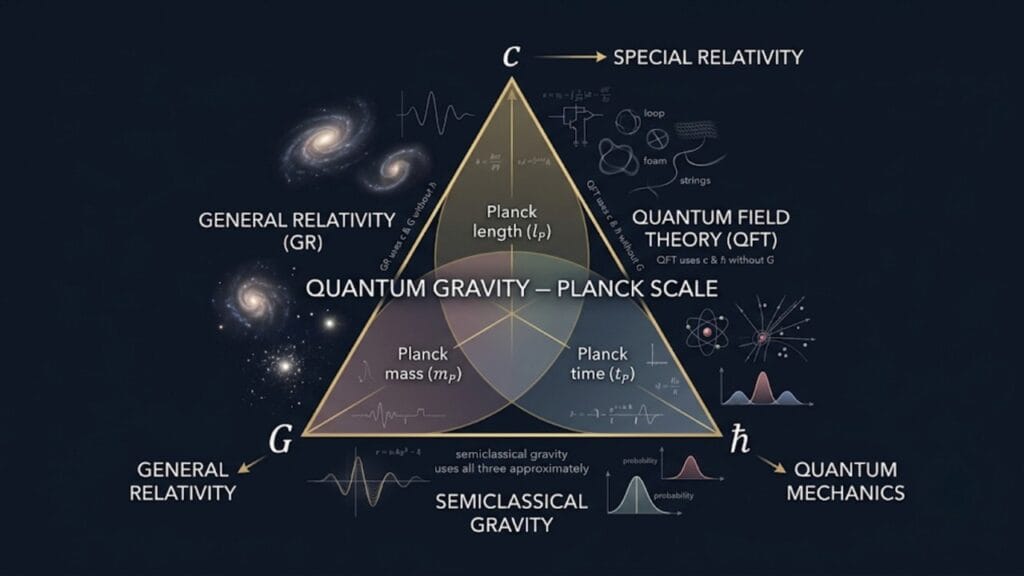
Setting \( \hbar = c = 1 \) (but not necessarily \( G = 1 \)) gives the system used in most particle physics calculations. In these units:
- Mass, energy, momentum and temperature all have the same unit (energy, measured in GeV)
- Length and time have units of inverse energy (GeV⁻¹)
- A proton’s mass is simply 0.938 GeV
This collapses four base units (kg, m, s, K) into one (GeV). The Lagrangians of the Standard Model become dimensionally transparent — every term has dimension \( [E]^4 \) (energy to the fourth power) and coupling constants are either dimensionless or have simple energy-dimension powers that carry information about the renormalizability of the theory.
In General Relativity
Setting \( G = c = 1 \) (geometric units) simplifies Einstein’s field equations:
\[ G{\mu\nu} = 8\pi T{\mu\nu} \]
instead of \( G{\mu\nu} = \frac{8\pi G}{c^4} T{\mu\nu} \) in SI. The \( G/c^4 \) factor, which spans many orders of magnitude in SI, becomes simply 1. This makes the geometric structure of the equations transparent.
In Quantum Gravity Research
When all of \( c = \hbar = G = k_B = 1 \), the Planck units emerge fully. Every dimensionful quantity is expressed as a power of the Planck energy. This is the most common convention in string theory and loop quantum gravity calculations, where the Planck scale is the natural arena.
Planck Units vs Other Natural Unit Systems
Planck units are the most fundamental natural unit system, but not the only one. Several others exist:
| System | Constants Set to 1 | Used In |
| Planck units | \( c, \hbar, G, k_B, k_e \) | Quantum gravity, cosmology |
| Natural units (particle physics) | \( c, \hbar \) | Quantum field theory, particle physics |
| Geometric units | \( c, G \) | General relativity, astrophysics |
| Stoney units | \( c, G, k_e, e \) | Historical; precursor to Planck units |
| Atomic units | \( e, m_e, \hbar, k_e \) | Atomic and molecular physics |
Each system is optimized for the domain in which it is used. Particle physicists rarely care about gravity, so they set \( G = 1 \) only in quantum gravity work. Relativists rarely care about quantum mechanics, so they set \( \hbar = 1 \) only when needed. Planck units set everything to 1 simultaneously — the most natural but also the most removed from any human-scale intuition.
Learn more about CGS vs MKS vs SI System: Differences, Comparison Table & Uses
Why Planck Units Are Not Used for Everyday Measurement
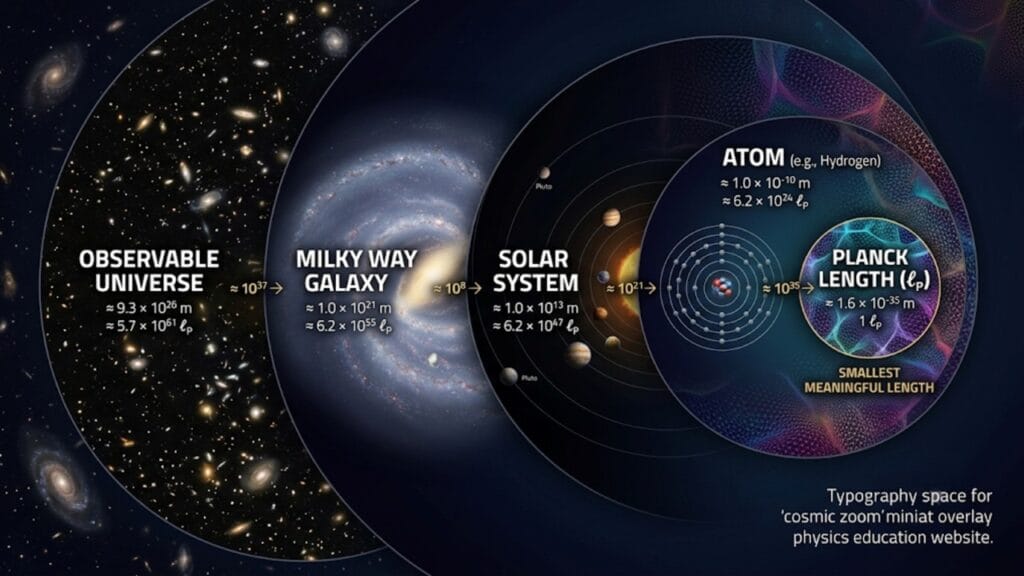
The answer is visible immediately from the table of Planck unit values. The Planck length is \( 10^{-35} \) m — about \( 10^{20} \) times smaller than a proton. The Planck time is \( 10^{-44} \) s. The Planck temperature is \( 10^{32} \) K.
In Planck units, a human being is approximately:
- \( 10^{35} \) Planck lengths tall
- \( 10^{58} \) Planck times old (for a 20-year-old)
- \( 10^{32} \) Planck kilograms in mass (using the Planck mass of \( 2.2 \times 10^{-8} \) kg)
Every human-scale number would be an incomprehensibly large power of 10. The convenience that Planck units offer — eliminating the \( c \), \( \hbar \) and \( G \) factors from equations — comes at the cost of any numerical intuition for human-scale quantities.
Planck units are the right language for theoretical physics at the extreme scales of nature. They are the wrong language for a physics lab, an engineering workshop, or a kitchen.
Planck Units and the 2019 SI Revision
An interesting historical connection: the 2019 revision of the SI system, which defined the kilogram through Planck’s constant, implicitly acknowledged the centrality of Planck units to modern measurement.
By fixing \( h = 6.626 \times 10^{-34} \) J·s exactly, the SI system anchored its mass unit to the same constant that defines the Planck mass. The kilogram is now:
\[ 1 \text{ kg} = \frac{h}{6.62607015 \times 10^{-34} \text{ m}^2\text{s}^{-1}} \]
In terms of the Planck mass:
\[ 1 \text{ kg} = \frac{m_P}{\sqrt{G\hbar/c}} \times \frac{1}{1\text{ kg}} \approx 4.595 \times 10^7 \text{ } m_P \]
The Planck mass and the SI kilogram are connected through \( h \), \( G \) and \( c \) — precisely the constants whose values are fixed in the new SI. This is not a coincidence — it reflects the fact that the 2019 SI revision moved toward a constants-based definition philosophy that Planck himself had proposed 120 years earlier.
Learn more about The Revised SI System (2019): How Constants Redefined Our Units of Measurement
The Deeper Question: Do Planck Units Reveal Something Real?
Planck proposed his unit system in 1899 as a mathematical curiosity — a way of expressing physical quantities that would be understood by any intelligence anywhere in the universe. He called them “natural units” because they are determined by natural constants rather than human convention.
But in the century since, Planck units have turned out to be not just mathematically natural but physically fundamental. The Planck length appears in string theory as the string scale. The Planck energy appears as the scale of grand unification. The Planck time appears as the beginning of what can be described in classical general relativity.
This convergence — the same combination of constants appearing in multiple independent approaches to the same physics — suggests that Planck units are not merely a convenient notation. They are pointing at something real about the structure of physical law. The universe appears to have a natural scale and that scale is the Planck scale.
Whether spacetime is actually discrete at the Planck scale, whether energy is quantized at the Planck energy, whether the Planck era can ever be described by a consistent theory — these are open questions at the frontier of physics. But that the Planck scale is where these questions become urgent is not in doubt.
Learn more about 7 Real-World Applications of Dimensional Analysis You Never Knew
Planck Units in the Exam Context
For Class 11 and Class 12 students preparing for board exams, JEE, or NEET, Planck units appear in the following contexts:
Dimensional analysis questions: Deriving the Planck length, Planck time, or Planck mass from dimensional analysis of \( \hbar \), \( G \) and \( c \) is a direct exam question type. The method shown earlier in this article — setting up the exponent equations and solving — is the correct approach.
Formula involving \( \hbar \): Questions about the dimensional formula of Planck’s constant (\( [ML^2T^{-1}] \)) and its relation to the Planck units.
Conceptual questions: The Planck scale as the scale at which quantum effects of gravity become important. The Planck time as the age of the universe at the end of the Planck epoch. The Planck length as the smallest meaningful length in current physics.
The full derivation of all five Planck units from dimensional analysis — shown step by step in this article — is not standard board exam content but is entirely within scope for JEE Advanced and NEET UG conceptual questions that test dimensional reasoning at a higher level.
Learn more about Dimensional Analysis Made Easy: Method, Rules and Practice Problems
Summary
| Aspect | Detail |
| Proposed by | Max Planck, 1899 |
| Based on constants | \( c, \hbar, G, k_B, k_e \) |
| Method of derivation | Dimensional analysis |
| Planck length | \( \sqrt{\hbar G/c^3} \approx 1.616 \times 10^{-35} \) m |
| Planck time | \( \sqrt{\hbar G/c^5} \approx 5.391 \times 10^{-44} \) s |
| Planck mass | \( \sqrt{\hbar c/G} \approx 2.176 \times 10^{-8} \) kg |
| Planck energy | \( m_P c^2 \approx 1.22 \times 10^{19} \) GeV |
| Planck temperature | \( E_P/k_B \approx 1.417 \times 10^{32} \) K |
| Physical significance | Scale where quantum gravity effects become important |
| Why not used in practice | Human-scale values are unmanageably large powers of 10 |
| Relation to 2019 SI | Kilogram now anchored to \( \hbar \) — Planck’s insight implemented |
Conclusion
Max Planck proposed his natural unit system as a solution to an aesthetic problem — the human arbitrariness of unit choices. What he could not have known in 1899 was that the combination of constants he chose would turn out to mark the exact boundary where the two great theories of 20th-century physics — quantum mechanics and general relativity — simultaneously become important and simultaneously break down.
The Planck scale is not merely a mathematical curiosity. It is where the universe keeps its deepest secrets: the nature of spacetime at the shortest distances, the behaviour of matter at the highest energies, the physics of the first instant of cosmic time. Every approach to quantum gravity — every attempt to build a theory that unifies quantum mechanics with gravity — must ultimately give predictions at the Planck scale and must reduce to known physics far from it.
In this sense, Planck units are a map of where physics needs to go next. The units themselves are the signpost.
Frequently Asked Questions
What are Planck units and why are they called natural units?
Planck units are a system of measurement based entirely on fundamental constants of physics — \( c \), \( \hbar \), \( G \), \( k_B \) and \( k_e \). They are called natural units because they are determined by the laws of physics rather than by human convention. Any intelligent civilization anywhere in the universe, using the same physics, would derive the same Planck units. Their values are universal — not contingent on Earth’s geography, biology, or technology.
How is the Planck length derived?
By dimensional analysis of \( c \), \( \hbar \) and \( G \). Write \( \ell_P = c^a \hbar^b G^c \) and require \( [\ell_P] = L \). Substituting the dimensional formulas and equating exponents of M, L, T gives \( a = -3/2 \), \( b = 1/2 \), \( c = 1/2 \), leading to \( \ell_P = \sqrt{\hbar G / c^3} \approx 1.616 \times 10^{-35} \) m.
Why can’t we use Planck units for everyday measurements?
Because human-scale quantities expressed in Planck units involve astronomically large numbers. A human being is about \( 10^{35} \) Planck lengths tall and lives for about \( 10^{60} \) Planck times. Every measurement, every engineering specification, every experimental result would be expressed as a power of 10 too large to be practical. Planck units are optimal for theoretical physics near the Planck scale — not for everyday science or engineering.
Are Planck units related to the 2019 SI redefinition?
Yes, in a conceptual sense. The 2019 SI redefinition anchored the kilogram to a fixed value of Planck’s constant \( h \), connecting the SI mass unit to the same constant that defines the Planck mass. This reflects the broader philosophical shift in the 2019 revision: defining units through fundamental constants rather than physical artefacts — the same approach Planck proposed in 1899.
What happens at the Planck time after the Big Bang?
The Planck time (\( \approx 5.4 \times 10^{-44} \) s) marks the earliest moment that current physics can meaningfully describe. Before this — during the Planck epoch — the density and temperature of the universe were so extreme that quantum gravitational effects were dominant and both general relativity and quantum field theory break down. The Planck epoch is opaque to current theory; what happened during it remains one of the most profound open questions in physics.
Leave a Comment