


Introduction
Seven is a surprisingly small number when you consider what it needs to cover. The SI system uses exactly seven base units to describe every measurable physical quantity in the known universe — from the diameter of a quark to the luminosity of a quasar, from the electrical resistance of a nanowire to the thermal energy of a gas cloud. Seven numbers, carefully chosen, span the entire measurable world.
This raises an obvious question that most physics courses never quite answer: why seven? Why not five, or twelve, or three? And why these particular seven — mass, length, time, electric current, temperature, amount of substance and luminous intensity? Are these choices arbitrary conventions, or do they reflect something deeper about the structure of physical reality?
The answer is genuinely interesting and worth understanding properly. It touches on the logical foundations of measurement, the history of how physics organized itself as a discipline and some subtle but important questions about what it means to measure something at all.
The Question Behind the Question
To understand why the SI system uses seven base units, it helps to be precise about what a base unit actually is — and what problem the choice of base units is meant to solve.
A base unit is a unit for a physical quantity that is defined independently — not in terms of other units. A derived unit is defined by combining base units through the equations of physics.
The Newton, for example, is a derived unit. It is defined as kg·m·s⁻², which comes directly from \( F = ma \). You do not need a separate, independent definition of force. Once you have mass, length and time, force follows automatically from the physics.
The question is: what is the smallest set of independently defined units from which all other units in physics can be derived? That is what the seven base units are trying to be.
This is not a purely mathematical question — it depends on what physical theories you are using. Different physical theories relate different quantities to each other in different ways and those relationships determine which quantities need independent definitions and which can be derived.
The Logical Foundation: Independence and Completeness
A good set of base units must satisfy two criteria:
Independence: No base unit should be derivable from the others using the equations of physics. If one unit could be expressed in terms of the others, it is not truly independent — it is redundant.
Completeness: The set must be large enough to express every physical quantity that appears in the domain of physics being described. If a new quantity appears that cannot be expressed in terms of the existing base units, a new base unit must be added.
These two requirements — independence and completeness — drive the choice of seven. The system uses exactly as many base units as needed for completeness without violating independence.
Why Three Mechanical Units: Mass, Length and Time
The first three base units — mass (M), length (L) and time (T) — cover all of classical mechanics. This is the content of the CGS and MKS systems: with just these three, you can derive the units for every mechanical quantity.
Force: \( [F] = MLT^{-2} \)
Energy: \( [E] = ML^2T^{-2} \)
Power: \( [P] = ML^2T^{-3} \)
Pressure: \( [P] = ML^{-1}T^{-2} \)
Momentum, angular momentum, torque, viscosity, surface tension — all derivable from M, L, T alone. The entire edifice of classical mechanics stands on three base dimensions.
These three are chosen rather than other combinations — such as force, length and time — for pragmatic reasons. Mass, length and time are the most directly and independently measurable. You can measure a mass by comparison with a standard without knowing anything about force. You can measure a length by comparison with a standard ruler. You can measure time by counting oscillations. Force, by contrast, requires knowing mass and acceleration to be defined operationally — it is more naturally derived than primitive.
Could We Manage With Fewer Than Three?
Not in classical mechanics. Mass, length and time are dimensionally independent — no combination of powers of M and L gives T, no combination of L and T gives M and so on. Trying to express all mechanical quantities with only two base dimensions would require either combining certain mechanically distinct quantities (like setting force equal to energy per length, which is true but conflates two conceptually different things) or losing the ability to distinguish quantities that are physically different but mathematically similar.
The dimensionality argument makes this precise: three mechanical base dimensions are the minimum needed to span the dimensional space of classical mechanics.
Learn more about SI Units Explained: The 7 Base Units Every Physics Student Must Know
Why a Fourth Unit for Electromagnetism: The Ampere
When you move beyond mechanics into electromagnetism, something new happens. The equations of electromagnetism — Coulomb’s law, Ampere’s force law, Faraday’s law — introduce new physical relationships that connect electrical quantities to mechanical ones. But they connect them through constants (the permittivity \( \varepsilon_0 \) and permeability \( \mu_0 \)) whose values are not fixed by the mechanical base units alone.
In the CGS system, physicists tried to build electrical units entirely from the mechanical base units. There were two ways to do this:
- ESU (electrostatic units): Define charge so that the constant in Coulomb’s law equals 1. This sets the unit of charge in terms of g, cm, s.
- EMU (electromagnetic units): Define current so that the constant in the Biot-Savart law equals 1. This sets the unit of current in terms of g, cm, s.
The problem is that these two approaches give different — and incompatible — values to the same electrical quantities. The ratio between the ESU and EMU values of charge involves \( c \), the speed of light, which is a physical constant of electromagnetism. This incompatibility is a sign that something is being forced: electrical quantities are not fully reducible to mechanical ones without making an arbitrary choice about which electromagnetic constant to normalize.
The clean solution, proposed by Giovanni Giorgi in 1901 and adopted by the SI system, is to add a fourth independent base unit for electrical quantities — the ampere. The ampere is defined independently of M, L and T. Once you have it, all other electrical units (volt, ohm, farad, weber, tesla) derive from it.
This resolves the ESU/EMU inconsistency entirely. There is no longer a need to choose which electromagnetic constant to normalize — both \( \varepsilon_0 \) and \( \mu_0 \) take specific non-trivial values and the speed of light appears naturally as \( c = 1/\sqrt{\varepsilon_0\mu_0} \), a consequence of the system rather than an input.
Why the Ampere and Not the Coulomb?
The ampere (current = charge per time) was chosen over the coulomb (charge) as the electrical base unit because current is more directly and practically measurable. A current can be measured by the mechanical force it produces between two parallel conductors — a direct, practical, repeatable experiment. The coulomb, as a static charge, is much harder to measure precisely in isolation.
Why a Fifth Unit for Temperature: The Kelvin
Temperature might seem like a quantity that should derive from energy — after all, the kinetic theory of gases gives:
\[ \langle KE \rangle = \frac{3}{2} k_B T \]
Thermal energy per degree of freedom is proportional to temperature. Could we define temperature as energy divided by the Boltzmann constant \( k_B \) and avoid adding a new base unit?
Technically, yes — and in natural unit systems (such as Planck units), temperature is often expressed directly in energy units. But the SI system chose to keep temperature as an independent base unit for two important reasons:
Practical operationalizability: Before the Boltzmann constant was known to high precision, temperature was measured through its effects — thermal expansion, gas pressure, electrical resistance — using thermometers and gas thermometers. These instruments give temperature readings that are practically independent of any knowledge of \( k_B \). The kelvin was defined to match the empirical temperature scale of the ideal gas thermometer.
Conceptual clarity across macroscopic and microscopic physics: In thermodynamics, temperature appears as a fundamentally independent variable in the equations of state. The entropy, free energy and chemical potential of a system all depend on temperature in ways that are most naturally expressed when temperature has its own dimension. Collapsing it into energy units would require carrying \( k_B \) (or its inverse) through every thermodynamic equation, which adds notational overhead without physical insight.
The 2019 revision of SI fixed this by defining the kelvin through a fixed numerical value of \( k_B \) — acknowledging the conceptual link between temperature and energy while retaining the kelvin as an independent base unit for practical reasons.
Learn more about The Revised SI System (2019): How Constants Redefined Our Units of Measurement
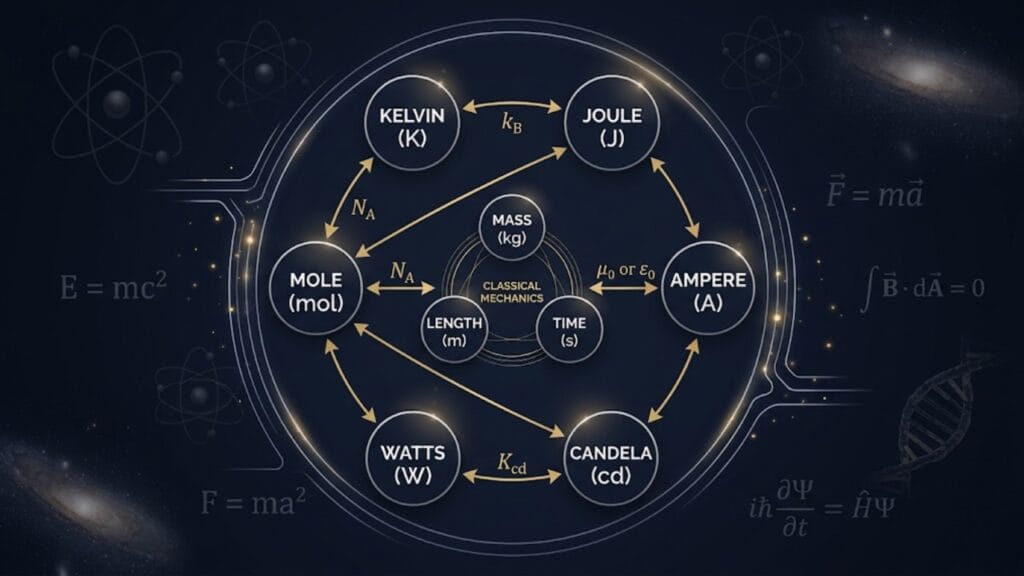
Why a Sixth Unit for Amount of Substance: The Mole
The mole is the base unit that raises the most eyebrows — and generates the most debate about whether it belongs in the list at all.
At first glance, it seems unnecessary. Amount of substance is just a count — a number of entities (atoms, molecules, ions). Why does counting need its own base unit? A count is dimensionless, like the number 12 in a dozen. What is fundamentally different about 6.022 × 10²³ atoms?
The answer is partly practical and partly conceptual.
The practical reason: In chemistry and chemical physics, reactions occur between specific numbers of atoms and molecules — but we can never count individual molecules directly. We weigh bulk quantities of matter. The mole provides the bridge between the macroscopic (grams) and the microscopic (individual molecules). The molar mass of a substance in g/mol links a directly weighable quantity to the number of chemical entities involved in a reaction.
If we had to express all chemical quantities in pure numbers of atoms, the numbers would be unmanageably large (on the order of \( 10^{23} \)) and would require knowing Avogadro’s number \( N_A \) explicitly in every chemical calculation. The mole absorbs \( N_A \) into the unit system, making chemical equations cleaner and more practical.
The conceptual reason: Amount of substance is physically distinct from mass. 1 mole of hydrogen and 1 mole of oxygen have completely different masses (2 g vs 32 g). The mole counts entities; the kilogram weighs them. They are independent physical properties and treating them as the same dimension would conflate things that are physically different.
After the 2019 SI revision, the mole is defined by fixing the numerical value of Avogadro’s constant to exactly \( N_A = 6.02214076 \times 10^{23} \) mol⁻¹. This makes the mole genuinely a counting unit — one mole contains exactly this many entities — rather than a unit tied to any physical artefact.
Why a Seventh Unit for Luminous Intensity: The Candela
The candela is the most specialized of the seven base units — and arguably the one whose inclusion in the base set is most a matter of practical convention rather than deep physical necessity.
What it measures: Luminous intensity is the power of light emitted per unit solid angle, weighted by the sensitivity of the human eye. It is not simply radiant power (which is measured in watts and derives entirely from M, L, T) — it is radiant power multiplied by a standardized function of the human eye’s response to different wavelengths, called the luminosity function.
Why it needs its own unit: The luminosity function is not a universal physical constant — it is a biological property of human vision. It peaks at green light (around 555 nm) and falls to zero at the edges of the visible spectrum. Different wavelengths of light with the same radiant power (watts) produce different perceived brightness because the eye responds to them differently.
Photometry — the measurement of light as perceived by human observers — is essential for lighting standards, photography, display technology, medical imaging and any application where human visual experience is what matters. Without a base unit for luminous intensity, photometric quantities cannot be expressed in a physically meaningful and standardized way.
The candela is defined by fixing the luminous efficacy of monochromatic radiation at 540 × 10¹² Hz (green light near the eye’s peak sensitivity) to exactly 683 lm/W. This anchors the human visual weighting function into the unit system.
The honest caveat: The candela is the one base unit that most physicists would arguably omit from a purely physical standpoint — luminous intensity can, in principle, always be expressed in watts per steradian and the human visual weighting added on top. The candela’s inclusion in SI reflects the practical importance of photometric applications rather than a fundamental physical necessity. But given the breadth of human activity that depends on standardized photometric measurement, its inclusion in the official base set is well justified.
Could We Use Fewer Base Units?
This is where the physics becomes genuinely deep.
In principle, the number of required base units depends on the physical theory being used and on which constants are treated as independent.
In natural unit systems — such as Planck units, or the units used in theoretical particle physics — physicists set certain fundamental constants equal to 1:
- Setting \( c = 1 \) merges length and time (spacetime is one entity and distance can be measured in seconds)
- Setting \( \hbar = 1 \) merges mass-energy and inverse time
- Setting \( G = 1 \) fixes the mass unit
- Setting \( k_B = 1 \) merges temperature and energy
In Planck units, only one independent unit remains — everything else is a dimensionless number. The “one unit” is sometimes described as the Planck unit of action, or simply as a single natural scale of physics.
This raises a profound question: are the dimensions of physics fundamentally one-dimensional, with the appearance of multiple dimensions being an artifact of convenient conventions? Some theoretical physicists and philosophers of physics argue yes — that the seven SI dimensions reflect human measurement conventions more than they reflect fundamental physics. Others argue that the dimensions reflect genuine structural properties of physical law that cannot be collapsed without losing physical content.
The SI system takes a pragmatic middle position: use as many base units as are needed for practical completeness in all domains of applied science, without trying to reduce to the theoretical minimum. This gives seven.
Learn more about Planck Units: The Natural Unit System That Defined the Universe’s Scale
The 2019 Redefinition: Constants as the Foundation
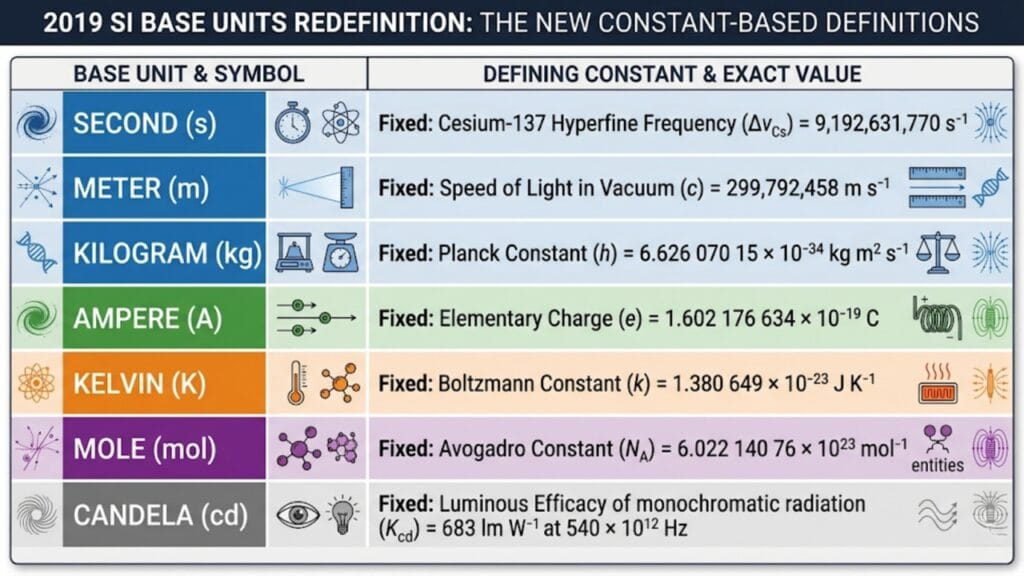
The 2019 revision of SI made an important philosophical shift in how the base units are defined. Rather than defining base units in terms of physical artefacts or operational procedures, the revision defines them by fixing exact numerical values of seven fundamental physical constants:
| Fixed Constant | Value Fixed | Base Unit Defined |
| Hyperfine frequency of Cs-133, \( \Delta\nu_\text{Cs} \) | 9192631770 Hz exactly | Second (s) |
| Speed of light, \( c \) | 299792458 m/s exactly | Metre (m) |
| Planck’s constant, \( h \) | \( 6.62607015 \times 10^{-34} \) J·s exactly | Kilogram (kg) |
| Elementary charge, \( e \) | \( 1.602176634 \times 10^{-19} \) C exactly | Ampere (A) |
| Boltzmann constant, \( k_B \) | \( 1.380649 \times 10^{-23} \) J/K exactly | Kelvin (K) |
| Avogadro constant, \( N_A \) | \( 6.02214076 \times 10^{23} \) mol⁻¹ exactly | Mole (mol) |
| Luminous efficacy, \( K_\text{cd} \) | 683 lm/W exactly | Candela (cd) |
This approach is more elegant than it might appear. By fixing the values of exactly seven fundamental constants, each with independent physical meaning, the SI system guarantees that the unit system remains stable indefinitely — no artefact can drift, no physical object can be lost or damaged, no experimental improvement can force a redefinition. The units are anchored to the laws of physics themselves.
The choice of seven constants mirrors the choice of seven base units — and this is not a coincidence. Each fixed constant defines one degree of freedom in the unit system. Seven constants for seven dimensions: a one-to-one correspondence between the physical constants that anchor the units and the base dimensions those units represent.
Why Not More Than Seven?
If completeness requires seven for classical mechanics through photometry, why not add more for, say, nuclear physics, particle physics, or quantum field theory?
The answer is that the seven existing base units are sufficient to express every physical quantity in these domains as well. Nuclear binding energies are in joules. Particle masses are in kilograms (or equivalently, in MeV/c², which converts to kilograms through \( E = mc^2 \)). Cross-sections (effective areas of interaction) are in square metres. Coupling constants in quantum field theory are dimensionless.
No new physical domain has yet required a genuinely new independent base dimension. All quantities encountered in physics — from Planck scale to cosmological scale, from classical to quantum, from mechanics to thermodynamics to electromagnetism — are expressible in terms of M, L, T, A, K, mol and cd.
This is not guaranteed a priori — it is an empirical fact that the physical world appears to be describable with seven independent measurement dimensions. If a genuinely new type of quantity were discovered that could not be expressed in terms of the existing seven, physics would need an eighth base unit. So far, none has been found.
The Deeper Answer: Why Seven and Not Another Number?
The honest answer to “why seven?” is: because that is how many dimensionally independent quantities appear to be needed to describe the full scope of physics as we currently understand it.
Three come from the requirement to span classical mechanics (M, L, T). A fourth comes from the dimensional independence of electromagnetic quantities (A). A fifth comes from the practical and conceptual independence of temperature (K). A sixth comes from the need to bridge macroscopic and microscopic descriptions of matter (mol). A seventh comes from the practical need to standardize measurements of light as perceived by humans (cd).
Each addition to the list solved a real problem — either a fundamental dimensional independence issue (M, L, T, A, K) or a practical standardization need (mol, cd). None was added arbitrarily.
Whether the number will always be seven is genuinely open. A theory of quantum gravity might reveal that length and time are not truly independent at the Planck scale — in which case the number might effectively reduce to six, or the definition of those two units might need to change fundamentally. Conversely, if a new type of physical phenomenon were discovered that introduced a genuinely new dimensional structure, the number might increase.
For now, seven appears to be right. Not by convention, not by aesthetics, but by the physics.
Summary: Why Seven?
| Unit | Domain It Covers | Why Independent |
| Kilogram (kg) | Mechanics | Mass is not reducible to length or time |
| Metre (m) | Mechanics | Length is not reducible to mass or time |
| Second (s) | Mechanics | Time is not reducible to mass or length |
| Ampere (A) | Electromagnetism | Electrical quantities need a fourth independent dimension |
| Kelvin (K) | Thermodynamics | Temperature has practical and conceptual independence from energy |
| Mole (mol) | Chemistry / Microscopic physics | Amount of substance bridges macro and micro |
| Candela (cd) | Photometry | Human-perceived light requires biologically-weighted measurement |
Conclusion
The SI system uses seven base units because seven appears to be the minimum number needed to span the full dimensional space of physical measurement, from classical mechanics through electromagnetism, thermodynamics, chemistry and photometry. Each unit was added to the list because it solved a real problem — a genuine dimensional independence that could not be resolved by deriving the new unit from the existing ones without losing physical content or practical operationalizability.
The 2019 redefinition of SI deepened this picture by anchoring each base unit to a fixed fundamental constant. The seven constants chosen — the Cs-133 hyperfine frequency, the speed of light, Planck’s constant, the elementary charge, the Boltzmann constant, Avogadro’s constant and the luminous efficacy — are exactly as many independent anchors as there are independent dimensions. Seven constants, seven dimensions, one coherent system.
The choice of seven is not arbitrary. It is the current best answer to one of the most fundamental questions in the philosophy of measurement: how many independently defined quantities does physics actually need?
Learn more about SI Units Explained: The 7 Base Units Every Physics Student Must Know
Frequently Asked Questions
Why does the SI system have exactly 7 base units?
The SI system uses seven base units because seven appears to be the minimum number of dimensionally independent quantities needed to describe all physical phenomena — from classical mechanics to electromagnetism, thermodynamics, chemistry and photometry. Three cover mechanics (kg, m, s), one adds electromagnetism (A), one adds thermodynamics (K), one bridges macroscopic and microscopic descriptions (mol) and one standardizes human-perceived light (cd).
Could physics work with fewer than 7 base units?
Yes, in principle. Natural unit systems such as Planck units reduce everything to a single scale by setting fundamental constants like \( c \), \( \hbar \) and \( G \) equal to 1. This collapses multiple dimensions into one. However, such systems are impractical for everyday scientific and engineering use because they produce numbers that are either extremely large or extremely small for most human-scale measurements. The SI system uses seven for practical completeness across all domains.
Why was the ampere added as a separate base unit instead of deriving electrical units from mechanics?
Because electrical quantities are not fully reducible to mechanical ones without making an arbitrary choice about which electromagnetic constant to normalize. The CGS system attempted this and produced two incompatible sub-systems (ESU and EMU). Adding the ampere as an independent base unit, as Giorgi proposed in 1901, resolves this inconsistency and gives the SI system a clean, unified electrical framework.
Is temperature really independent of energy? Could kelvin be derived from joules?
Theoretically, temperature can be expressed as energy divided by the Boltzmann constant \( k_B \), making it dimensionally equivalent to energy. Natural unit systems often do this. The SI system retains the kelvin as an independent base unit for practical reasons — temperature was historically measured independently of any knowledge of \( k_B \), thermodynamic equations are cleaner with temperature as an independent variable and the 2019 redefinition anchors the kelvin to a fixed value of \( k_B \) while preserving its independence.
Why is the candela included as a base unit when it seems less fundamental than the others?
The candela is the most practically motivated of the seven base units. Luminous intensity measures radiant power weighted by the human eye’s sensitivity — a biological rather than purely physical property. It is included because photometry (the measurement of light as perceived by humans) is important in technology, medicine and everyday life and standardizing it requires a base unit that incorporates the human visual weighting function. Some physicists consider the candela the weakest candidate for base unit status on fundamental grounds.
What changed about the SI base units in 2019?
The 2019 revision redefined all seven base units by fixing exact numerical values of seven fundamental physical constants — the Cs-133 hyperfine frequency, the speed of light, Planck’s constant, the elementary charge, the Boltzmann constant, Avogadro’s constant and the luminous efficacy of green light. This makes the units independent of any physical artefact and ensures they are stable, universal and reproducible by any laboratory in the world with appropriate equipment.
Could there ever be an 8th SI base unit?
Yes, in principle, if a genuinely new type of physical quantity were discovered that cannot be expressed in terms of the existing seven base dimensions. No such quantity has been found so far — all known physical quantities, from particle physics to cosmology, can be expressed using M, L, T, A, K, mol and cd. However, a theory of quantum gravity might alter our understanding of space and time at the Planck scale in ways that affect the structure of the base dimensions. The possibility of an eighth base unit remains open.
Leave a Comment