

Introduction
The nearest star beyond our Sun is approximately 4.24 light years away. That number sounds simple enough — until you try to think about what it would actually mean to measure it. You cannot stretch a tape measure to Alpha Centauri. You cannot bounce a laser off it and time the return signal the way you can with the Moon. The star is simply too far away for any direct, intuitive measuring technique to work.
And yet astronomers know that distance to four significant figures. They know the distances to thousands of stars, to distant galaxies, to objects billions of light years away — with varying degrees of precision, using an ingenious stack of measurement methods, each one extending the reach of the previous. This stack is called the cosmic distance ladder and it is one of the greatest engineering achievements in the history of measurement.
This article explains how astronomical distances are measured, what units are used to express them, how those units convert to SI and why the measurement of cosmic distances matters for physics beyond astronomy.
The Scale Problem in Astronomy
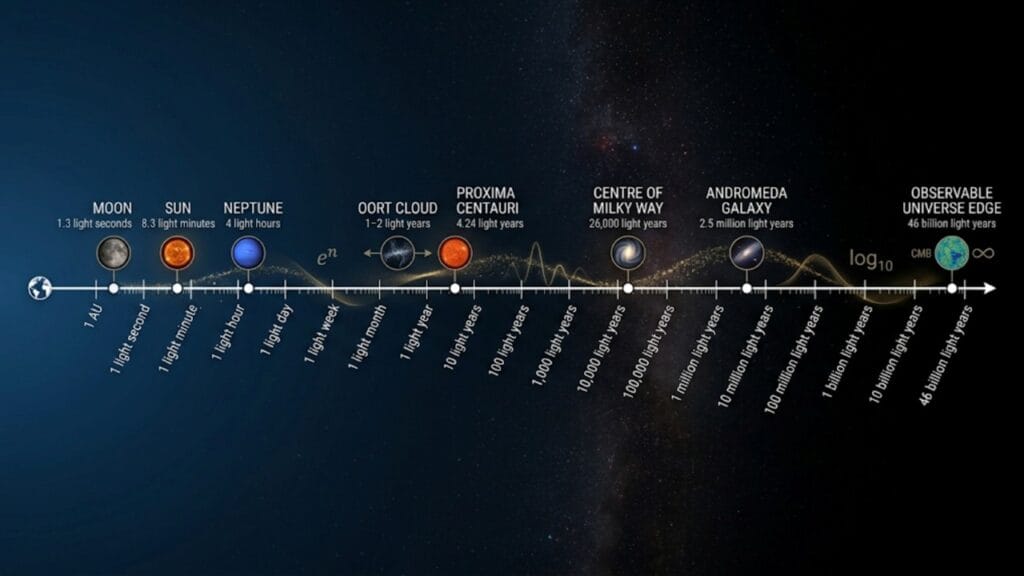
Before discussing methods, it is worth appreciating the scale challenge directly. Consider a few representative distances:
| Object | Distance from Earth | In Metres |
| Moon | 384,400 km | \( 3.84 \times 10^8 \) m |
| Sun | 149.6 million km | \( 1.50 \times 10^{11} \) m |
| Nearest star (Proxima Centauri) | 4.24 light years | \( 4.01 \times 10^{16} \) m |
| Centre of the Milky Way | ~26,000 light years | \( 2.46 \times 10^{20} \) m |
| Andromeda Galaxy | ~2.537 million light years | \( 2.40 \times 10^{22} \) m |
| Observable universe edge | ~46 billion light years | \( 4.35 \times 10^{26} \) m |
The distances span 18 orders of magnitude — from \( 10^8 \) m to \( 10^{26} \) m. No single measurement technique works across this entire range. Different methods are calibrated against each other, each one extending further than the last, like the rungs of a ladder.
Astronomical Units of Distance
Before the methods, the units. Astronomical distances are not typically expressed in metres — the numbers are impractical. Three purpose-built units are used instead.
The Astronomical Unit (AU)
Definition: 1 AU = the mean distance from the Earth to the Sun = 149,597,870,700 metres (defined exactly since 2012).
In SI: \( 1 \text{ AU} \approx 1.496 \times 10^{11} \text{ m} \)
Where it is used: Within the solar system. Planetary distances, asteroid orbits and comet trajectories are all conveniently expressed in AU. The Earth is at 1 AU; Mars is at 1.52 AU; Neptune is at 30.07 AU; the outer edge of the Oort Cloud (the distant reservoir of comets) is estimated at 50,000–200,000 AU.
How it was established historically: The first serious measurement of the AU came from observations of the Transit of Venus in 1761 and 1769. By measuring the duration of Venus crossing the solar disc from different latitudes on Earth, astronomers could use parallax geometry to calculate the Earth-Sun distance. Edmond Halley had proposed this method in 1716 and international expeditions — including James Cook’s voyage to Tahiti — were organized to make the observations.
The value was refined through subsequent transits, radar ranging of Venus and finally established to extraordinary precision by interplanetary spacecraft tracking. Modern spacecraft navigational precision has pushed the AU to 11 significant figures.
The Light Year (ly)
Definition: 1 light year = the distance light travels in vacuum in one Julian year (365.25 days).
In SI:
\[ 1 \text{ ly} = c \times 1 \text{ year} = 3 \times 10^8 \text{ m/s} \times 365.25 \times 24 \times 3600 \text{ s} \]
\[ = 3 \times 10^8 \times 3.156 \times 10^7 \approx 9.461 \times 10^{15} \text{ m} \]
\[ \boxed{1 \text{ ly} \approx 9.46 \times 10^{15} \text{ m}} \]
Where it is used: In popular science communication and in discussing stellar and galactic distances. The light year is not preferred by professional astronomers for technical work (the parsec is preferred), but it is the most intuitively meaningful unit for the general reader because it connects distance to the travel time of light.
The light year also has a physical interpretation that goes beyond mere distance measurement: when you observe a star 100 light years away, you are seeing it as it was 100 years ago. Astronomical observation is inherently a form of time travel backward — looking further means seeing earlier. This is not a philosophical metaphor; it is a measurable physical fact with consequences for cosmology.
Useful sub-units:
- 1 light minute \( \approx 1.80 \times 10^{10} \) m (the Sun is ~8.3 light minutes from Earth)
- 1 light second \( \approx 3 \times 10^8 \) m (the Moon is ~1.3 light seconds away)
- 1 light day \( \approx 2.59 \times 10^{13} \) m
The Parsec (pc)
Definition: 1 parsec = the distance at which 1 AU subtends an angle of 1 arcsecond.
In SI:
\[ 1 \text{ pc} = \frac{1 \text{ AU}}{\tan(1”)} \approx \frac{1 \text{ AU}}{4.848 \times 10^{-6}} \approx 3.086 \times 10^{16} \text{ m} \]
Relation to light years:
\[ 1 \text{ pc} \approx 3.26 \text{ ly} \]
Where it is used: By professional astronomers for almost all technical distance measurements. The parsec is defined directly from the parallax measurement method (see below), which is why it is the preferred unit — it connects the definition of distance to the primary measurement technique.
Useful multiples:
- 1 kiloparsec (kpc) = 1000 pc \( \approx 3.086 \times 10^{19} \) m (galactic-scale distances)
- 1 megaparsec (Mpc) = \( 10^6 \) pc \( \approx 3.086 \times 10^{22} \) m (inter-galactic and cosmological distances)
- 1 gigaparsec (Gpc) = \( 10^9 \) pc (cosmological surveys)
Unit Conversion Summary
| Unit | In metres | In AU | In light years | In parsecs |
| 1 AU | \( 1.496 \times 10^{11} \) m | 1 | \( 1.581 \times 10^{-5} \) | \( 4.848 \times 10^{-6} \) |
| 1 light year | \( 9.461 \times 10^{15} \) m | 63,241 | 1 | 0.3066 |
| 1 parsec | \( 3.086 \times 10^{16} \) m | 206,265 | 3.2616 | 1 |
Learn more about All SI Prefixes from Pico to Tera: Quick Reference Chart with Examples
The Cosmic Distance Ladder: Method by Method
Each rung of the distance ladder uses a different technique. Each technique is calibrated against the one below it for nearby objects and then extended to greater distances.
Rung 1: Radar Ranging (Within the Solar System)
Range: Up to about 50 AU (to Pluto and beyond)
Principle: A radio pulse is transmitted toward a solar system object (a planet, asteroid, or spacecraft). The time for the echo to return, \( \Delta t \), gives the distance:
\[ d = \frac{c \cdot \Delta t}{2} \]
This is the most direct and precise method available. It established the AU to modern precision and provides the foundational calibration for the entire distance ladder.
Accuracy: Sub-kilometre precision for nearby planets. The distance to Venus has been measured to within 30 metres using planetary radar.
Limitation: Radio waves spread out and weaken with distance as \( 1/r^2 \). Beyond the inner solar system, signals become too faint to detect an echo. Interplanetary spacecraft can be tracked much further using their transponders (which actively retransmit the signal), but true radar ranging is limited to the inner solar system.
Rung 2: Stellar Parallax (Nearby Stars)
Range: Reliable to about 1000–3000 parsecs (with Hipparcos/Gaia satellites)
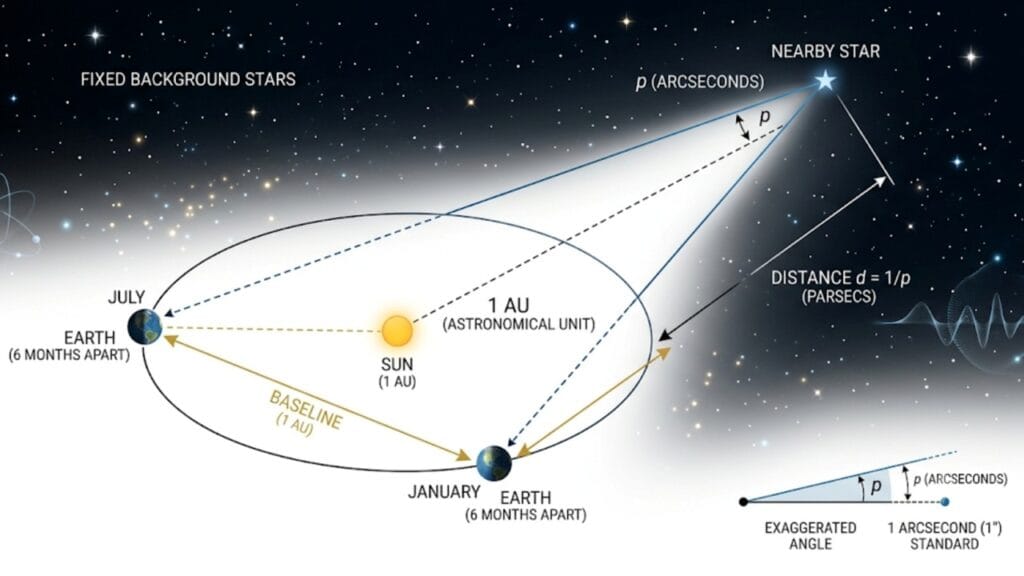
Principle: As the Earth orbits the Sun, nearby stars appear to shift slightly in position against the background of more distant stars. This apparent shift — the parallax angle \( p \) — is half the total angular shift observed over six months (when Earth has moved from one side of its orbit to the other, a baseline of 2 AU).
The distance \( d \) to the star in parsecs is:
\[ d \text{ (parsecs)} = \frac{1}{p \text{ (arcseconds)}} \]
This formula defines the parsec: a star at 1 parsec has a parallax angle of 1 arcsecond.
Example: Proxima Centauri has a parallax angle of 0.7687 arcseconds. Its distance is:
\[ d = \frac{1}{0.7687} = 1.301 \text{ pc} = 4.243 \text{ ly} \]
Historical note: The first successful stellar parallax measurement was made by Friedrich Bessel in 1838 for the star 61 Cygni (parallax ≈ 0.314″). This was a landmark achievement — the first direct measurement of the distance to a star other than the Sun.
Modern capability: The Hipparcos satellite (1989–1993) measured parallaxes to about 100,000 stars with precision of 1 milliarcsecond. The Gaia mission (launched 2013) has measured parallaxes for over 1.5 billion stars with precision reaching 20 microarcseconds — extending reliable parallax distances to several thousand parsecs.
Limitation: Parallax angles become too small to measure reliably for stars more than a few thousand parsecs away. At 3000 pc, the parallax is only 0.33 milliarcseconds — at the limit of Gaia’s precision. Beyond this, other methods must take over.
Rung 3: Standard Candles — Cepheid Variable Stars
Range: Up to about 30 megaparsecs
Principle: A standard candle is any object whose intrinsic luminosity (true power output) is known. If you know how bright an object truly is (its absolute magnitude) and you can measure how bright it appears from Earth (its apparent magnitude), the distance follows from the inverse-square law:
\[ F = \frac{L}{4\pi d^2} \]
Where \( F \) is the measured flux (power per unit area at Earth), \( L \) is the intrinsic luminosity and \( d \) is the distance. Solving for \( d \):
\[ d = \sqrt{\frac{L}{4\pi F}} \]
Cepheid variables are pulsating stars that vary in brightness with a precise, regular period. Henrietta Swan Leavitt discovered in 1912 that there is a tight relationship between the period of pulsation and the intrinsic luminosity: longer period means higher luminosity. This is the period-luminosity relation (Leavitt Law).
To use it:
- Observe the period of brightness variation \( P \)
- Use the period-luminosity relation to find the intrinsic luminosity \( L \)
- Measure the apparent brightness \( F \)
- Calculate the distance \( d = \sqrt{L/4\pi F} \)
Historical significance: Edwin Hubble used Cepheid variables in the Andromeda Galaxy in 1923–1924 to demonstrate that Andromeda was far beyond the boundaries of the Milky Way — resolving the Great Debate about whether the nebulae were nearby clouds of gas or distant island universes (galaxies). This was the discovery that the universe extends far beyond our own galaxy.
Calibration: The absolute calibration of the Cepheid period-luminosity relation depends on parallax measurements of nearby Cepheids. This is how the ladder connects — parallax-calibrated Cepheids are used to measure distances where parallax itself is too small to detect.
Limitation: Cepheids require individual stars to be resolved, which is only possible in relatively nearby galaxies. Beyond about 30 Mpc, individual stars cannot be resolved even with Hubble Space Telescope and even brighter standard candles are needed.
Rung 4: Type Ia Supernovae
Range: Up to several gigaparsecs (billions of light years)
Principle: A Type Ia supernova occurs when a white dwarf star in a binary system accretes enough mass from its companion to exceed the Chandrasekhar limit (~1.4 solar masses), triggering a runaway nuclear fusion explosion. Because the explosion always occurs at approximately the same mass threshold, the peak luminosity of Type Ia supernovae is remarkably consistent — they all reach approximately the same intrinsic brightness at maximum light.
This makes them extremely powerful standard candles. A Type Ia supernova at peak brightness is roughly \( 5 \times 10^9 \) times more luminous than the Sun — visible across billions of light years.
The peak luminosity is further standardized by the Phillips relation (1993): supernovae that decline more slowly after peak are intrinsically more luminous. Applying this correction makes Type Ia supernovae even more reliable standard candles.
Historical significance: In 1998, two independent teams (Saul Perlmutter’s Supernova Cosmology Project and Brian Schmidt and Adam Riess’s High-Z Supernova Search Team) used Type Ia supernovae at high redshift to discover that the expansion of the universe is accelerating — driven by what is now called dark energy. This discovery earned the 2011 Nobel Prize in Physics.
Limitation: Type Ia supernovae are rare events (roughly once every 100–200 years per galaxy) and require either patient monitoring or large survey telescopes to catch. Their consistency also has real but manageable scatter — dust, metallicity differences and progenitor system diversity introduce uncertainties at the 5–10% level.
Rung 5: The Hubble Law — Redshift as Distance Indicator
Range: Beyond a few hundred megaparsecs, to the edge of the observable universe
Principle: In 1929, Edwin Hubble established that galaxies are receding from us with velocities proportional to their distances — the Hubble Law:
\[ v = H_0 \cdot d \]
Where:
- \( v \) = recession velocity (measured from the redshift of spectral lines)
- \( d \) = distance to the galaxy
- \( H_0 \) = the Hubble constant, approximately 67–73 km/s/Mpc (the precise value is currently debated)
The recession velocity is measured through the cosmological redshift: spectral lines of known wavelength, when observed from a distant galaxy, appear shifted to longer (redder) wavelengths. The redshift \( z \) is:
\[ z = \frac{\lambda\text{observed} – \lambda\text{emitted}}{\lambda_\text{emitted}} \]
For moderate velocities, \( v \approx cz \), giving:
\[ d \approx \frac{cz}{H_0} \]
Limitation: The Hubble constant \( H_0 \) must be calibrated from the lower rungs of the ladder. A 5% uncertainty in \( H_0 \) propagates as a 5% uncertainty in all cosmological distances derived from Hubble’s law. This is the Hubble tension — measurements of \( H_0 \) from Type Ia supernovae give approximately 73 km/s/Mpc, while measurements from the cosmic microwave background give approximately 67 km/s/Mpc. This unresolved discrepancy is currently one of the most actively investigated problems in cosmology.
Special Case: Measuring the Moon’s Distance
The Moon is close enough that multiple techniques work — and comparing them provides a rich illustration of measurement principles.
Laser Ranging
Since the Apollo missions placed corner-cube retroreflectors on the lunar surface (1969–1971), the distance to the Moon has been measured by timing a laser pulse round-trip:
\[ d = \frac{c \cdot \Delta t}{2} \]
With \( \Delta t \approx 2.56 \) seconds for the round trip, \( d \approx 384,400 \) km. Modern measurements achieve millimetre precision — the distance to the Moon is known better than any other astronomical distance.
Historical: Lunar Parallax
Before laser ranging, the Moon’s distance was measured by lunar parallax — observing the Moon simultaneously from two widely separated locations on Earth and measuring the difference in its angular position against the star background. The baseline (distance between observing stations) and the angular shift give the distance by simple triangulation.
The Physics Behind the Methods
Each rung of the distance ladder is grounded in specific physics:
| Method | Physics Used |
| Radar ranging | Electromagnetic wave propagation, \( d = c\Delta t/2 \) |
| Stellar parallax | Euclidean geometry, trigonometry |
| Cepheid variables | Stellar pulsation physics, period-luminosity relation |
| Type Ia supernovae | Nuclear physics, Chandrasekhar mass, standard candle calibration |
| Hubble Law / Redshift | Expansion of spacetime, cosmological redshift |
The ladder as a whole represents physics reasoning at its most ambitious: using the laws of physics — electromagnetic wave propagation, stellar physics, nuclear physics, general relativity — to extend measurement far beyond any direct observational reach.
Why Astronomical Distance Measurement Matters for Physics
The measurement of astronomical distances is not an isolated specialty. It is entangled with some of the most fundamental questions in physics:
The age and size of the universe: The Hubble constant gives the expansion rate of the universe, from which its age can be estimated (\( \sim 1/H_0 \approx 13.8 \) billion years). The distance to the edge of the observable universe (\( \sim 46 \) billion light years) follows from the age, the expansion history and the speed of light.
Dark energy: The discovery that the universe’s expansion is accelerating — derived from Type Ia supernova distances — is the primary observational evidence for dark energy, which now appears to constitute roughly 68% of the total energy of the universe.
The Hubble tension: The discrepancy between early-universe and late-universe measurements of \( H_0 \) may point to new physics beyond the standard cosmological model — possibly a modification to dark energy, dark matter, or the physics of the early universe. Resolving it requires improving the precision of every rung in the distance ladder.
Testing general relativity: The observed deflection of light by massive objects (gravitational lensing) and the delay of signals passing near massive objects (Shapiro delay) both depend on astronomical distances. Testing these effects to high precision requires knowing those distances accurately.
Learn more about What Is Dimensional Formula? Derivation, Applications & Limitations
Common Exam Questions on Astronomical Distances
For Class 11 physics, the following points are most commonly tested:
Conversion between units:
\[ 1 \text{ ly} = 9.46 \times 10^{15} \text{ m} \] \[ 1 \text{ AU} = 1.496 \times 10^{11} \text{ m} \] \[ 1 \text{ pc} = 3.086 \times 10^{16} \text{ m} = 3.26 \text{ ly} \]
Parallax formula:
\[ d \text{ (pc)} = \frac{1}{p \text{ (arcsec)}} \]
Inverse square law for standard candles:
\[ F = \frac{L}{4\pi d^2} \Rightarrow d = \sqrt{\frac{L}{4\pi F}} \]
Light travel time as a distance indicator:
The time for light to travel a distance \( d \) is \( t = d/c \). The Sun’s light takes 8.3 minutes to reach Earth; Proxima Centauri’s light takes 4.24 years.
Summary
Astronomers measure distances using a hierarchy of methods — the cosmic distance ladder — where each rung calibrates the next:
- Radar ranging gives distances within the solar system to extraordinary precision and establishes the AU.
- Stellar parallax extends to thousands of parsecs and defines the parsec itself.
- Cepheid variables reach to ~30 Mpc and bridged the gap between our galaxy and others.
- Type Ia supernovae extend to gigaparsecs and revealed the accelerating universe.
- Hubble’s Law covers the observable universe through the relationship between redshift and distance.
Three units are used: the AU (solar system), the light year (popular communication) and the parsec (professional astronomy). All convert cleanly to SI metres through well-established factors.
Conclusion
Measuring a distance of 4 × 10¹⁶ metres to a star you cannot touch, cannot visit and cannot directly interrogate is not a matter of brute engineering. It is a matter of understanding physics deeply enough to use the laws of nature as measuring instruments.
The cosmic distance ladder is what results when that understanding is applied systematically and honestly — each method calibrated carefully, each rung’s uncertainties propagated into the next, the whole edifice tested internally for consistency. When two methods give the same distance to the same object, confidence grows. When they disagree (as in the Hubble tension), physics is forced to examine its assumptions.
That combination — ingenuity, calibration and a willingness to take disagreement seriously — is what measurement in physics looks like at its finest. The astronomical scale just makes the stakes unusually dramatic.
Learn more about How to Convert Units in Physics: Step-by-Step with Solved Examples
Frequently Asked Questions
What is the difference between a light year, an astronomical unit and a parsec?
A light year is the distance light travels in one year (\( \approx 9.46 \times 10^{15} \) m). An astronomical unit is the mean Earth-Sun distance (\( \approx 1.496 \times 10^{11} \) m). A parsec is the distance at which 1 AU subtends 1 arcsecond of parallax angle (\( \approx 3.086 \times 10^{16} \) m, or 3.26 light years). AU is used within the solar system; light years in popular communication; parsecs in professional astronomy.
How do astronomers measure the distance to nearby stars?
Using stellar parallax — the apparent shift in a star’s position against the background of more distant stars as Earth orbits the Sun over six months. The parallax angle \( p \) in arcseconds gives the distance in parsecs as \( d = 1/p \). The Gaia satellite has measured this for over 1.5 billion stars with precision reaching 20 microarcseconds.
How far is a light year in kilometres and metres?
One light year equals approximately 9.461 × 10¹² km or 9.461 × 10¹⁵ m. It is the distance light covers in one Julian year (365.25 days) travelling at \( 3 \times 10^8 \) m/s.
What is the parallax formula for stellar distances?
\( d \text{ (parsecs)} = 1 / p \text{ (arcseconds)} \). The star’s distance in parsecs is the reciprocal of its parallax angle measured in arcseconds. For example, Proxima Centauri has a parallax of 0.7687 arcseconds, giving a distance of 1/0.7687 ≈ 1.30 parsecs ≈ 4.24 light years.
What is the cosmic distance ladder?
The cosmic distance ladder is the hierarchy of astronomical distance measurement methods — each calibrated against the previous and extending further into space. It includes: radar ranging (solar system), stellar parallax (nearby stars), Cepheid variable stars (nearby galaxies), Type Ia supernovae (distant galaxies) and Hubble’s Law (cosmological distances). No single method works across all distance scales.
Why is the parsec preferred over the light year by professional astronomers?
The parsec is directly defined by the parallax measurement method — the primary technique for measuring stellar distances. When astronomers measure a star’s parallax angle in arcseconds, the distance in parsecs follows immediately from \( d = 1/p \), making calculation straightforward. The light year, while more intuitive for general audiences, requires an additional conversion step that adds no physical insight for professional work.
How was the distance to the Sun first measured accurately?
The AU was first measured accurately through observations of the Transit of Venus in 1761 and 1769. By timing Venus crossing the solar disc from multiple locations on Earth with different latitudes, astronomers applied parallax geometry to calculate the Earth-Sun distance. Later, radar ranging of Venus in the 1960s refined the measurement dramatically. The AU was fixed at exactly 149,597,870,700 m by the International Astronomical Union in 2012.
Leave a Comment