

Introduction
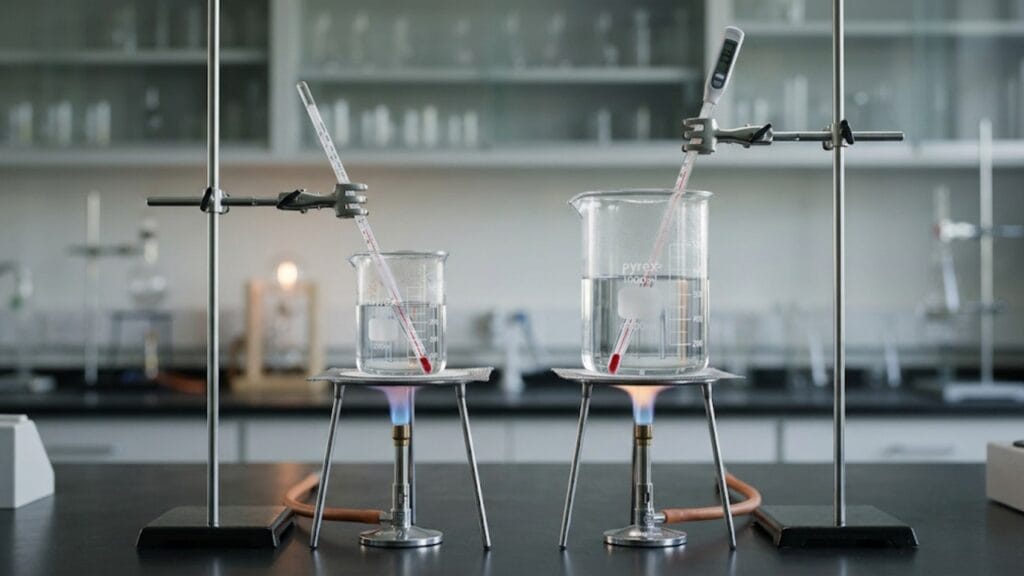
Here’s a pair of terms that sound almost identical but represent genuinely different physical quantities: heat capacity and specific heat capacity. Students often use them interchangeably and honestly, the similar wording doesn’t help. But mixing them up in a calorimetry problem can lead to wrong answers even when every other step is done correctly.
This article clears up the distinction once and for all, explains the formulas behind each and works through calorimetry problems where knowing exactly which one to use actually matters.
What Is Heat Capacity?
Heat capacity is the amount of heat energy required to raise the temperature of an entire object or a specific given amount of substance by one degree Celsius (or Kelvin). It depends on both the material and the total mass of the object in question.
The formula for heat capacity is:
\( C = \frac{Q}{\Delta T} \)
Where:
- \( C \) = heat capacity (J/K)
- \( Q \) = heat energy supplied (J)
- \( \Delta T \) = change in temperature (K or °C)
Notice that heat capacity is specific to a particular object — a large pot of water and a small cup of water will have very different heat capacities, even though both are made of water.
What Is Specific Heat Capacity?
Specific heat capacity, on the other hand, is a property of the material itself, independent of how much of it you have. It’s defined as the amount of heat energy required to raise the temperature of exactly one kilogram of a substance by one degree.
The formula is:
\( c = \frac{Q}{m\Delta T} \)
Where:
- \( c \) = specific heat capacity (J/kg·K)
- \( Q \) = heat energy supplied (J)
- \( m \) = mass of the substance (kg)
- \( \Delta T \) = change in temperature (K or °C)
This is the same \( c \) used in the widely applied formula \( Q = mc\Delta T \), covered step by step in [How to Calculate Heat Absorbed or Released Using Q = mcΔT: Step-by-Step Guide].
The Relationship Between the Two
Heat capacity and specific heat capacity are connected through mass:
\( C = mc \)
In other words, heat capacity is simply specific heat capacity multiplied by the mass of the object. This single relationship is often the key to solving problems that mix both terms together.
Key Differences at a Glance
| Aspect | Heat Capacity | Specific Heat Capacity |
|---|---|---|
| Definition | Heat needed to raise temperature of a given object by 1°C | Heat needed to raise temperature of 1 kg of substance by 1°C |
| Depends on Mass? | Yes | No |
| SI Unit | J/K | J/kg·K |
| Symbol | C (capital) | c (lowercase) |
| Nature | Property of a specific object | Property of the material itself |
| Formula | \( C = \frac{Q}{\Delta T} \) | \( c = \frac{Q}{m\Delta T} \) |
This distinction closely echoes the broader conceptual gap between heat and temperature discussed in [Heat vs Temperature: Key Differences Every Physics Student Must Know] — one is quantity-dependent, the other is an intrinsic property.
Why Specific Heat Capacity Values Differ Between Materials
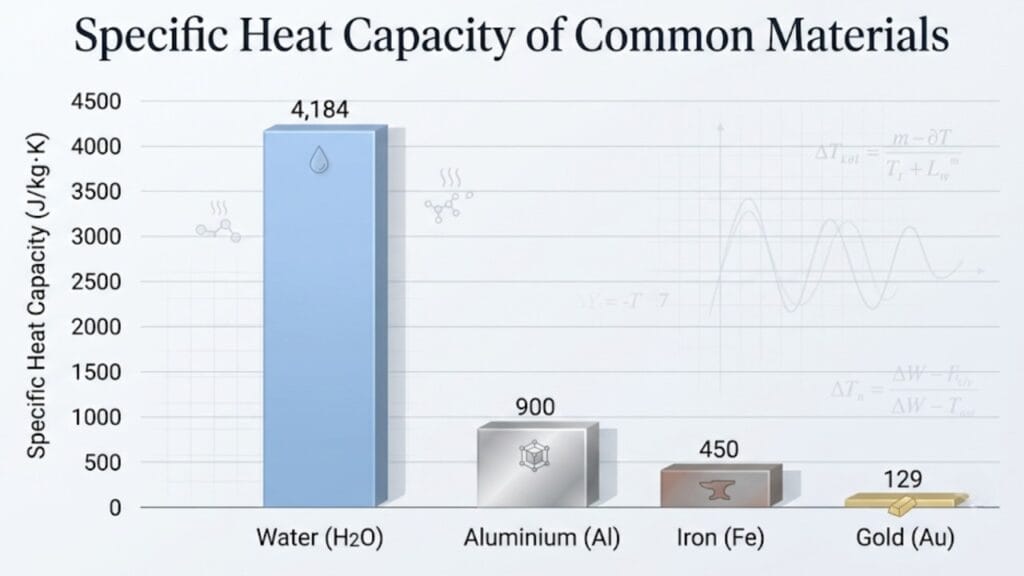
Different substances need different amounts of energy to achieve the same temperature rise because of how their molecules are structured and bonded. Water, famously, has a very high specific heat capacity of about 4200 J/kg·K, largely because of the strong hydrogen bonding between its molecules, which absorbs a lot of energy before temperature actually starts rising.
| Material | Specific Heat Capacity (J/kg·K) |
|---|---|
| Water | 4200 |
| Aluminium | 900 |
| Glass | 840 |
| Iron | 450 |
| Copper | 385 |
| Gold | 129 |
This is why coastal cities tend to experience milder temperature swings than inland desert regions — large bodies of water absorb and release heat slowly, moderating nearby air temperatures throughout the day and across seasons.
Calorimetry Problems Using Both Concepts
Problem 1: Finding Heat Capacity of an Object
A copper block has a mass of 2 kg. Given that the specific heat capacity of copper is 385 J/kg·K, find the heat capacity of this specific block.
\( C = mc \)
\( C = 2 \times 385 = 770 \, J/K \)
This means this particular copper block requires 770 joules of heat energy to raise its temperature by exactly one degree — a value that would be different for a copper block of a different mass.
Problem 2: Using Heat Capacity Directly
A metal object with a heat capacity of 500 J/K absorbs 12,500 J of heat. Find the rise in its temperature.
\( \Delta T = \frac{Q}{C} \)
\( \Delta T = \frac{12500}{500} = 25°C \)
Notice how this calculation didn’t require knowing the mass or specific heat capacity individually — heat capacity alone was sufficient, since it already accounts for both.
Problem 3: Calorimetry — Method of Mixtures
150 g of water at 80°C is mixed with 350 g of water at 20°C in an insulated container. Find the final equilibrium temperature. (Specific heat capacity of water = 4200 J/kg·K)
Using the principle that heat lost by the hot water equals heat gained by the cold water:
\( m_1 c (T_1 – T_f) = m_2 c (T_f – T_2) \)
Since both are water, \( c \) cancels out:
\( 0.15 (80 – T_f) = 0.35 (T_f – 20) \)
\( 12 – 0.15T_f = 0.35T_f – 7 \)
\( 19 = 0.5T_f \)
\( T_f = 38°C \)
The final equilibrium temperature settles at 38°C, closer to the larger, cooler quantity of water — which makes intuitive sense given it has more than double the mass. This exact method is explored in far greater depth in [How to Solve Calorimetry Problems: Method of Mixtures with Solved Examples].
Common Mistakes Students Make
- Using specific heat capacity when the problem actually gives heat capacity, or vice versa. Always check the units given — J/K signals heat capacity, while J/kg·K signals specific heat capacity.
- Forgetting that heat capacity changes with mass, while specific heat capacity does not. Doubling the mass of an object doubles its heat capacity but leaves its specific heat capacity completely unchanged.
- Skipping unit conversion for mass. Since specific heat capacity formulas use kilograms, forgetting to convert grams is one of the most frequent sources of calculation errors.
- Assuming specific heat capacity is constant across all temperature ranges. In reality, it can vary slightly with temperature, though this is usually ignored in introductory-level problems.
A wider list of frequent numerical slip-ups in this general topic area is available in [Top 5 Mistakes Students Make in Heat & Calorimetry Problems (And How to Fix Them)].
Why This Distinction Matters
Understanding the difference between heat capacity and specific heat capacity isn’t just a vocabulary exercise — it directly affects how you approach calorimetry problems, thermal engineering calculations and even basic household observations like why water takes so long to boil compared to how quickly a pan heats up. This foundational clarity supports later topics including [Latent Heat Explained: Latent Heat of Fusion & Vaporisation with Derivations] and broader exam preparation covered in [Thermal Properties of Matter for JEE Main: Key Concepts, Formulas & PYQs].
Conclusion
Heat capacity and specific heat capacity might sound like near-synonyms, but they describe fundamentally different things. Heat capacity depends on the total mass of a specific object, while specific heat capacity is a fixed material property independent of quantity. Once you internalize this difference — and remember the simple relationship \( C = mc \) connecting them — calorimetry problems become far more approachable and a lot of common calculation mistakes simply disappear.
Frequently Asked Questions
What is the main difference between heat capacity and specific heat capacity?
Heat capacity depends on the mass of a specific object, while specific heat capacity is a fixed property of the material, independent of how much of it is present.
What is the formula connecting heat capacity and specific heat capacity?
The relationship is \( C = mc \), where C is heat capacity, m is mass and c is specific heat capacity.
What are the SI units for heat capacity and specific heat capacity?
Heat capacity is measured in J/K, while specific heat capacity is measured in J/kg·K.
Why does water have such a high specific heat capacity?
Water molecules form strong hydrogen bonds, which absorb significant energy before the temperature actually starts to rise, giving water an unusually high specific heat capacity compared to most other common substances.
Can two objects made of the same material have different heat capacities?
Yes. If they have different masses, their heat capacities will differ even though their specific heat capacity remains identical, since it’s a property of the material itself.
Why is this distinction important in calorimetry problems?
Mixing up the two can lead to incorrect setup of equations, especially in method-of-mixtures problems where mass and specific heat capacity must be handled separately and correctly.