

Introduction
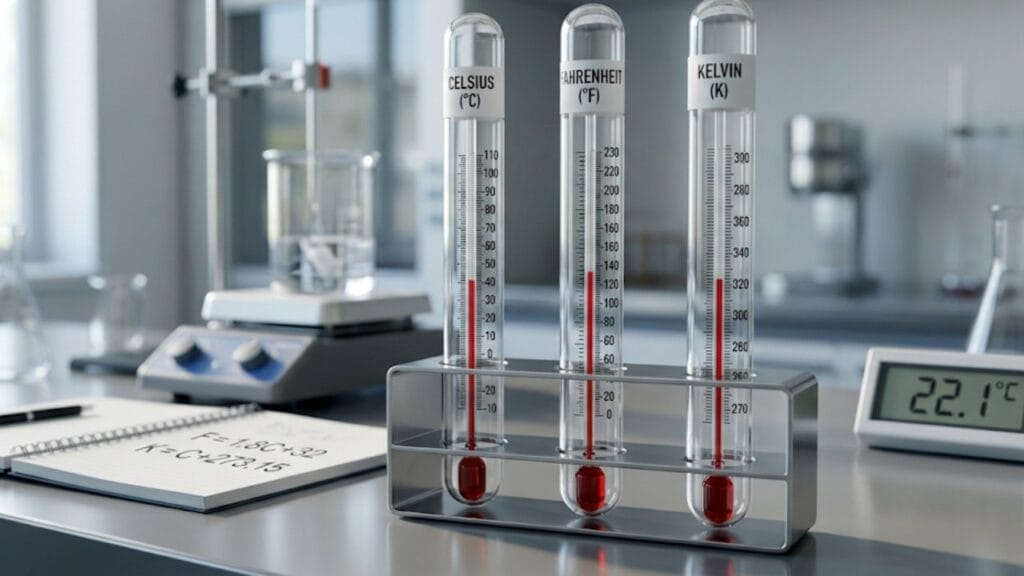
At some point, almost every physics student runs into the same annoying moment: a question gives temperature in Fahrenheit, but the formula needs Kelvin. Or a weather report says 95°F and you have absolutely no intuitive sense of whether that’s warm or dangerously hot in Celsius terms. Temperature conversion feels like a small, almost trivial skill, but it trips up more students than it should, mostly because the formulas get memorized without being understood.
This guide walks through the exact conversion formulas between Celsius, Fahrenheit and Kelvin, explains why they look the way they do and works through several solved examples so you can apply them confidently in both exams and daily life.
Why Three Different Scales Exist
Before jumping into formulas, it helps to understand why we even have three temperature scales in the first place. Celsius and Fahrenheit were both developed using practical reference points — the freezing and boiling points of water, or in Fahrenheit’s case, a mix of reference solutions used at the time. Kelvin, on the other hand, was developed later as a scientific necessity, anchored to absolute zero rather than any specific substance’s behavior.
A deeper look at what temperature actually represents at the particle level is covered in [What Is Temperature in Physics? Scales, Measurement & How Thermometers Work], which is worth reading if you want the conceptual background behind these numbers.
The Conversion Formulas
Here are the three core formulas you’ll need, along with what each variable represents.
Celsius to Fahrenheit
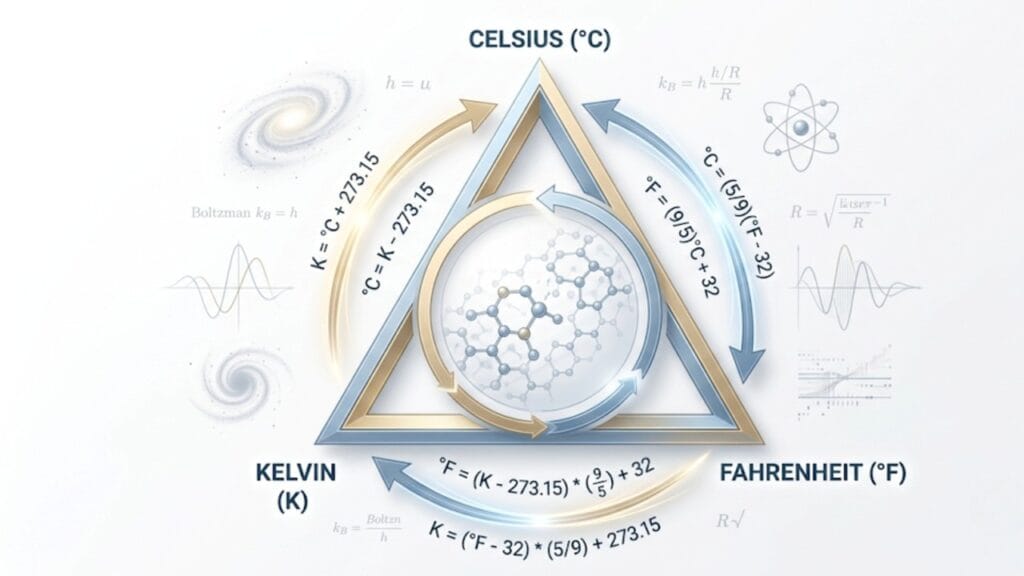
\( F = \frac{9}{5}C + 32 \)
Fahrenheit to Celsius
\( C = \frac{5}{9}(F – 32) \)
Celsius to Kelvin
\( K = C + 273.15 \)
Kelvin to Celsius
\( C = K – 273.15 \)
Fahrenheit to Kelvin
\( K = \frac{5}{9}(F – 32) + 273.15 \)
Kelvin to Fahrenheit
\( F = \frac{9}{5}(K – 273.15) + 32 \)
Where:
- \( C \) = temperature in Celsius
- \( F \) = temperature in Fahrenheit
- \( K \) = temperature in Kelvin
Important note: Celsius and Kelvin conversions only involve addition or subtraction because both scales use the same size of “degree.” Fahrenheit conversions require multiplication because Fahrenheit divides the same temperature range into more, smaller units.
Quick Reference Table
| From → To | Formula |
| Celsius → Fahrenheit | \( F = \frac{9}{5}C + 32 \) |
| Fahrenheit → Celsius | \( C = \frac{5}{9}(F – 32) \) |
| Celsius → Kelvin | \( K = C + 273.15 \) |
| Kelvin → Celsius | \( C = K – 273.15 \) |
| Fahrenheit → Kelvin | \( K = \frac{5}{9}(F – 32) + 273.15 \) |
| Kelvin → Fahrenheit | \( F = \frac{9}{5}(K – 273.15) + 32 \) |
For a broader comparison of all three scales, including historical origins and reference points, see [Celsius vs Fahrenheit vs Kelvin: 7 Key Differences with Conversion Table].
Solved Examples
Formulas only really make sense once you’ve worked through a few numbers yourself, so let’s go through several common scenarios.
Example 1: Converting Body Temperature (Celsius to Fahrenheit)
Normal human body temperature is approximately 37°C. Convert this to Fahrenheit.
\( F = \frac{9}{5}(37) + 32 \)
\( F = 66.6 + 32 = 98.6°F \)
This matches the commonly known figure of 98.6°F, which is a nice way to confirm the formula is being applied correctly.
Example 2: Converting a Hot Day (Fahrenheit to Celsius)
A weather report shows 104°F. What is this in Celsius?
\( C = \frac{5}{9}(104 – 32) \)
\( C = \frac{5}{9}(72) = 40°C \)
That’s a genuinely hot day by most standards and converting it helps put the number into more familiar terms for someone used to Celsius.
Example 3: Converting Room Temperature (Celsius to Kelvin)
A physics lab records room temperature as 25°C. Convert this to Kelvin.
\( K = 25 + 273.15 = 298.15 \, K \)
This kind of conversion shows up constantly in gas law calculations and thermodynamics problems, where Kelvin is mandatory for the math to work correctly.
Example 4: Converting a Scientific Reading (Kelvin to Celsius)
An experiment measures a sample at 310 K. What is this temperature in Celsius?
\( C = 310 – 273.15 = 36.85°C \)
That’s just slightly below normal human body temperature, useful context if the sample were, say, a biological specimen.
Example 5: Converting Directly (Fahrenheit to Kelvin)
An industrial furnace reads 500°F. Find the equivalent temperature in Kelvin.
\( K = \frac{5}{9}(500 – 32) + 273.15 \)
\( K = \frac{5}{9}(468) + 273.15 = 260 + 273.15 = 533.15 \, K \)
This kind of three-scale conversion often appears in engineering contexts where instruments and standards use different scales.
A Simple Table for Quick Reference
For students who just need common values without recalculating every time, this table can save a lot of effort during revision.
| Celsius (°C) | Fahrenheit (°F) | Kelvin (K) |
| 0 | 32 | 273.15 |
| 10 | 50 | 283.15 |
| 20 | 68 | 293.15 |
| 25 | 77 | 298.15 |
| 37 | 98.6 | 310.15 |
| 100 | 212 | 373.15 |
Common Mistakes Students Make
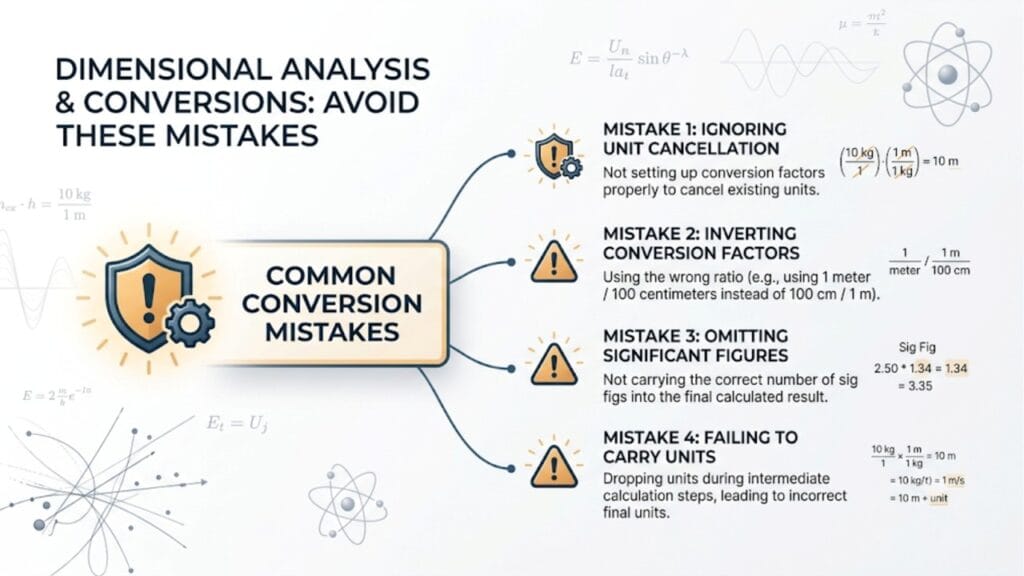
- Forgetting the order of operations in Fahrenheit conversions. Subtracting 32 must happen before multiplying by 5/9, not after.
- Mixing up which scale requires 273.15 versus 273. For most classroom purposes, 273 is used as an approximation, but 273.15 is the precise scientific value.
- Using Celsius or Fahrenheit directly in physics formulas that require Kelvin. Many formulas involving gas laws and radiation strictly require Kelvin, since they rely on an absolute scale starting from true zero.
- Assuming the size of a “degree” is the same across all three scales. Celsius and Kelvin share identical degree sizes, but Fahrenheit degrees are smaller, which is exactly why its formula involves a 9/5 or 5/9 multiplier.
If you tend to lose marks on these small but costly slips, [Top 5 Mistakes Students Make in Heat & Calorimetry Problems (And How to Fix Them)] covers several related numerical pitfalls worth reviewing alongside this topic.
Why Accurate Conversion Matters
Temperature conversion isn’t just an exam skill — it shows up in real engineering and scientific work constantly. International collaborations often mix scales depending on which country’s data or instruments are being used, weather forecasting services need to serve audiences using different systems and scientific formulas almost universally demand Kelvin regardless of what scale the raw data came in. A single conversion error in a lab report or engineering calculation can lead to meaningfully wrong conclusions, so this isn’t a skill worth rushing through.
This foundational skill also supports later, more advanced calculations found in [How to Calculate Heat Absorbed or Released Using Q = mcΔT: Step-by-Step Guide], where using the correct temperature scale directly affects the accuracy of the final answer.
Conclusion
Converting between Celsius, Fahrenheit and Kelvin comes down to just a handful of formulas, but understanding why they’re structured the way they are makes them far easier to remember and apply correctly. Celsius and Kelvin share the same degree size, differing only by a fixed offset, while Fahrenheit requires a scaling factor because its degrees are smaller. With a bit of practice on solved examples like the ones above, these conversions become second nature rather than something to look up every time.
Frequently Asked Questions
What is the formula to convert Celsius to Fahrenheit?
The formula is \( F = \frac{9}{5}C + 32 \), where C is the temperature in Celsius.
How do you convert Kelvin to Celsius?
Subtract 273.15 from the Kelvin value: \( C = K – 273.15 \).
Why is Kelvin used instead of Celsius in most physics formulas?
Kelvin is an absolute scale starting at true zero particle motion, which many physics formulas, especially those involving gas laws and radiation, require for mathematical accuracy.
What is normal body temperature in Fahrenheit and Kelvin?
Normal body temperature of 37°C converts to approximately 98.6°F and 310.15 K.
Is there a direct formula to convert Fahrenheit to Kelvin?
Yes, the formula is \( K = \frac{5}{9}(F – 32) + 273.15 \).
Why do Celsius and Kelvin conversions only involve addition or subtraction?
Because both scales use identical degree sizes, only their starting reference points differ, requiring just a fixed offset rather than a scaling factor.