

Introduction
Calorimetry problems have a reputation for being the section where students either feel completely confident or completely lost — there doesn’t seem to be much middle ground. And honestly, the reason is simple: the underlying idea is genuinely straightforward, but the setup of equations feels intimidating until you’ve done it a few times.
At its heart, calorimetry relies on one elegant principle — heat lost by a hotter substance equals heat gained by a colder one, assuming no energy escapes to the surroundings. This article walks through the method of mixtures step by step, works through several solved examples of increasing complexity and highlights the mistakes that most commonly trip students up.
The Core Principle: Conservation of Heat Energy
Calorimetry is built on a simple application of the law of conservation of energy. When two substances at different temperatures are mixed inside an insulated container, heat flows from the hotter substance to the colder one until both reach a common final temperature — known as the equilibrium temperature.
Assuming no heat is lost to the surroundings:
Heat lost by the hotter substance = Heat gained by the colder substance
This principle rests on the definitions covered in [What Is Heat, Thermal Energy & Temperature in Physics? Definitions, Formulas & Real-Life Examples], where heat is described as energy flowing due to a temperature difference — calorimetry is really just this idea applied to a closed system.
The Formula Behind Method of Mixtures
For two substances mixed together, the general form of the calorimetry equation is:
\( m_1 c_1 (T_1 – T_f) = m_2 c_2 (T_f – T_2) \)
Where:
- \( m_1, m_2 \) = masses of the hot and cold substances
- \( c_1, c_2 \) = specific heat capacities of the hot and cold substances
- \( T_1 \) = initial temperature of the hotter substance
- \( T_2 \) = initial temperature of the colder substance
- \( T_f \) = final equilibrium temperature
This formula is really just the \( Q = mc\Delta T \) equation applied twice — once for the substance losing heat, once for the substance gaining it — and set equal to each other. A refresher on that base formula is available in [How to Calculate Heat Absorbed or Released Using Q = mcΔT: Step-by-Step Guide].
Step-by-Step Method for Solving Calorimetry Problems
- Identify which substance is hotter and which is colder. This tells you which side of the equation each mass and temperature belongs to.
- List known values clearly — masses, specific heat capacities and initial temperatures.
- Set up the equation using heat lost equals heat gained.
- Solve for the unknown, whether that’s final temperature, an unknown mass, or an unknown specific heat capacity.
- Sanity check your answer. The final equilibrium temperature must always lie between the two initial temperatures — if it doesn’t, something has gone wrong in the setup.
Important note: If specific heat capacities are identical (like when mixing two quantities of water), they cancel out of the equation entirely, simplifying the algebra significantly.
Solved Examples
Example 1: Mixing Two Quantities of Water
200 g of water at 90°C is mixed with 300 g of water at 10°C. Find the final equilibrium temperature.
Since both are water, specific heat capacity cancels out:
\( m_1 (T_1 – T_f) = m_2 (T_f – T_2) \)
\( 0.2 (90 – T_f) = 0.3 (T_f – 10) \)
\( 18 – 0.2T_f = 0.3T_f – 3 \)
\( 21 = 0.5T_f \)
\( T_f = 42°C \)
Notice the final temperature lands closer to the larger mass’s original temperature — a pattern worth remembering for quick sanity checks.
Example 2: Mixing Water With a Metal Object
A 500 g block of aluminium at 200°C is dropped into 1 kg of water at 25°C. Find the final equilibrium temperature. (Specific heat capacity of aluminium = 900 J/kg·K, water = 4200 J/kg·K)
\( m_1 c_1 (T_1 – T_f) = m_2 c_2 (T_f – T_2) \)
\( 0.5 \times 900 \times (200 – T_f) = 1 \times 4200 \times (T_f – 25) \)
\( 450(200 – T_f) = 4200(T_f – 25) \)
\( 90000 – 450T_f = 4200T_f – 105000 \)
\( 195000 = 4650T_f \)
\( T_f \approx 41.9°C \)
Notice how little the final temperature shifted toward the metal’s original temperature, despite it starting at a much higher value. This happens because water’s specific heat capacity is so much greater than aluminium’s, meaning water resists temperature change far more strongly.
Example 3: Finding an Unknown Specific Heat Capacity
A 250 g unknown metal at 150°C is placed into 500 g of water at 20°C. The final equilibrium temperature is measured as 25°C. Find the specific heat capacity of the metal. (Specific heat capacity of water = 4200 J/kg·K)
\( m_1 c_1 (T_1 – T_f) = m_2 c_2 (T_f – T_2) \)
\( 0.25 \times c_1 \times (150 – 25) = 0.5 \times 4200 \times (25 – 20) \)
\( 0.25 \times c_1 \times 125 = 2100 \times 5 \)
\( 31.25 \, c_1 = 10500 \)
\( c_1 = 336 \, J/kg \cdot K \)
This kind of reverse calculation is a common exam favorite, since it tests whether students truly understand the structure of the equation rather than just plugging numbers mechanically.
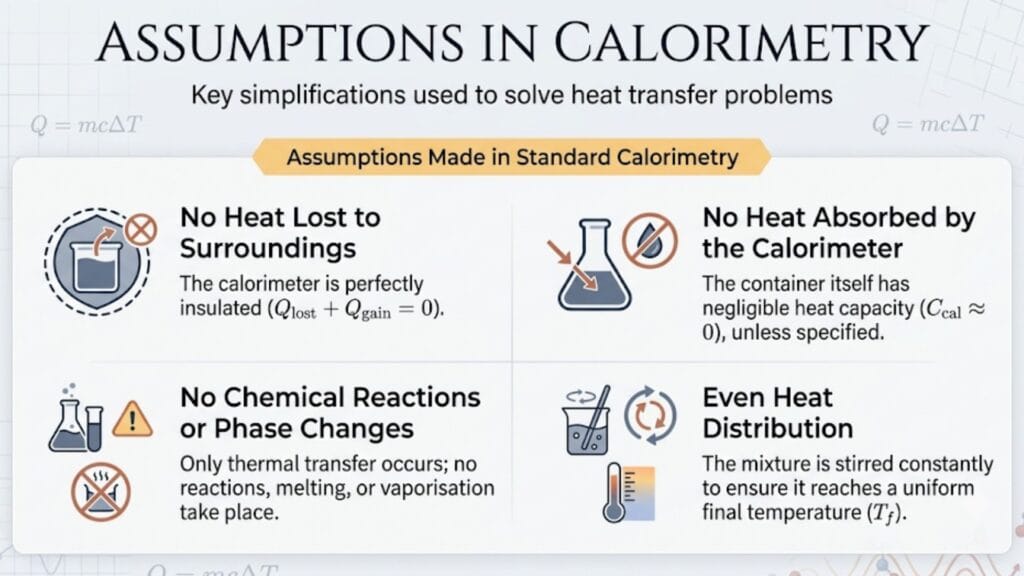
Assumptions Made in Calorimetry Problems
Most introductory calorimetry problems rely on a few simplifying assumptions worth keeping in mind:
- No heat is lost to the surroundings — the system is treated as perfectly insulated.
- The container itself absorbs no heat, unless the problem specifically mentions the calorimeter’s own heat capacity, in which case it must be included in the equation.
- No phase change occurs during mixing, unless explicitly stated. If ice is involved, latent heat must be factored in, as explained in [Latent Heat Explained: Latent Heat of Fusion & Vaporisation with Derivations].
- Specific heat capacities remain constant across the temperature range involved.
Common Mistakes Students Make
- Mixing up which substance is hotter and which is colder in the equation setup, leading to a sign error.
- Forgetting to convert grams to kilograms before applying specific heat capacity values, since standard values are given per kilogram.
- Ignoring the calorimeter’s own heat absorption when the problem specifically provides this detail.
- Not sanity-checking the final temperature. If your calculated equilibrium temperature falls outside the range of the two initial temperatures, there’s definitely an error somewhere in the setup.
A broader review of these frequent slip-ups is available in [Top 5 Mistakes Students Make in Heat & Calorimetry Problems (And How to Fix Them)].
Why Calorimetry Matters Beyond the Classroom
Calorimetry isn’t just an academic exercise — it’s the basis for measuring the energy content of food, testing fuel efficiency and even studying chemical reactions in laboratories. The method of mixtures specifically is used in countless practical scenarios, from industrial cooling systems to everyday cooking, where understanding how heat redistributes between substances has real, tangible consequences.
For students preparing for board or competitive exams, mastering this topic also builds directly toward broader revision material like [Thermal Properties of Matter for JEE Main: Key Concepts, Formulas & PYQs] and [NEET Physics: Temperature & Heat – Important Topics, MCQs & Revision Notes].
Conclusion
The method of mixtures might look intimidating with all its subscripts and multiple variables, but it really boils down to one clean idea: heat lost equals heat gained, as long as the system stays insulated. Once you get comfortable identifying which substance is losing heat and which is gaining it, setting up the equation becomes a fairly mechanical process. Practice a handful of problems like the ones above and calorimetry stops being the intimidating section it’s often made out to be.
Frequently Asked Questions
1. What is the basic principle behind calorimetry? Calorimetry relies on the principle that heat lost by a hotter substance equals heat gained by a colder substance, assuming no heat escapes to the surroundings.
2. What is the formula for the method of mixtures? The general formula is \( m_1 c_1 (T_1 – T_f) = m_2 c_2 (T_f – T_2) \), where subscripts 1 and 2 represent the hotter and colder substances respectively.
3. Does the calorimeter itself affect the calculation? Yes, if the problem specifies the calorimeter’s own heat capacity, it must be included in the equation, since the container also absorbs some heat during the process.
4. What happens if ice is involved in a calorimetry problem? If a phase change occurs, latent heat must be included in addition to the standard Q = mcΔT calculation, since temperature remains constant during melting or freezing.
5. How can I check if my calorimetry answer is correct? The final equilibrium temperature should always fall between the initial temperatures of the two substances involved — if it doesn’t, there’s an error in the setup.
6. Why does mixing water with a metal often result in a temperature closer to water’s original value? Water has a much higher specific heat capacity than most metals, meaning it resists temperature change more strongly and pulls the equilibrium temperature closer to its own starting point.