

Introduction
Ask ten people what “heat” means and you’ll probably get ten slightly different answers. Some will say it’s something you feel on a hot day. Others will say it’s the opposite of cold. Both answers are fine for daily life, but in physics, heat, thermal energy and temperature are three distinct ideas that often get mixed up — even by students who’ve studied the chapter twice.
This confusion isn’t really anyone’s fault. In everyday language we use these words interchangeably. “It’s so hot today” really means the temperature is high. But physics demands precision and once you understand the actual definitions, an entire branch of science — thermodynamics — starts making a lot more sense. This article breaks down what heat, thermal energy and temperature actually mean at the molecular level, gives you the exact formulas involved and walks through real-world examples so the concepts stick.
Understanding Thermal Energy: The Foundation
Every object is made of atoms and molecules and these particles are never truly still. They vibrate, rotate and move around constantly — even in a solid block of iron sitting on your table. This ceaseless microscopic motion carries energy and the sum total of all this kinetic and potential energy stored within the particles of a substance is called thermal energy.
Here’s the key idea worth remembering: thermal energy is an internal property of matter. It exists inside the object, tied to the motion of its particles, regardless of whether that object is interacting with anything else. A cup of coffee sitting untouched still has thermal energy simply because its molecules are jiggling around.
Why Thermal Energy Matters
Thermal energy is what actually gets transferred when we talk about “heat.” Without particle motion, there is no thermal energy and without thermal energy, there is nothing to transfer as heat. This is the starting point for [Zeroth Law of Thermodynamics: Statement, Significance & Connection to Temperature], which formalizes how thermal equilibrium works between objects.
What Is Heat, Really?
This is where most textbooks get too abstract too quickly, so let’s keep it simple.
Heat is the energy that flows from a hotter object to a colder object because of a temperature difference.
Notice the wording carefully — heat is not something an object “has.” It’s not a stored quantity sitting inside a body. Heat is energy in transit. Once that transfer stops, we stop calling it heat. The energy that arrived simply becomes part of the object’s internal (thermal) energy.
Think of it like money being transferred between two bank accounts. While it’s moving, you might call it a “transaction.” Once it lands in the account, it’s just balance. Heat works the same way — it’s the transaction, not the balance.
Heat is measured in joules (J) in the SI system, though calories are still commonly used, especially in nutrition and chemistry contexts.
The Formula for Heat
The amount of heat absorbed or released by a substance is calculated using:
\( Q = mc\Delta T \)
Where:
- \( Q \) = heat energy transferred (in joules)
- \( m \) = mass of the substance (in kg)
- \( c \) = specific heat capacity of the substance (J/kg·K)
- \( \Delta T \) = change in temperature (final minus initial)
This formula is genuinely one of the most useful equations in all of thermal physics and if you want a complete walkthrough with worked examples, check out [How to Calculate Heat Absorbed or Released Using Q = mcΔT: Step-by-Step Guide].
Important note: \( c \), the specific heat capacity, is different for every material. Water has an unusually high specific heat capacity, which is exactly why it takes so long to boil a full pot but heats up a metal spoon left inside almost instantly.
What Is Temperature, Then?
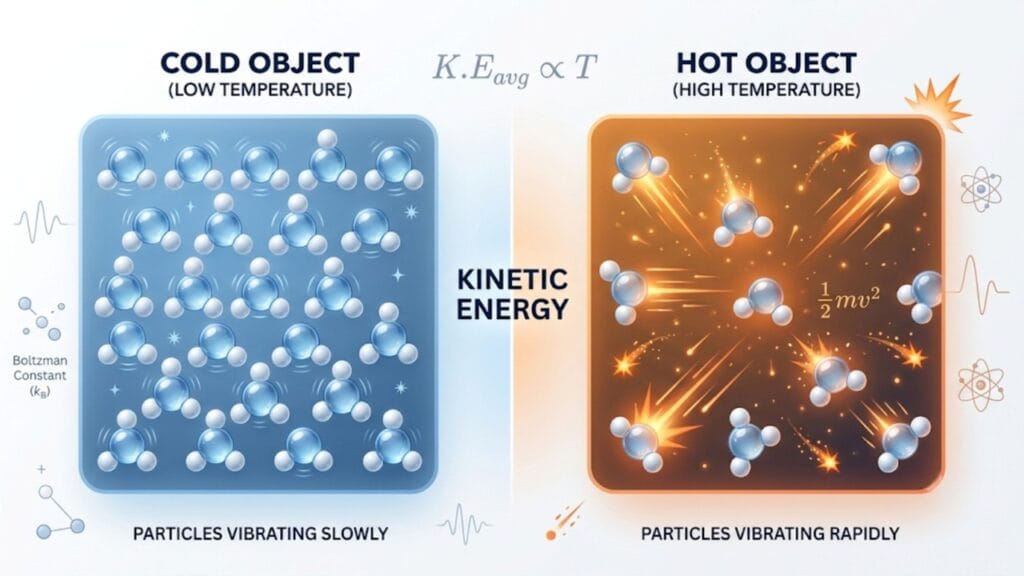
If heat is energy in motion, temperature is a measure of how fast, on average, the particles of a substance are moving.
More precisely, temperature reflects the average kinetic energy of the particles in a system. It doesn’t tell you how much total thermal energy an object has — it only tells you the intensity of molecular motion.
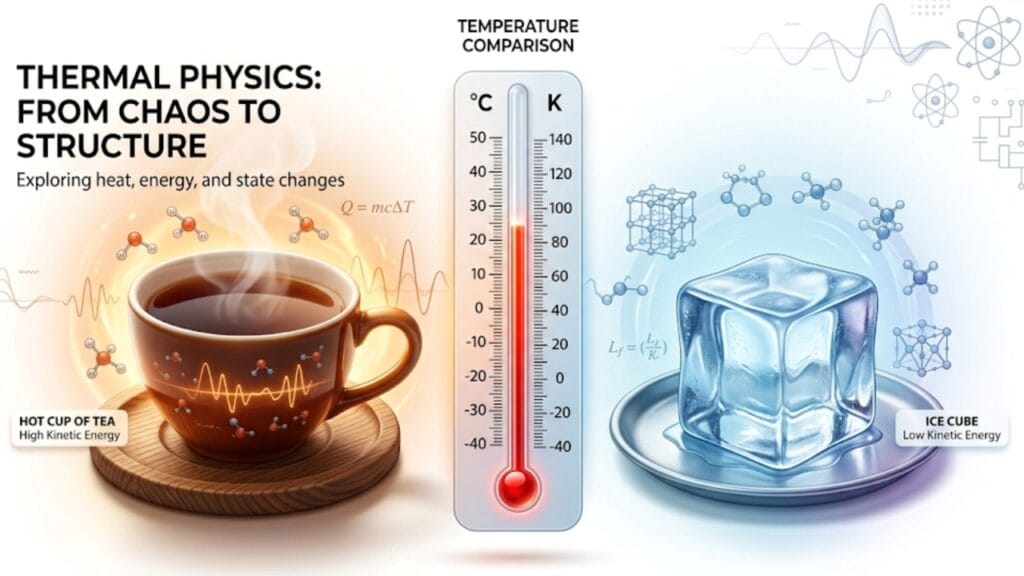
This distinction matters enormously. A cup of tea at 90°C has far less total thermal energy than an entire swimming pool at 30°C, even though the tea feels much hotter. The pool simply has vastly more molecules contributing to its total energy, even if each individual molecule, on average, is moving slower than a molecule in the tea.
For a full breakdown of how temperature is defined, measured and scaled, see [What Is Temperature in Physics? Scales, Measurement & How Thermometers Work].
Common Temperature Scales
| Scale | Symbol | Freezing Point of Water | Boiling Point of Water | Common Usage |
| Celsius | °C | 0°C | 100°C | Daily life, most countries |
| Fahrenheit | °F | 32°F | 212°F | United States |
| Kelvin | K | 273.15 K | 373.15 K | Scientific calculations |
Kelvin is the SI unit of temperature and the only scale where zero actually means “no molecular motion” — a concept called absolute zero. If you regularly need to switch between these scales, [How to Convert Between Celsius, Fahrenheit & Kelvin: Formula & Solved Examples] covers the exact conversion methods with practice problems.
Heat, Thermal Energy & Temperature — Side by Side
Putting all three together in one place makes the distinctions much clearer.
| Concept | What It Represents | SI Unit | Depends On |
| Thermal Energy | Total internal energy of particle motion | Joule (J) | Mass, temperature, material |
| Heat | Energy transferred due to temperature difference | Joule (J) | Temperature difference, mass, specific heat |
| Temperature | Average kinetic energy of particles | Kelvin (K) | Speed/intensity of particle motion only |
If you’re prepping for exams, this exact comparison shows up constantly and a more detailed breakdown is available in [Heat vs Temperature: Key Differences Every Physics Student Must Know].
Real-Life Examples That Make This Click
Sometimes formulas alone don’t help until you see them in action.
- Cooking on a stove — The flame provides heat energy. As this heat flows into the pan, the water’s temperature rises steadily until it reaches 100°C, where it starts changing state instead of temperature.
- A metal spoon in hot soup — The spoon has much less mass and lower specific heat capacity than the soup, so it reaches a high temperature quickly, even though it received far less total heat energy than the soup itself.
- Desert nights and days — Deserts get scorching hot during the day and freezing at night because sand has low specific heat capacity — it heats up and cools down rapidly compared to something like ocean water.
- Ice melting in your hand — Heat flows from your warmer hand into the colder ice. Your hand feels cold not because “cold” is flowing into you, but because heat is leaving your skin.
Common Misconceptions
- “Heat and temperature are the same thing.” They’re related but fundamentally different — one is energy in transit, the other is a measure of molecular intensity.
- “An object at a higher temperature always has more heat energy.” Not true. A small flame can be at a much higher temperature than a large lake, yet the lake stores enormously more total thermal energy.
- “Cold is a form of energy that flows into objects.” Cold isn’t an entity that transfers — it’s simply the absence or lower intensity of thermal energy. What actually happens is heat leaving the warmer object.
- “Zero on any temperature scale means zero energy.” Only true for the Kelvin scale. Zero degrees Celsius or Fahrenheit does not mean molecules have stopped moving.
Why This Topic Matters
Understanding the difference between heat, thermal energy and temperature isn’t just an academic exercise — it’s foundational to nearly every chapter that follows in thermal physics. Concepts like [Specific Heat Capacity vs Heat Capacity: Definition, Differences, Formula & Calorimetry Problems], calorimetry problems, thermal expansion and even engine efficiency calculations all build directly on these three definitions. Get this wrong at the start and confusion tends to snowball through the entire unit.
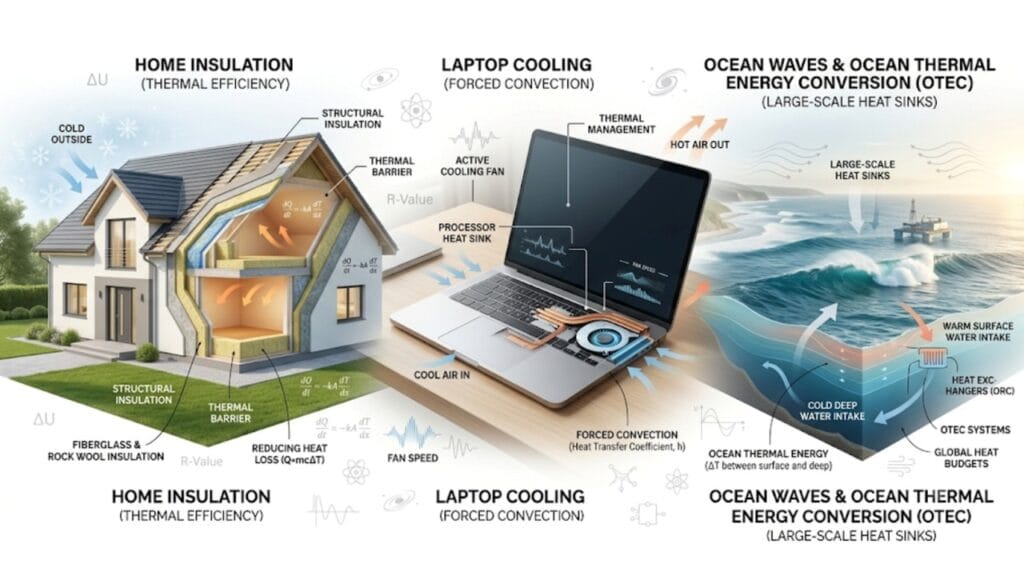
Beyond exams, this knowledge shows up everywhere — from designing better insulation for buildings, to understanding why your laptop has a cooling fan, to figuring out how weather patterns form based on how land and water absorb heat differently.
Conclusion
Heat, thermal energy and temperature might sound like three words describing the same warm feeling, but physics treats them as separate, precisely defined quantities. Thermal energy is the internal energy stored in a substance’s particle motion. Heat is the energy that flows between objects because of a temperature difference. And temperature is simply a measure of how intensely those particles are moving on average.
Once this distinction is clear, formulas like \( Q = mc\Delta T \) stop feeling like abstract symbols and start making intuitive sense. Keep these definitions sharp and the rest of thermodynamics — from calorimetry to thermal expansion — becomes far easier to follow.
Frequently Asked Questions
1. What is the main difference between heat and temperature?
Heat is energy transferred between objects due to a temperature difference, measured in joules. Temperature is a measure of the average kinetic energy of particles, measured in Kelvin, Celsius, or Fahrenheit.
2. Can an object have a high temperature but low thermal energy?
Yes. A lit matchstick can reach a very high temperature but contains very little total thermal energy because its mass is so small.
3. Why does water take longer to heat up than metal?
Water has a much higher specific heat capacity than most metals, meaning it needs more heat energy to achieve the same rise in temperature.
4. Is thermal energy the same as internal energy?
They are closely related. Thermal energy generally refers to the kinetic part of internal energy, while total internal energy may also include potential energy from molecular bonds.
5. What unit is heat measured in?
Heat is measured in joules (J) in the SI system, though calories are also commonly used in chemistry and nutrition contexts.
6. Why do we use Kelvin instead of Celsius in physics formulas?
Kelvin starts from absolute zero, the point where particle motion theoretically stops, making it essential for formulas involving direct proportionality to molecular kinetic energy.