

Introduction
If there’s one question that trips up almost every student in their first thermodynamics class, it’s this: aren’t heat and temperature basically the same thing? It’s a fair question, honestly. In everyday conversation, we use them interchangeably all the time — “the heat is unbearable today” really just means the temperature is high. But in physics, treating these two as identical is one of the most common sources of confusion and it tends to show up as silly mistakes in exams even when students clearly understand the underlying concepts.
The good news is that once the difference clicks, it clicks permanently. This article lays out exactly how heat and temperature differ, why the distinction matters and how to avoid the mix-ups that cost marks in calorimetry and thermodynamics problems.
Quick Definitions First
Before comparing the two, it helps to pin down what each term actually means on its own.
Heat is energy that flows from a hotter object to a colder one due to a temperature difference. It’s energy in transit — once the transfer stops, it’s no longer called heat.
Temperature is a measure of the average kinetic energy of particles in a substance. It tells you how intensely particles are moving, not how much total energy exists.
Both of these ideas are explored in more depth in [What Is Heat, Thermal Energy & Temperature in Physics? Definitions, Formulas & Real-Life Examples] and [What Is Temperature in Physics? Scales, Measurement & How Thermometers Work], which are worth reading first if these definitions still feel a bit abstract.
The Core Difference, Explained Simply
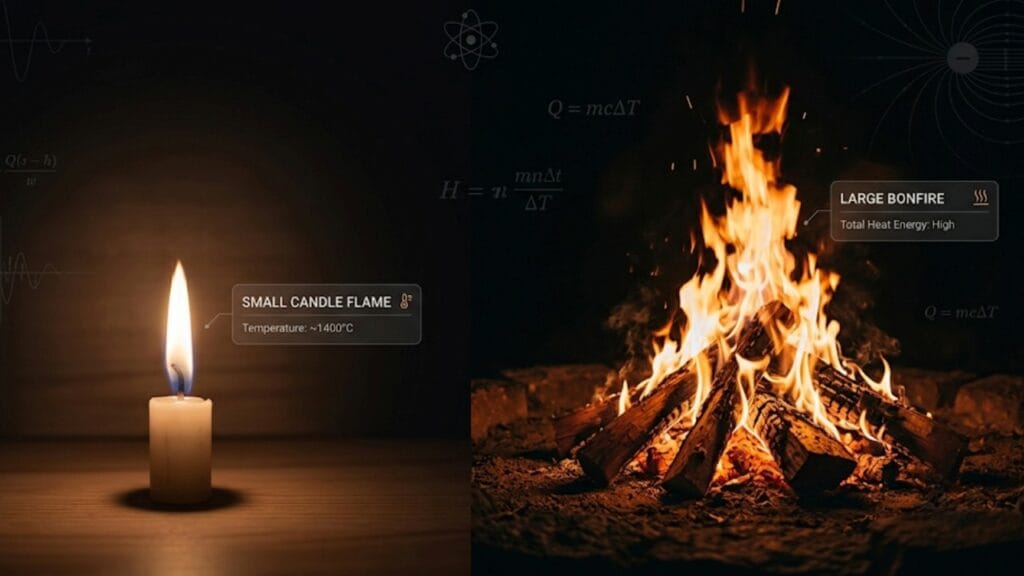
Here’s an analogy that tends to make this click for most students. Imagine two containers of water — a small teacup and a large bathtub — both sitting in the same warm room. Given enough time, the bathtub actually holds far more total thermal energy simply because it contains so much more water, even though both eventually reach the same temperature.
Now imagine boiling the teacup water on a stove until it reaches 100°C, while the bathtub sits at a comfortable 30°C. The teacup is at a much higher temperature, yet the bathtub still contains more total heat energy, purely because of its greater mass.
This is the essence of the difference: temperature is about intensity, heat is about quantity.
Table: Heat vs Temperature at a Glance
| Aspect | Heat | Temperature |
| Definition | Energy transferred due to temperature difference | Measure of average kinetic energy of particles |
| Nature | Energy in transit | A physical property/state |
| SI Unit | Joule (J) | Kelvin (K) |
| Depends On | Mass, specific heat capacity, temperature change | Speed/intensity of particle motion only |
| Measuring Instrument | Calorimeter | Thermometer |
| Can be zero? | Yes, when no transfer occurs | No, only zero at absolute zero (0 K) |
| Direction | Flows from hot to cold | No inherent direction; it’s a state, not a flow |
Why Mass Matters for Heat but Not for Temperature
This is honestly the single biggest source of confusion, so it deserves its own section.
Heat energy depends directly on mass. Double the mass of a substance and (all else equal) you roughly double the heat energy required to raise it by the same temperature change. This relationship is captured in the formula:
\( Q = mc\Delta T \)
Where:
- \( Q \) = heat energy (joules)
- \( m \) = mass (kg)
- \( c \) = specific heat capacity (J/kg·K)
- \( \Delta T \) = change in temperature (K or °C)
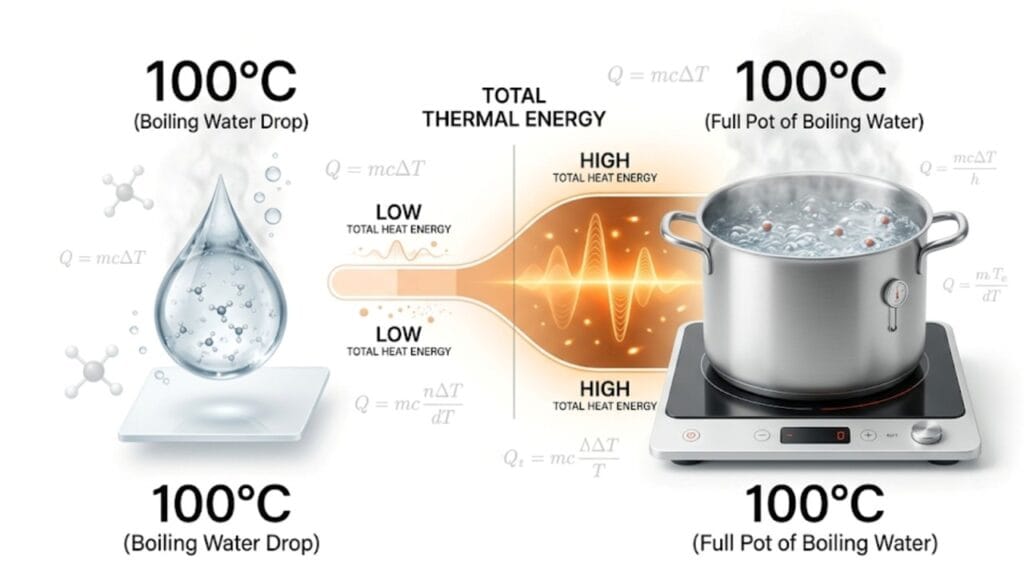
Temperature, on the other hand, has no direct dependence on mass in its definition. A single drop of boiling water and an entire pot of boiling water are both at 100°C — same temperature, wildly different heat content.
For a full walkthrough of applying this formula to numerical problems, see [How to Calculate Heat Absorbed or Released Using Q = mcΔT: Step-by-Step Guide].
Specific Heat Capacity: Where the Two Concepts Meet
Specific heat capacity is the bridge that connects heat and temperature mathematically. It tells you how much heat energy is required to raise the temperature of one kilogram of a substance by one degree Celsius (or Kelvin).
Different materials need very different amounts of heat to achieve the same temperature rise. Water, for instance, has an unusually high specific heat capacity compared to metals, which is exactly why coastal regions experience milder temperature swings than desert regions — water resists rapid temperature change far better than sand or rock.
This concept gets its own detailed treatment in [Specific Heat Capacity vs Heat Capacity: Definition, Differences, Formula & Calorimetry Problems], including how it’s distinct from total heat capacity of an object.
How Instruments Measure Each Quantity Differently
It’s worth noting that heat and temperature aren’t even measured using the same instruments, which reinforces just how different they are conceptually.
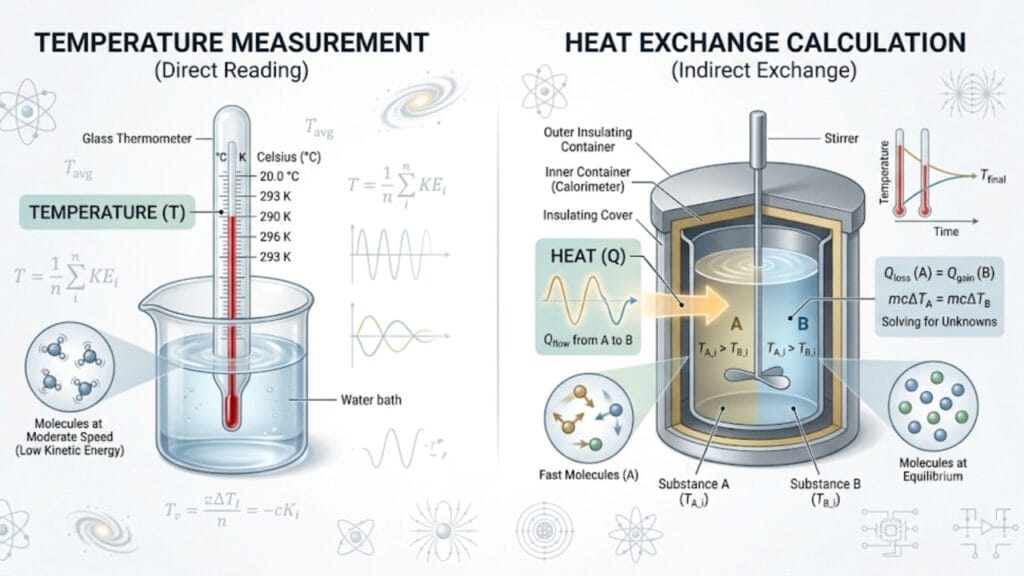
- Temperature is measured directly using a thermometer, which detects a physical property like liquid expansion, electrical resistance, or radiated infrared energy.
- Heat is measured indirectly, typically using a calorimeter, by observing the temperature change of a known mass of substance (often water) and applying \( Q = mc\Delta T \).
This is precisely why calorimetry experiments always involve careful temperature readings before and after mixing substances — the heat exchanged is calculated, not read off directly. If you want to strengthen your grip on this method, [How to Solve Calorimetry Problems: Method of Mixtures with Solved Examples] is a great next step.
Common Misconceptions Students Should Avoid
- “Higher temperature always means more heat energy.” False. Total heat energy depends on mass and specific heat capacity too, not just temperature.
- “Heat is stored inside objects.” Not quite. What’s stored is thermal energy; heat specifically refers to energy while it’s being transferred.
- “Adding heat always raises temperature.” Not always true — during a phase change, like ice melting or water boiling, heat is absorbed without any change in temperature at all. This is explained further in [Latent Heat Explained: Latent Heat of Fusion & Vaporisation with Derivations].
- “Objects at the same temperature must contain equal heat energy.” Only true if they also have identical mass and specific heat capacity.
Why This Distinction Matters for Exams and Real Understanding
This is one of those topics where a shaky understanding creates a domino effect. Calorimetry problems, thermal expansion, latent heat and even engineering applications like [Thermal Stress and Thermal Strain: Concept, Formula & Engineering Applications] all rely on students correctly distinguishing between the two quantities before applying any formula.
Students preparing for competitive exams often lose marks not because they don’t know the formula, but because they misidentify which variable represents heat and which represents temperature in a word problem. This exact issue is addressed in [Top 5 Mistakes Students Make in Heat & Calorimetry Problems (And How to Fix Them)], which is worth a look if you want to avoid the most frequent traps.
Conclusion
Heat and temperature might seem interchangeable in daily conversation, but in physics, they represent fundamentally different ideas. Heat is energy on the move, dependent on mass and material, while temperature is a measure of how intensely particles are vibrating, entirely independent of quantity. Once this distinction becomes second nature, an entire category of thermodynamics problems — calorimetry, specific heat, latent heat — becomes noticeably easier to approach with confidence.
Frequently Asked Questions
Is heat the same as temperature?
No. Heat is energy transferred due to a temperature difference, while temperature measures the average kinetic energy of particles. They are related but distinct physical quantities.
Can two objects have the same temperature but different amounts of heat energy?
Yes. Heat energy also depends on mass and specific heat capacity, so two objects at the same temperature can hold very different amounts of total heat energy.
What instrument measures heat and what instrument measures temperature?
Temperature is measured directly with a thermometer. Heat is calculated indirectly using a calorimeter along with the formula \( Q = mc\Delta T \).
Does adding heat always increase temperature?
Not always. During a phase change, such as melting or boiling, heat is absorbed by the substance without any rise in temperature.
Why is specific heat capacity important in understanding heat and temperature?
It quantifies exactly how much heat energy is needed to raise a given mass of a substance by one degree, linking the two concepts mathematically.
What is the SI unit for heat and for temperature?
Heat is measured in joules (J), while temperature is measured in Kelvin (K) in the SI system.