

Introduction
Thermal physics has a reputation for being one of the more intimidating chapters in school and college physics, mostly because it throws a lot of new vocabulary at you all at once — heat, temperature, thermal energy, specific heat, latent heat, expansion, calorimetry. If you’re just starting out, it can feel like drowning in terms before you’ve even understood the basic picture.
This guide is meant to be the starting point. Instead of diving straight into formulas, we’ll build the whole topic up gradually — starting with what temperature and heat actually mean, moving through how they’re measured, how they behave in different materials and finally touching on where this knowledge shows up in daily life and exams. By the end, you should have a solid mental map of thermal physics, even if you’ve never studied it before.
Starting With the Basics: What Is Thermal Physics?
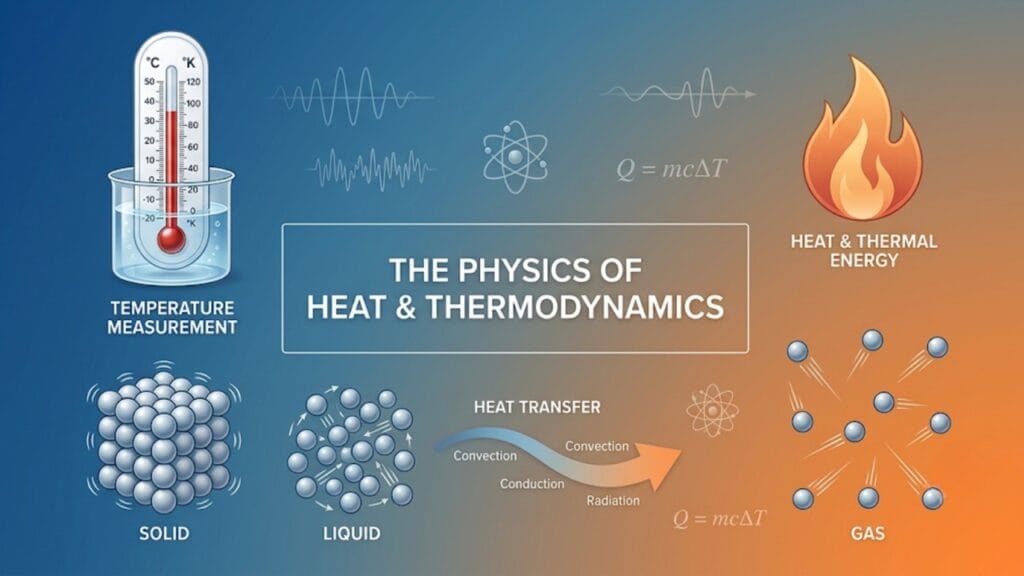
Thermal physics is the branch of physics dealing with heat, temperature and the behavior of matter as energy moves through it. At its core, it’s built on a simple idea: everything around us is made of particles that are constantly in motion and this motion carries energy.
The faster particles move, the more energy they carry and this shows up as what we perceive as “hot.” The slower they move, the “colder” something feels. This single idea — motion equals energy — is really the seed from which the entire subject grows.
Temperature: A Measure of Particle Motion
Temperature tells you how intensely, on average, particles in a substance are moving. It doesn’t measure total energy — just intensity. A deeper explanation of this, along with formal definitions, is available in [What Is Temperature in Physics? Scales, Measurement & How Thermometers Work].
Temperature is measured using instruments like thermometers and it’s expressed using scales such as Celsius, Fahrenheit and Kelvin — each with its own reference points, covered in detail in [Celsius vs Fahrenheit vs Kelvin: 7 Key Differences with Conversion Table].
Heat: Energy on the Move
Heat, unlike temperature, refers to energy actually flowing between objects because of a temperature difference. It’s not something an object permanently holds — it’s energy in transit, moving from something hotter to something colder until both reach the same temperature.
If this distinction feels blurry, [Heat vs Temperature: Key Differences Every Physics Student Must Know] breaks it down with clear comparisons and examples that should clear up any lingering confusion.
The Fundamental Formula: Q = mcΔT
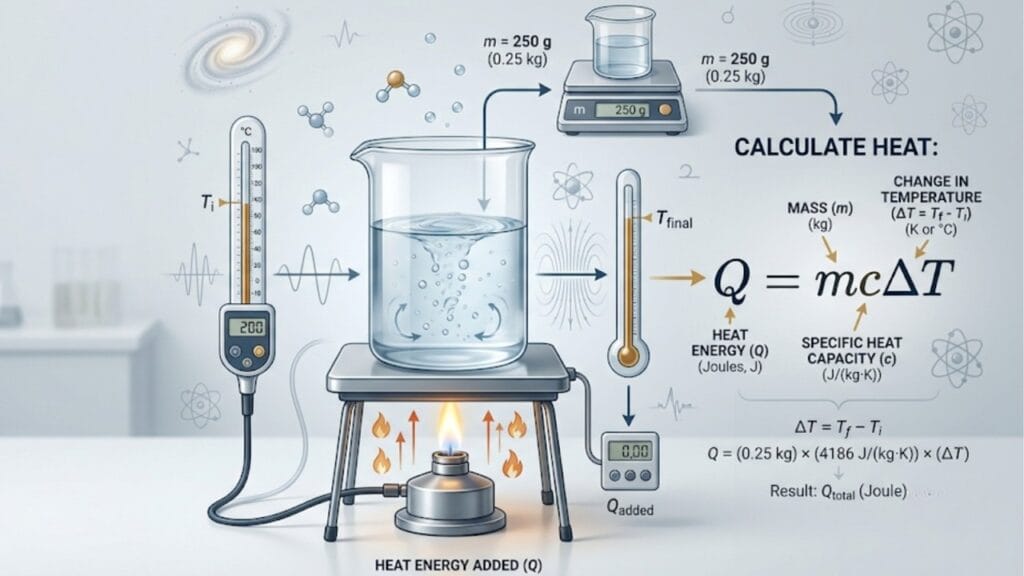
Once you understand heat and temperature separately, the next natural step is learning how to calculate the amount of heat involved in a temperature change. This is done using:
\( Q = mc\Delta T \)
Where:
- \( Q \) = heat energy absorbed or released (joules)
- \( m \) = mass of the object (kg)
- \( c \) = specific heat capacity of the material (J/kg·K)
- \( \Delta T \) = change in temperature (K or °C)
This formula essentially says: the amount of heat needed depends on how much material you have, what it’s made of and how much you want its temperature to change. A full worked walkthrough is available in [How to Calculate Heat Absorbed or Released Using Q = mcΔT: Step-by-Step Guide].
Quick example: Heating 2 kg of water from 20°C to 40°C with a specific heat capacity of 4200 J/kg·K would require:
\( Q = 2 \times 4200 \times 20 = 168000 \, J \)
That’s 168 kilojoules just to warm a couple of kilograms of water by 20 degrees — a good reminder of just how much energy water can absorb compared to many other substances.
Specific Heat Capacity: Why Materials Heat Up Differently
Not all substances respond to heat the same way. Specific heat capacity tells us how much energy is required to raise one kilogram of a substance by one degree. Water has a notably high specific heat capacity, which is why oceans and lakes moderate nearby climates so effectively, while metals like iron heat up and cool down much faster.
This concept is explored more thoroughly in [Specific Heat Capacity vs Heat Capacity: Definition, Differences, Formula & Calorimetry Problems], which also distinguishes it from the related but different idea of total heat capacity.
What Happens When Materials Are Heated: Expansion
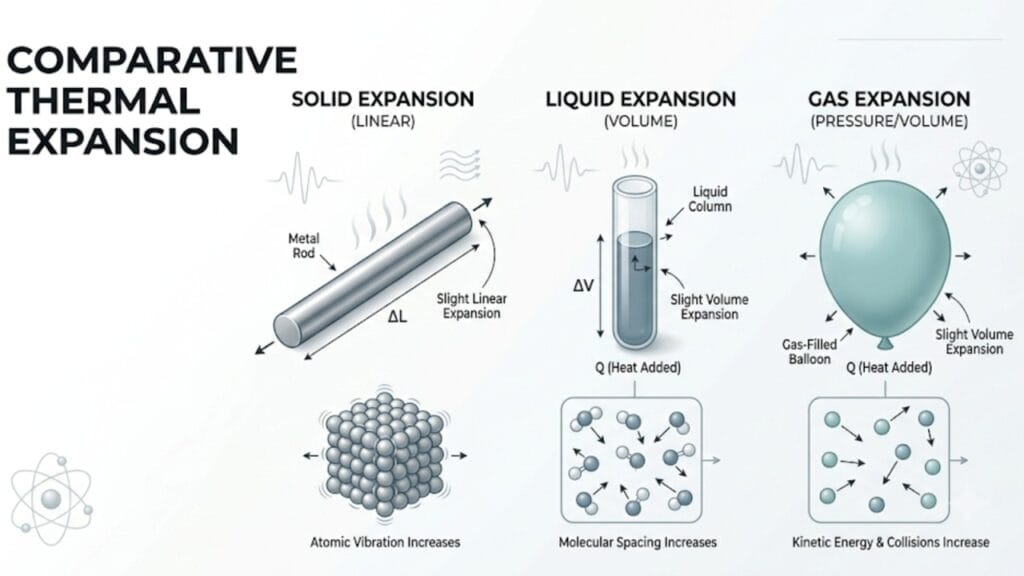
Heating substances doesn’t just raise their temperature — it often changes their physical dimensions too. Most solids, liquids and gases expand when heated, because increased particle motion pushes them slightly further apart on average.
| Material Type | Expansion Behavior | Example |
| Solids | Expand slightly in length/volume | Railway tracks leave gaps for expansion |
| Liquids | Expand more than solids for same heat | Mercury rising in a thermometer |
| Gases | Expand significantly, most sensitive to heat | Hot air balloons rising |
Interestingly, water breaks this pattern near freezing point, actually expanding as it cools between 4°C and 0°C — a phenomenon known as anomalous expansion, discussed fully in [Thermal Expansion of Solids, Liquids & Gases: Coefficients, Formulas, Solved Problems & Anomalous Expansion of Water]. This is also why ice floats instead of sinking, a detail that quietly makes aquatic life possible in frozen lakes.
For everyday examples of expansion you’ve probably noticed without realizing it, check out [10 Real-Life Examples of Thermal Expansion You See Every Day].
How Heat Travels: Conduction, Convection & Radiation
Heat doesn’t just appear — it moves from one place to another through three distinct mechanisms:
- Conduction — heat transfer through direct contact, common in solids like metal rods.
- Convection — heat transfer through the movement of fluids, like warm air rising or water circulating in a pot.
- Radiation — heat transfer through electromagnetic waves, requiring no medium at all, which is how the sun warms the Earth across empty space.
A full comparison of these three mechanisms, along with real-world applications of each, is available in [Types of Heat Transfer: Conduction, Convection & Radiation — Full Comparison].
Measuring Heat Exchange: Calorimetry
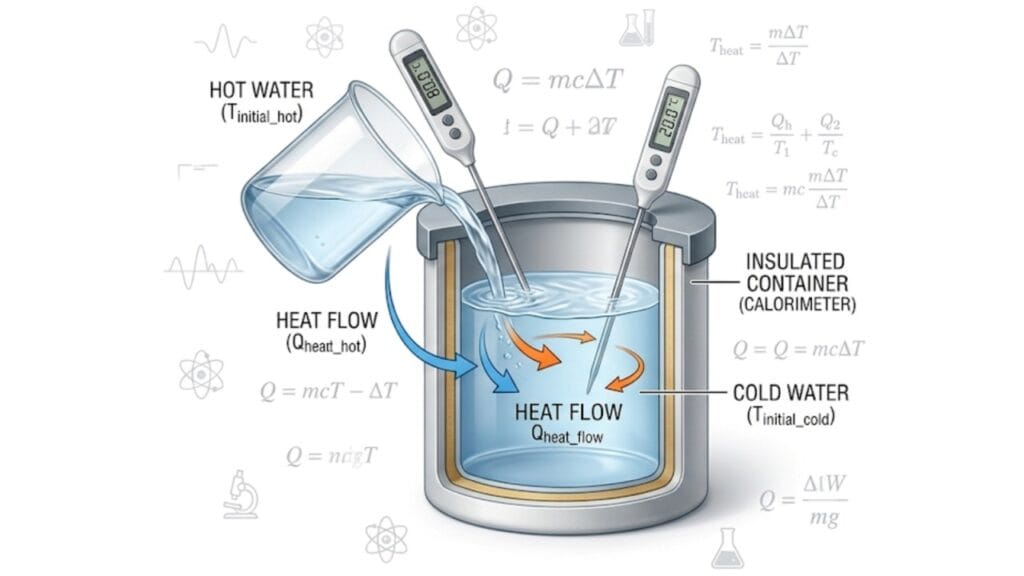
When two substances at different temperatures are mixed, heat flows from the hotter one to the colder one until both reach a common equilibrium temperature. This principle, known as the method of mixtures, forms the basis of calorimetry.
Note: In an ideal, isolated system, heat lost by the hotter substance equals heat gained by the colder one — this simple balance is the backbone of most calorimetry numerical problems.
If you want a structured method for solving these problems step by step, [How to Solve Calorimetry Problems: Method of Mixtures with Solved Examples] is an excellent next stop.
Common Misconceptions Beginners Should Avoid
- “Heat and temperature are interchangeable terms.” They aren’t — heat is energy in transit, temperature is a measure of particle motion intensity.
- “Objects at 0°C or 0°F have zero energy.” Only 0 Kelvin represents the theoretical absence of thermal motion.
- “Adding heat always raises temperature.” During phase changes, like melting or boiling, temperature stays constant even as heat is continuously absorbed.
- “All materials expand at the same rate when heated.” Expansion rates vary significantly depending on the material and its physical state.
Why This Foundation Matters
Thermal physics isn’t just an isolated chapter — it’s genuinely foundational to much of physics and engineering that follows. Concepts here directly feed into more advanced topics like [Newton’s Law of Cooling: Statement, Derivation, Graph & Applications], [Latent Heat Explained: Latent Heat of Fusion & Vaporisation with Derivations] and even engineering fields dealing with [Thermal Stress and Thermal Strain: Concept, Formula & Engineering Applications]. Students preparing for board exams or competitive tests will find this chapter referenced repeatedly, since it forms the base layer for [Class 11 Thermal Properties of Matter: NCERT Solutions & Summary Notes] and beyond.
Conclusion
Thermal physics starts with one simple idea — particles in motion carry energy — and builds outward from there into temperature scales, heat calculations, material expansion, heat transfer mechanisms and calorimetry. None of it needs to feel overwhelming once you see how each piece connects to the next. Take it one concept at a time, keep the heat-versus-temperature distinction clear in your mind and the rest of the chapter tends to fall into place naturally.
Frequently Asked Questions
1. What is the difference between heat and temperature for beginners?
Heat is energy transferred between objects due to a temperature difference, while temperature measures how intensely particles are moving on average. Heat is energy in motion; temperature is a state.
2. What is the basic formula used in thermal physics?
The most commonly used formula is \( Q = mc\Delta T \), which calculates heat energy based on mass, specific heat capacity and temperature change.
3. Why does water take longer to heat and cool than metal?
Water has a much higher specific heat capacity than most metals, meaning it requires more energy for the same temperature change and also releases heat more slowly.
4. What are the three modes of heat transfer?
Heat travels through conduction (direct contact), convection (fluid movement) and radiation (electromagnetic waves, no medium required).
5. Does temperature always rise when heat is added?
No. During a phase change such as melting or boiling, heat is absorbed by the substance without causing any change in temperature.
6. Why is thermal physics considered an important chapter for exams?
It forms the conceptual foundation for later topics like calorimetry, latent heat, thermal expansion and thermodynamics, making a clear understanding essential for tackling advanced problems confidently.