


Introduction
Every morning, someone somewhere checks a thermometer — a doctor checking a patient, a parent checking their sick child, a scientist checking a lab sample, or just you checking the weather app before stepping out. Temperature is one of those quantities we measure constantly without really thinking about what it means or how the instrument in our hand actually works.
But temperature isn’t as simple as “hot” or “cold.” In physics, it has a precise definition tied to the motion of particles, it’s measured on several different scales that don’t always agree with each other numerically and the devices we use to measure it rely on some surprisingly clever physical principles. This article walks through what temperature really is, the major scales used around the world and the science behind how thermometers actually detect and display it.
What Does Temperature Actually Mean?
In physics, temperature is defined as a measure of the average kinetic energy of the particles in a substance. When particles move faster, on average, the substance has a higher temperature. When they slow down, the temperature drops.
This is a subtly different idea from heat and the two get confused often. Temperature tells you how intensely particles are moving, not how much total energy a substance contains. A full breakdown of that distinction, along with the underlying definitions, is covered in [What Is Heat, Thermal Energy & Temperature in Physics? Definitions, Formulas & Real-Life Examples].
Temperature is also what determines the direction of heat flow. Two objects in contact will always exchange energy until their temperatures equalize — never the other way around. This idea is formalized in physics through the [Zeroth Law of Thermodynamics: Statement, Significance & Connection to Temperature], which essentially gives us the scientific permission to say two objects are at “the same temperature” in the first place.
Why We Need a Scale at All
Kinetic energy of particles isn’t something you can casually read off with your eyes. So physicists needed a practical, repeatable way to assign numbers to how hot or cold something is. That’s exactly what a temperature scale does — it gives us fixed reference points (like the freezing and boiling points of water) and divides the space between them into equal, meaningful units.
The Major Temperature Scales
There isn’t just one way to measure temperature. Different scales were developed in different regions and for different scientific purposes and honestly, once you understand the reference points each one uses, none of them feel random anymore.
Celsius Scale
The Celsius scale, developed by Anders Celsius, sets 0°C as the freezing point of water and 100°C as its boiling point at standard atmospheric pressure. It’s the most widely used scale globally, especially outside the United States.
Fahrenheit Scale
The Fahrenheit scale is mostly used in the United States. Water freezes at 32°F and boils at 212°F, which admittedly feels less intuitive at first glance — but the scale was originally designed around different reference points, including the freezing point of a brine solution.
Kelvin Scale
The Kelvin scale is the SI unit of temperature and the one used almost universally in scientific work. Its starting point, 0 K, is absolute zero — the theoretical temperature at which particle motion reaches its minimum possible energy. Unlike Celsius or Fahrenheit, Kelvin has no negative values in physical reality, which makes it especially useful in formulas involving direct proportionality to kinetic energy.
Important note: The size of one Kelvin unit is identical to one Celsius degree. Only the starting point differs.
| Scale | Symbol | Freezing Point of Water | Boiling Point of Water | Absolute Zero |
| Celsius | °C | 0°C | 100°C | -273.15°C |
| Fahrenheit | °F | 32°F | 212°F | -459.67°F |
| Kelvin | K | 273.15 K | 373.15 K | 0 K |
If you frequently need to switch between these scales for numerical problems, [How to Convert Between Celsius, Fahrenheit & Kelvin: Formula & Solved Examples] walks through the exact conversion formulas with solved cases. A wider comparison of all three, including historical context, is also available in [Celsius vs Fahrenheit vs Kelvin: 7 Key Differences with Conversion Table].
Why Kelvin Is So Important in Physics
There’s a reason nearly every serious physics formula involving temperature uses Kelvin rather than Celsius or Fahrenheit. Kelvin is an absolute scale — it starts from a genuine physical zero rather than an arbitrary reference point like the freezing point of water.
This matters more than it sounds. A temperature of 200 K is genuinely twice as “energetic” at the particle level as 100 K. But 20°C is not twice as energetic as 10°C, because Celsius zero isn’t tied to zero particle motion at all — it’s just where water happens to freeze.
This is also why the [Triple Point of Water: Definition, Significance & Why It Defines the Kelvin Scale] holds such scientific importance. Rather than relying on approximate reference points, the modern Kelvin scale is fixed using the triple point of water, a single, extremely precise condition where solid, liquid and vapor phases of water coexist in equilibrium.
How Thermometers Actually Work
Now for the part most people never really think about — how does a thin glass tube or a small digital device actually figure out how hot something is?
Thermometers work by relying on a physical property that changes predictably with temperature. Different thermometer types use different properties, but the underlying logic is always the same: find something measurable that reacts consistently to temperature changes, then calibrate it against known reference points.
Types of Thermometers
| Thermometer Type | Physical Property Used | Common Use |
| Liquid-in-glass (mercury/alcohol) | Thermal expansion of liquid | Labs, older clinical thermometers |
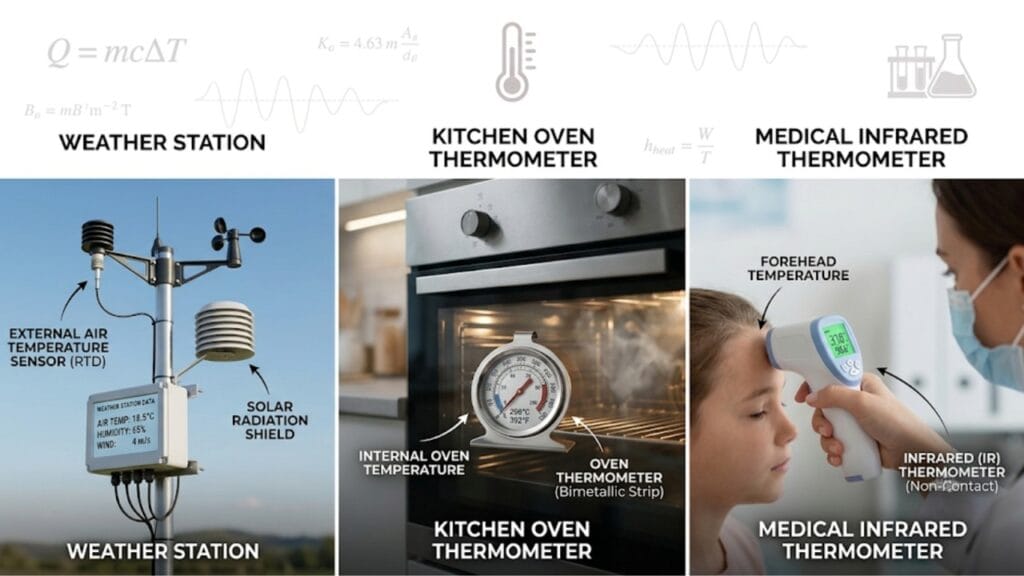
| Digital thermometer | Electrical resistance change | Homes, clinics |
| Thermocouple | Voltage generated between two metals | Industrial temperature sensing |
| Infrared thermometer | Radiated heat (infrared emission) | Contactless temperature checks |
| Gas thermometer | Pressure/volume change of gas | Precision scientific calibration |
Liquid-in-Glass Thermometers
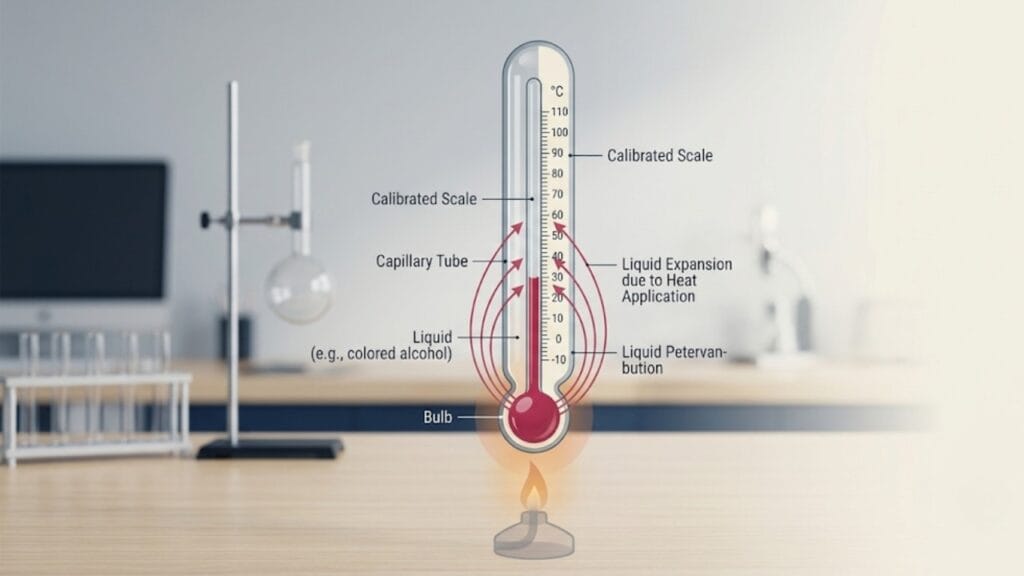
The classic mercury or alcohol thermometer works on a beautifully simple principle: liquids expand when heated and contract when cooled. As the liquid inside the sealed glass tube absorbs heat, it expands and rises up a narrow calibrated column. The scale printed alongside the tube was calibrated using known reference temperatures, like the freezing and boiling points of water.
This is a direct real-world application of [Thermal Expansion of Solids, Liquids & Gases: Coefficients, Formulas, Solved Problems & Anomalous Expansion of Water], since the entire mechanism depends on how reliably and predictably liquids expand with rising temperature.
Digital Thermometers
Digital thermometers typically use a component called a thermistor, whose electrical resistance changes in a very predictable way as temperature changes. A tiny circuit measures this resistance and converts it into a temperature reading almost instantly. This is why digital thermometers give results so quickly compared to older mercury versions, which needed time for the liquid to physically expand.
Infrared Thermometers
These don’t touch the object at all. Every object emits infrared radiation depending on its temperature and infrared thermometers detect this radiation and convert it into a temperature value. This is the same physical principle — though applied on a much larger and more theoretical scale — that underlies concepts like [Wien’s Displacement Law & Stefan-Boltzmann Law: Derivation & Blackbody Radiation], which describe how objects radiate energy based on temperature.
Common Misconceptions About Temperature
- “A thermometer measures heat.” It doesn’t. A thermometer measures temperature — the intensity of particle motion — not the total heat energy present in an object.
- “Negative temperatures mean negative energy.” On the Celsius or Fahrenheit scale, negative numbers are just points below an arbitrary zero. On the Kelvin scale, negative values don’t physically exist in ordinary matter.
- “All thermometers work the same way.” As shown above, different thermometers rely on entirely different physical properties — expansion, resistance, voltage, or radiation.
- “Body temperature is a fixed universal number.” It varies slightly by individual, time of day and measurement method (oral, ear, forehead), which is why slight variations from “normal” don’t always indicate illness.
Why This Topic Matters
Temperature measurement isn’t just a classroom topic — it underlies weather forecasting, cooking, medicine, industrial manufacturing, climate science and even space exploration. Engineers designing spacecraft heat shields, doctors monitoring patients and chefs calibrating ovens are all relying on the same fundamental physics discussed here.
For students, this topic also forms the base for later chapters like [Newton’s Law of Cooling: Statement, Derivation, Graph & Applications] and calorimetry, where accurate temperature measurement becomes essential to solving numerical problems correctly.
Conclusion
Temperature is far more than a number on a screen or a mercury column — it’s a direct window into how energetically particles are moving inside a substance. Understanding the different scales, especially why Kelvin holds such scientific importance and knowing how various thermometers translate invisible molecular motion into a readable number, gives you a much deeper appreciation for something we usually take for granted. Next time you glance at a thermometer, you’ll know there’s real physics happening behind that number.
Frequently Asked Questions
What is the SI unit of temperature?
The SI unit of temperature is the Kelvin (K), which is an absolute scale starting from absolute zero.
Why does Kelvin not have negative values?
Kelvin is based on absolute zero, the theoretical lowest possible temperature where particle motion reaches its minimum, so ordinary matter cannot go below 0 K.
How does a mercury thermometer measure temperature?
It relies on the thermal expansion of mercury, which rises predictably up a calibrated glass tube as temperature increases.
Is Celsius or Fahrenheit more scientifically accurate?
Neither is more “accurate” than the other; they are simply different scales with different reference points. Kelvin is preferred in scientific formulas because it’s an absolute scale.
How do infrared thermometers measure temperature without touching an object?
They detect the infrared radiation naturally emitted by objects and convert the intensity of that radiation into a temperature reading.
What is the triple point of water and why does it matter for temperature scales?
The triple point of water is the precise condition where its solid, liquid and gas phases coexist simultaneously and it is used to define the Kelvin scale with extreme accuracy.