

Introduction
Unit conversion is one of those skills that sounds simple on paper but trips up students at the worst possible moments — right in the middle of a numerical problem during an exam. You have the formula right, the values ready and then suddenly you realize the speed is in km/h but everything else is in SI units. That one mismatch can unravel the entire solution.
This guide breaks down unit conversion in physics from first principles. Whether you are a Class 11 student tackling mechanics for the first time or someone preparing for JEE or NEET, this step-by-step explanation with solved examples will make the process feel natural and reliable.
What Is Unit Conversion and Why Does It Matter?
Every physical quantity has two parts: a numerical value and a unit. When you say an object is moving at 72 km/h, neither “72” alone nor “km/h” alone tells the full story. Both pieces together form a complete, meaningful measurement.
Unit conversion is the process of expressing the same physical quantity in a different unit without changing its actual value. The magnitude changes, but the physical reality does not. 72 km/h and 20 m/s describe the exact same motion.
This matters enormously in physics because:
- Equations only work when all quantities share consistent units
- Comparing results across experiments requires a common unit system
- Errors in unit conversion are among the most common causes of wrong answers in competitive exams
Learn more about What Are Units of Measurement? A Complete Beginner’s Guide to Physics
The Core Principle: Multiplication by 1
Here is the cleanest way to think about unit conversion. Every conversion factor is mathematically equal to 1. When you multiply a quantity by a conversion factor, you are multiplying by 1 — so the actual value does not change, only its representation does.
For example, since \( 1 \text{ km} = 1000 \text{ m} \), you can write:
\[ \frac{1000 \text{ m}}{1 \text{ km}} = 1 \]
Multiplying any distance in kilometres by this fraction converts it to metres without changing the physical distance.
This is the foundation of the factor-label method, also called dimensional analysis applied to conversion.
Learn more about Dimensional Analysis Made Easy: Method, Rules and Practice Problems
Step-by-Step Method for Unit Conversion
Step 1: Identify the Given Unit and the Target Unit
Write down clearly what unit you are starting from and what unit you need to reach.
Example: Convert 5 km to metres.
- Given unit: km
- Target unit: m
Step 2: Write the Appropriate Conversion Factor
Look up or recall the relationship between the two units.
\[ 1 \text{ km} = 1000 \text{ m} \]
Step 3: Set Up the Fraction So Unwanted Units Cancel
Write the conversion factor as a fraction. Place the unwanted unit in the denominator so it cancels with the numerator of your original quantity.
\[ 5 \text{ km} \times \frac{1000 \text{ m}}{1 \text{ km}} \]
Step 4: Cancel Units and Multiply
\[ 5 \times 1000 \text{ m} = 5000 \text{ m} \]
The km units cancel. You are left with metres.
Step 5: Check Your Answer for Reasonableness
5 km is a reasonable walking distance. 5000 m is an equivalent way to say that. The answer makes sense.
Solved Examples: Unit Conversion in Physics
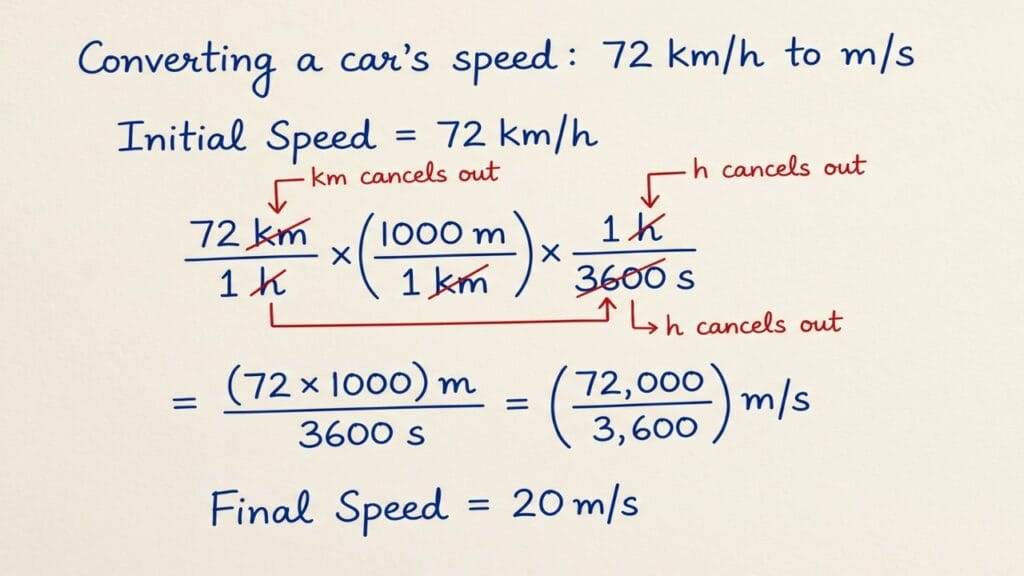
Example 1: Converting Speed — km/h to m/s
This is one of the most frequently tested conversions in physics.
Convert 72 km/h to m/s.
Solution:
We know:
- \( 1 \text{ km} = 1000 \text{ m} \)
- \( 1 \text{ hour} = 3600 \text{ s} \)
\[ 72 \frac{\text{km}}{\text{h}} \times \frac{1000 \text{ m}}{1 \text{ km}} \times \frac{1 \text{ h}}{3600 \text{ s}} \]
\[ = \frac{72 \times 1000}{3600} \frac{\text{m}}{\text{s}} = \frac{72000}{3600} = 20 \text{ m/s} \]
Quick trick: Divide km/h by 3.6 to get m/s. So \( 72 \div 3.6 = 20 \text{ m/s} \).
Example 2: Converting Area — cm² to m²
This catches many students off guard. When you square a length unit, you must square the conversion factor too.
Convert \( 500 \text{ cm}^2 \) to \( \text{m}^2 \).
Solution:
\[ 1 \text{ cm} = 10^{-2} \text{ m} \]
\[ 1 \text{ cm}^2 = (10^{-2})^2 \text{ m}^2 = 10^{-4} \text{ m}^2 \]
\[ 500 \text{ cm}^2 = 500 \times 10^{-4} \text{ m}^2 = 0.05 \text{ m}^2 \]
Example 3: Converting Density — g/cm³ to kg/m³
Density involves both mass and volume units simultaneously.
Convert \( 8.9 \text{ g/cm}^3 \) to \( \text{kg/m}^3 \) (density of copper).
Solution:
\[ 1 \text{ g} = 10^{-3} \text{ kg}, \quad 1 \text{ cm}^3 = 10^{-6} \text{ m}^3 \]
\[ 8.9 \frac{\text{g}}{\text{cm}^3} = 8.9 \times \frac{10^{-3} \text{ kg}}{10^{-6} \text{ m}^3} = 8.9 \times 10^{3} \frac{\text{kg}}{\text{m}^3} \]
\[ = 8900 \text{ kg/m}^3 \]
Example 4: Converting Energy — eV to Joules
Used heavily in modern physics, atomic physics and NEET/JEE problems.
Convert 13.6 eV to Joules.
Solution:
\[ 1 \text{ eV} = 1.6 \times 10^{-19} \text{ J} \]
\[ 13.6 \text{ eV} = 13.6 \times 1.6 \times 10^{-19} \text{ J} = 21.76 \times 10^{-19} \text{ J} \]
\[ = 2.176 \times 10^{-18} \text{ J} \]
Example 5: Multi-Step Conversion — Converting Gravitational Constant G
This is a classic example for students moving between CGS and SI systems.
The value of G in CGS is \( 6.67 \times 10^{-8} \text{ dyne cm}^2 \text{g}^{-2} \). Convert to SI units.
In SI, G is expressed in \( \text{N m}^2 \text{kg}^{-2} \).
Using:
- \( 1 \text{ dyne} = 10^{-5} \text{ N} \)
- \( 1 \text{ cm} = 10^{-2} \text{ m} \)
- \( 1 \text{ g} = 10^{-3} \text{ kg} \)
\[ G = 6.67 \times 10^{-8} \times \frac{10^{-5} \text{ N} \cdot (10^{-2} \text{ m})^2}{(10^{-3} \text{ kg})^2} \]
\[ = 6.67 \times 10^{-8} \times \frac{10^{-5} \times 10^{-4}}{10^{-6}} \text{ N m}^2 \text{kg}^{-2} \]
\[ = 6.67 \times 10^{-8} \times 10^{-3} \text{ N m}^2 \text{kg}^{-2} \]
\[ = 6.67 \times 10^{-11} \text{ N m}^2 \text{kg}^{-2} \]
This matches the standard SI value of G perfectly.
Common Unit Conversion Factors in Physics
| Conversion | Relationship |
| Length: 1 km to m | \( 1 \text{ km} = 1000 \text{ m} \) |
| Length: 1 cm to m | \( 1 \text{ cm} = 10^{-2} \text{ m} \) |
| Length: 1 Angstrom to m | \( 1 \text{ Å} = 10^{-10} \text{ m} \) |
| Length: 1 light year to m | \( 1 \text{ ly} \approx 9.46 \times 10^{15} \text{ m} \) |
| Mass: 1 kg to g | \( 1 \text{ kg} = 1000 \text{ g} \) |
| Mass: 1 u (atomic mass unit) to kg | \( 1 \text{ u} = 1.66 \times 10^{-27} \text{ kg} \) |
| Time: 1 hour to seconds | \( 1 \text{ h} = 3600 \text{ s} \) |
| Time: 1 year to seconds | \( 1 \text{ yr} \approx 3.15 \times 10^{7} \text{ s} \) |
| Energy: 1 eV to Joules | \( 1 \text{ eV} = 1.6 \times 10^{-19} \text{ J} \) |
| Force: 1 dyne to Newton | \( 1 \text{ dyne} = 10^{-5} \text{ N} \) |
| Pressure: 1 atm to Pascal | \( 1 \text{ atm} = 1.013 \times 10^5 \text{ Pa} \) |
| Speed: 1 km/h to m/s | Divide by 3.6 |
| Speed: 1 m/s to km/h | Multiply by 3.6 |
Converting Units Using Dimensional Analysis
The more powerful, exam-ready approach to unit conversion uses dimensional formulas. This is especially useful when converting a physical constant between two different systems.
The formula is:
\[ n_2 = n_1 \left[\frac{M_1}{M_2}\right]^a \left[\frac{L_1}{L_2}\right]^b \left[\frac{T_1}{T_2}\right]^c \]
Where:
- \( n_1 \) = numerical value in the original system
- \( n_2 \) = numerical value in the new system
- \( M_1, L_1, T_1 \) = units of mass, length, time in the original system
- \( M_2, L_2, T_2 \) = units of mass, length, time in the new system
- \( a, b, c \) = dimensional exponents of the quantity
Learn more about What Is Dimensional Formula? Derivation, Applications & Limitations
This method is elegant because you do not need to memorize every unit relation. As long as you know the dimensional formula of a quantity and the base unit sizes in each system, the conversion follows automatically.
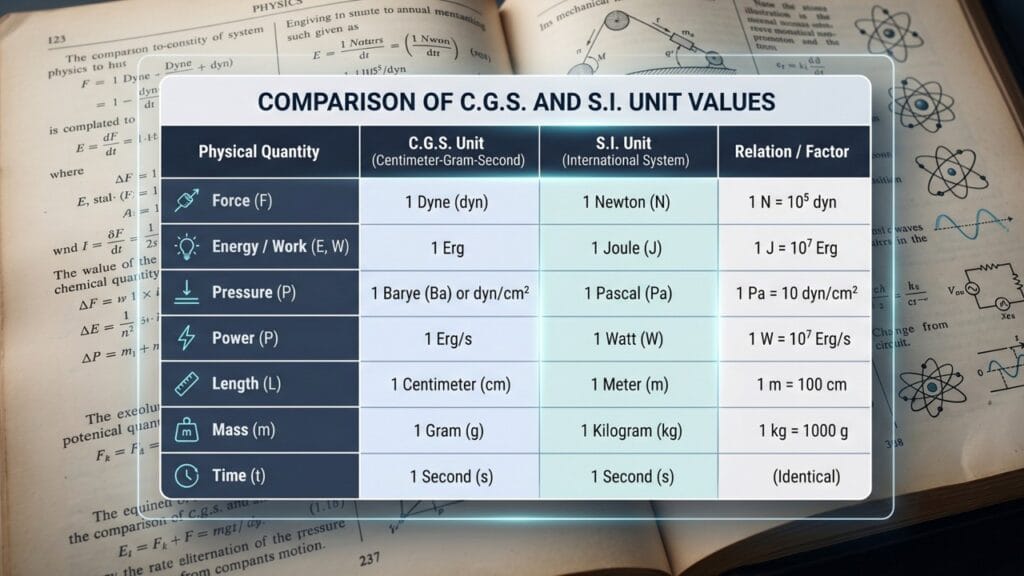
CGS vs SI: Knowing Which System You Are In
Many students struggle because physics problems sometimes appear in CGS and sometimes in SI. Mixing them up is a guaranteed error.
| Quantity | CGS Unit | SI Unit | Conversion |
| Length | centimetre (cm) | metre (m) | \( 1 \text{ m} = 100 \text{ cm} \) |
| Mass | gram (g) | kilogram (kg) | \( 1 \text{ kg} = 1000 \text{ g} \) |
| Time | second (s) | second (s) | Same |
| Force | dyne | Newton (N) | \( 1 \text{ N} = 10^5 \text{ dyne} \) |
| Energy | erg | Joule (J) | \( 1 \text{ J} = 10^7 \text{ erg} \) |
| Pressure | dyne/cm² | Pascal (Pa) | \( 1 \text{ Pa} = 10 \text{ dyne/cm}^2 \) |
Learn more about CGS vs MKS vs SI System: Differences, Comparison Table & Uses
Common Mistakes to Avoid
These are the errors that cost marks in exams. Knowing them helps you stay one step ahead.
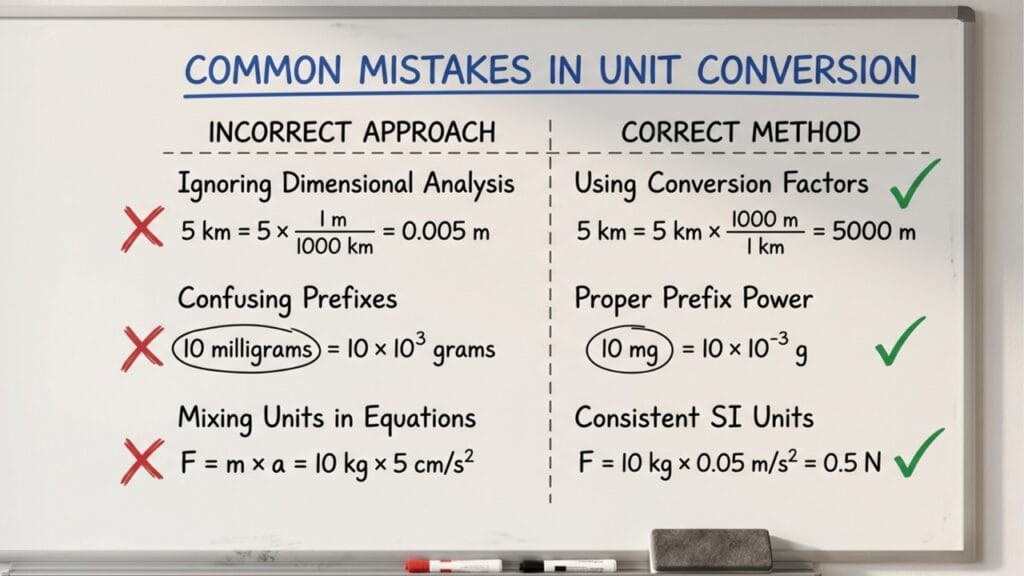
- Forgetting to square or cube the conversion factor for area and volume. If \( 1 \text{ m} = 100 \text{ cm} \), then \( 1 \text{ m}^3 = 10^6 \text{ cm}^3 \), not \( 100 \text{ cm}^3 \).
- Inverting the conversion fraction. The unit you want to eliminate must go in the denominator. If you flip it accidentally, your answer will be off by many orders of magnitude.
- Mixing unit systems mid-problem. Pick SI or CGS and stick with it throughout a problem. Never mix dyne with Newton or erg with Joule in the same equation.
- Ignoring significant figures after conversion. After converting, round your result to match the precision of the original data. This is important in error analysis and lab work.
- Using the km/h to m/s trick incorrectly. The factor of 3.6 works only for speed, not for acceleration or distance.
Learn more about How to Find Significant Figures: Rules, Examples & Common Mistakes
Why Unit Conversion is a Fundamental Physics Skill
Some students treat unit conversion as a procedural chore — something to get through before the “real” physics begins. That is the wrong way to look at it.
Unit conversion reflects something deep about physics: that the same physical reality can be described in many different mathematical representations and that changing the description does not change the reality.
When you convert correctly, you are demonstrating that you understand the structure of physical quantities — not just how to plug numbers into formulas. This understanding pays dividends across all of physics, from mechanics to thermodynamics to electromagnetism.
It also directly connects to measurement. Every measurement comes with a unit and the ability to translate between units is what makes data from different instruments and different countries comparable. Without this, doing science at a global level would be impossible.
Learn more about SI Units Explained: The 7 Base Units Every Physics Student Must Know
Quick Reference: SI Prefixes for Rapid Conversion
Knowing SI prefixes saves time and reduces reliance on memorized conversion tables.
| Prefix | Symbol | Power of 10 |
| Tera | T | \( 10^{12} \) |
| Giga | G | \( 10^{9} \) |
| Mega | M | \( 10^{6} \) |
| Kilo | k | \( 10^{3} \) |
| Hecto | h | \( 10^{2} \) |
| Deci | d | \( 10^{-1} \) |
| Centi | c | \( 10^{-2} \) |
| Milli | m | \( 10^{-3} \) |
| Micro | μ | \( 10^{-6} \) |
| Nano | n | \( 10^{-9} \) |
| Pico | p | \( 10^{-12} \) |
Once you internalize these, converting between units within the same system — say, milliamperes to amperes — becomes nearly instantaneous.
Conclusion
Unit conversion is not just arithmetic. It is a disciplined way of thinking about physical quantities — recognizing what a number means, what unit gives it context and how to translate that meaning across different measurement systems.
The core idea is simple: multiply by a conversion factor that equals 1. Get the unit arrangement right, let the unwanted units cancel and check your answer. That is the whole process.
Practice this enough and it becomes second nature. After a while, you will not even think about it — you will just see that 36 km/h is 10 m/s, that 1 g/cm³ is 1000 kg/m³ and that area conversions involve squaring the factor. That level of fluency is what separates students who lose marks on avoidable errors from those who do not.
Frequently Asked Questions
What is the easiest way to convert units in physics?
The simplest approach is the factor-label method: multiply your given quantity by a conversion fraction where the units you want to eliminate are in the denominator. Set it up so those units cancel and you are left with the target unit.
How do I convert km/h to m/s?
Divide the speed in km/h by 3.6 to get m/s. For example, 90 km/h = 90 ÷ 3.6 = 25 m/s. Alternatively, multiply by 1000 and divide by 3600, which simplifies to dividing by 3.6.
Why do I need to square the conversion factor for area?
Because area is a two-dimensional quantity — it involves length multiplied by length. If 1 m = 100 cm, then 1 m² = 100 cm × 100 cm = 10,000 cm² = \( 10^4 \) cm². Failing to square the factor is a common and costly mistake.
What is the difference between unit conversion and dimensional analysis?
Unit conversion is the practical process of changing a value from one unit to another. Dimensional analysis is a broader technique used to check the consistency of equations, derive formulas and perform conversions using dimensional formulas. Conversion is often one application of dimensional analysis.
How do I convert CGS units to SI units?
Identify the conversion factors for the base units involved (mass, length, time). Then apply these using the relation \( n_2 = n_1 \left[\frac{M_1}{M_2}\right]^a \left[\frac{L_1}{L_2}\right]^b \left[\frac{T_1}{T_2}\right]^c \), where a, b, c are the dimensional powers of the quantity being converted.
Is the conversion factor for kg to g the same as for kg/m³ to g/cm³?
No. For mass alone, 1 kg = 1000 g. But for density (kg/m³ to g/cm³), you must account for both mass and volume conversion. Since \( 1 \text{ kg/m}^3 = 10^{-3} \text{ g/cm}^3 \), the factor is 10⁻³, not 1000. Always treat derived unit conversions carefully.
Do unit conversion rules apply to vector quantities too?
Yes. Converting units for a vector quantity like velocity, force, or displacement follows the same rules. You convert the magnitude while keeping the direction unchanged. A displacement of 5 km north is exactly 5000 m north after conversion.
Leave a Comment