

Introduction
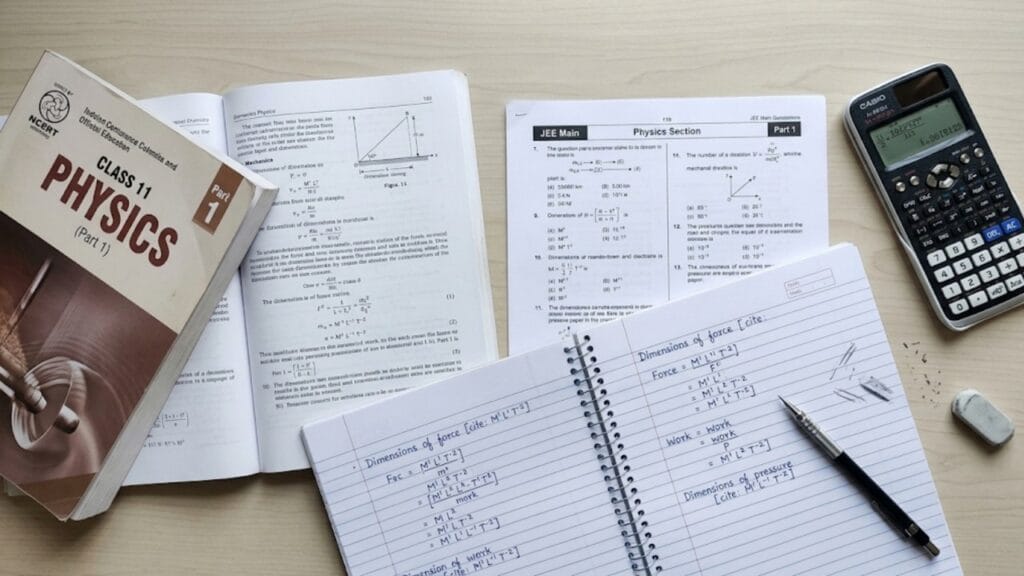
Units and Measurements is the opening chapter of Class 11 Physics — and for most students, it gets the least revision time before JEE Main. That is a mistake. Not because the chapter is heavily weighted by itself, but because the concepts in it thread through every other chapter in the syllabus. A dimensional analysis question can show up inside a mechanics problem. A significant figures rule can decide the correct option in a numerically identical set of four choices. An error propagation formula can appear inside a question nominally about optics or electricity.
This article covers everything you need from this chapter for JEE Main: the topics that actually get tested, all the formulas in ready-to-use form and a set of previous year questions with full solutions and the reasoning behind them. Work through this carefully once and you will not need to revisit the chapter separately again.
What JEE Main Actually Tests from This Chapter
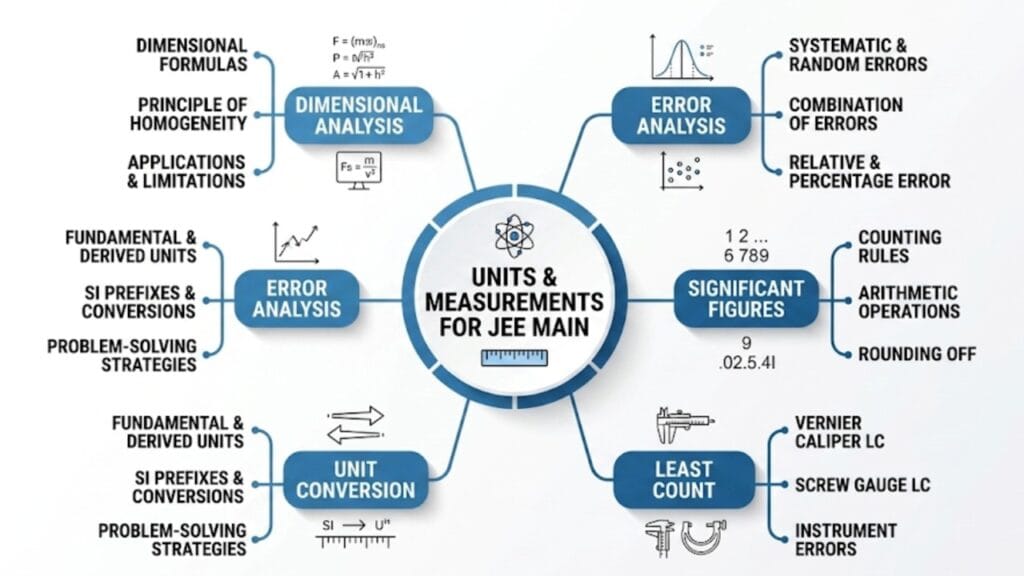
Before diving into content, it is worth being clear about what the exam actually asks. Units and Measurements typically contributes 1 to 2 questions in JEE Main. These questions almost never test rote recall. They test application — specifically:
- Dimensional analysis to verify or derive expressions
- Finding the dimensions of a physical constant given a formula
- Identifying a formula as dimensionally correct or incorrect
- Error propagation calculations (absolute, relative and percentage)
- Significant figures in computed results
- Conversion of a physical quantity between unit systems
- Least count and instrument reading problems
The chapter is small in marks but highly concept-dense. Every question from it is solvable in under two minutes if the underlying idea is clear. The goal here is to make every idea clear.
Important Topics for JEE Main
1. Dimensional Analysis
This is the highest-yield topic from this chapter in JEE Main. Expect at least one question directly or indirectly involving dimensions.
What to know:
- Dimensional formulas of all standard physical quantities (especially derived ones)
- The Principle of Dimensional Homogeneity
- Using dimensions to check equation validity
- Using dimensions to derive expressions (method of undetermined exponents)
- Converting physical quantities between unit systems using dimensional formulas
Frequently tested dimensional formulas:
| Physical Quantity | Dimensional Formula |
| Velocity | \( [LT^{-1}] \) |
| Acceleration | \( [LT^{-2}] \) |
| Force | \( [MLT^{-2}] \) |
| Work / Energy / Torque | \( [ML^2T^{-2}] \) |
| Power | \( [ML^2T^{-3}] \) |
| Momentum / Impulse | \( [MLT^{-1}] \) |
| Pressure / Stress / Modulus of Elasticity | \( [ML^{-1}T^{-2}] \) |
| Gravitational Constant G | \( [M^{-1}L^3T^{-2}] \) |
| Planck’s Constant h | \( [ML^2T^{-1}] \) |
| Boltzmann Constant k | \( [ML^2T^{-2}K^{-1}] \) |
| Universal Gas Constant R | \( [ML^2T^{-2}mol^{-1}K^{-1}] \) |
| Coefficient of Viscosity | \( [ML^{-1}T^{-1}] \) |
| Surface Tension | \( [MT^{-2}] \) |
| Angular Momentum | \( [ML^2T^{-1}] \) |
| Moment of Inertia | \( [ML^2] \) |
| Electric Charge | \( [AT] \) |
| Electric Field | \( [MLT^{-3}A^{-1}] \) |
| Magnetic Field (B) | \( [MT^{-2}A^{-1}] \) |
| Permittivity \( \varepsilon_0 \) | \( [M^{-1}L^{-3}T^4A^2] \) |
| Permeability \( \mu_0 \) | \( [MLT^{-2}A^{-2}] \) |
Learn more about What Is Dimensional Formula? Derivation, Applications & Limitations
2. Error Analysis
Error analysis generates reliable JEE questions because the rules are precise and the calculations are testable. There is no room for vagueness here — either you know the propagation rules or you do not.
Types of error:
- Absolute Error: \( \Delta x = |x{\text{measured}} – x{\text{true}}| \)
- Mean Absolute Error: \( \overline{\Delta x} = \frac{\sum |\Delta x_i|}{n} \)
- Relative Error: \( \frac{\overline{\Delta x}}{\bar{x}} \)
- Percentage Error: \( \frac{\overline{\Delta x}}{\bar{x}} \times 100\% \)
Error propagation rules — these are the ones that appear in JEE:
For \( Z = A + B \) or \( Z = A – B \):
\[ \Delta Z = \Delta A + \Delta B \]
For \( Z = A \times B \) or \( Z = \frac{A}{B} \):
\[ \frac{\Delta Z}{Z} = \frac{\Delta A}{A} + \frac{\Delta B}{B} \]
For \( Z = A^n \):
\[ \frac{\Delta Z}{Z} = n \cdot \frac{\Delta A}{A} \]
For \( Z = \frac{A^p \cdot B^q}{C^r} \):
\[ \frac{\Delta Z}{Z} = p\frac{\Delta A}{A} + q\frac{\Delta B}{B} + r\frac{\Delta C}{C} \]
This last formula is the general case. Every error propagation question in JEE reduces to an application of this.
Learn more about Absolute Error, Relative Error and Percentage Error: A Complete Guide
Learn more about Propagation of Errors in Physics Calculations: Rules, Formulas & Examples
3. Significant Figures
Significant figures questions in JEE Main are usually straightforward — they test whether you can correctly round a computed result or identify how many significant figures a given number carries. The rules are fixed; there is no interpretation required.
Rules to remember for JEE:
- All non-zero digits are significant
- Captive zeros (between non-zero digits) are significant
- Leading zeros are never significant
- Trailing zeros after a decimal point are significant
- For multiplication and division: round to the fewest significant figures among inputs
- For addition and subtraction: round to the fewest decimal places among inputs
One specific JEE trap: Addition and subtraction use decimal places, not significant figures. This distinction is tested directly.
Learn more about How to Find Significant Figures: Rules, Examples & Common Mistakes
4. Least Count and Instrument Reading
Questions on Vernier calipers and screw gauges appear regularly. They either ask for the least count given the scale specifications, or ask you to read a described instrument configuration and find the correct measurement including zero error correction.
Formulas:
\[ \text{LC of Vernier Caliper} = \frac{1 \text{ MSD}}{\text{No. of VSD}} = 1 \text{ MSD} – 1 \text{ VSD} \]
\[ \text{LC of Screw Gauge} = \frac{\text{Pitch}}{\text{No. of circular scale divisions}} \]
\[ \text{Total Reading (Vernier)} = \text{MSR} + (\text{VSR} \times \text{LC}) – \text{Zero Error} \]
\[ \text{Total Reading (Screw Gauge)} = \text{Sleeve Reading} + (\text{CSR} \times \text{LC}) – \text{Zero Error} \]
Learn more about Least Count of Vernier Caliper and Screw Gauge: Formula & Calculation
5. Unit Conversion Using Dimensional Analysis
This combines two skills: knowing the dimensional formula of a quantity and applying the conversion formula between unit systems. JEE uses this to test whether you can move the value of a physical constant from one system to another.
\[ n_2 = n_1 \left[\frac{M_1}{M_2}\right]^a \left[\frac{L_1}{L_2}\right]^b \left[\frac{T_1}{T_2}\right]^c \]
Where a, b, c are the dimensional exponents of mass, length and time in the dimensional formula of the given quantity.
Learn more about How to Convert Units in Physics: Step-by-Step with Solved Examples
All Formulas at a Glance
This table consolidates every formula from this chapter that has appeared in JEE Main or is likely to appear. Pin this or write it out — it covers the entire quantitative side of the chapter.
| Formula | What It Gives |
| \( \text{LC} = \frac{1 \text{ MSD}}{n_{\text{VSD}}} \) | Least count of Vernier caliper |
| \( \text{LC} = \frac{\text{Pitch}}{n_{\text{CSD}}} \) | Least count of screw gauge |
| \( \text{Reading} = \text{MSR} + \text{VSR} \times \text{LC} \) | Vernier caliper total reading |
| \( \text{Reading} = \text{SR} + \text{CSR} \times \text{LC} \) | Screw gauge total reading |
| \( \overline{x} = \frac{\sum x_i}{n} \) | Mean of repeated measurements |
| \( \Delta x_i = \|x_i – \bar{x}\| \) | Absolute error of each reading |
| \( \overline{\Delta x} = \frac{\sum \Delta x_i}{n} \) | Mean absolute error |
| \( \delta_r = \frac{\overline{\Delta x}}{\bar{x}} \) | Relative error |
| \( \delta_\% = \frac{\overline{\Delta x}}{\bar{x}} \times 100 \) | Percentage error |
| \( \Delta Z = \Delta A + \Delta B \) | Error in sum or difference |
| \( \frac{\Delta Z}{Z} = \frac{\Delta A}{A} + \frac{\Delta B}{B} \) | Error in product or quotient |
| \( \frac{\Delta Z}{Z} = n \cdot \frac{\Delta A}{A} \) | Error in \( Z = A^n \) |
| \( \frac{\Delta Z}{Z} = p\frac{\Delta A}{A} + q\frac{\Delta B}{B} + r\frac{\Delta C}{C} \) | General error propagation |
| \( n_2 = n_1 \left[\frac{M_1}{M_2}\right]^a \left[\frac{L_1}{L_2}\right]^b \left[\frac{T_1}{T_2}\right]^c \) | Unit system conversion |
Previous Year Questions (PYQs) with Full Solutions
These questions are drawn from JEE Main across recent years. Each is solved with the method shown in full — not just the answer, but the reasoning you would use under exam conditions.
PYQ 1 — Dimensional Analysis (JEE Main Pattern)
Question: The dimensions of \( \frac{1}{\mu_0 \varepsilon_0} \) are:
(A) \( [LT^{-1}] \) (B) \( [L^2T^{-2}] \) (C) \( [L^{-1}T] \) (D) \( [L^{-2}T^2] \)
Solution:
From Maxwell’s equations, the speed of light in vacuum is:
\[ c = \frac{1}{\sqrt{\mu_0 \varepsilon_0}} \Rightarrow c^2 = \frac{1}{\mu_0 \varepsilon_0} \]
Since \( [c] = LT^{-1} \):
\[ \left[\frac{1}{\mu_0 \varepsilon_0}\right] = [c^2] = L^2T^{-2} \]
Answer: (B)
Exam tip: Whenever you see a combination of \( \mu_0 \) and \( \varepsilon_0 \), think of the speed of light. This relationship is tested in different forms repeatedly.
PYQ 2 — Error Propagation
Question: The period of oscillation of a simple pendulum is \( T = 2\pi\sqrt{\frac{L}{g}} \). Measured values: \( L = 20.0 \pm 0.1 \) cm, \( T = 1.90 \pm 0.01 \) s. What is the percentage error in the determination of g?
Solution:
From the formula:
\[ g = \frac{4\pi^2 L}{T^2} \]
Applying the general error propagation rule:
\[ \frac{\Delta g}{g} = \frac{\Delta L}{L} + 2\frac{\Delta T}{T} \]
Substituting values:
\[ \frac{\Delta g}{g} = \frac{0.1}{20.0} + 2 \times \frac{0.01}{1.90} \]
\[ = 0.005 + 2 \times 0.00526 = 0.005 + 0.01052 = 0.01552 \]
\[ \% \text{ error in } g = 0.01552 \times 100 \approx 1.6\% \]
Answer: 1.6%
Exam tip: The power of T in \( g \propto T^{-2} \) means its error contribution is doubled. Always pull out the exponent as a multiplier. Do not forget to use the absolute value of each exponent.
PYQ 3 — Vernier Caliper Reading
Question: In a Vernier caliper, 10 divisions of the Vernier scale correspond to 9 divisions of the main scale. If 1 main scale division = 1 mm, what is the least count? If the main scale reads 23 mm and the 5th Vernier division coincides, what is the reading?
Solution:
Step 1 — Find LC:
\[ 1 \text{ VSD} = \frac{9}{10} \text{ mm} = 0.9 \text{ mm} \]
\[ \text{LC} = 1 – 0.9 = 0.1 \text{ mm} \]
Step 2 — Find total reading:
\[ \text{Reading} = 23 + (5 \times 0.1) = 23 + 0.5 = 23.5 \text{ mm} \]
Answer: 23.5 mm
PYQ 4 — Dimensional Formula of a Physical Constant
Question: The Van der Waals equation for one mole of gas is:
\[ \left(P + \frac{a}{V^2}\right)(V – b) = RT \]
What are the dimensions of the constant \( a \)?
Solution:
By dimensional homogeneity, \( P \) and \( \frac{a}{V^2} \) must have the same dimensions:
\[ \left[\frac{a}{V^2}\right] = [P] = ML^{-1}T^{-2} \]
\[ [a] = [P][V^2] = ML^{-1}T^{-2} \times L^6 = ML^5T^{-2} \]
Answer: \( [ML^5T^{-2}] \)
Exam tip: Van der Waals constants \( a \) and \( b \) both appear regularly. Remember: \( [a] = ML^5T^{-2} \), \( [b] = L^3 \). Derive them, do not memorize.
PYQ 5 — Significant Figures in Calculation
Question: The length and breadth of a rectangle are \( 5.7 \) m and \( 3.4 \) m respectively. What is the area reported to correct significant figures?
Solution:
\[ A = 5.7 \times 3.4 = 19.38 \text{ m}^2 \]
Both values have 2 significant figures. The answer must be rounded to 2 significant figures:
\[ A = 19 \text{ m}^2 \]
Answer: 19 m²
Exam tip: For multiplication, count total significant figures, not decimal places. 19.38 rounds to 19, not 19.4.
PYQ 6 — Unit Conversion Using Dimensional Method
Question: If the unit of force is 1 kN, unit of length is 1 km and unit of time is 100 s, what is the unit of mass in this system?
Solution:
Dimensional formula of force: \( [MLT^{-2}] \)
So:
\[ 1 \text{ kN} = 1 \text{ unit of mass} \times 1 \text{ km} \times (100 \text{ s})^{-2} \]
\[ 10^3 \text{ N} = M_{\text{new}} \times 10^3 \text{ m} \times 10^{-4} \text{ s}^{-2} \]
\[ 10^3 \text{ kg m s}^{-2} = M_{\text{new}} \times 10^{-1} \text{ m s}^{-2} \]
\[ M_{\text{new}} = \frac{10^3}{10^{-1}} \text{ kg} = 10^4 \text{ kg} \]
Answer: \( 10^4 \) kg
PYQ 7 — Error in a Product Formula
Question: In an experiment, the resistance R is calculated using \( R = \frac{V}{I} \), where \( V = 10.0 \pm 0.2 \) V and \( I = 2.00 \pm 0.05 \) A. What is the percentage error in R?
Solution:
\[ \frac{\Delta R}{R} = \frac{\Delta V}{V} + \frac{\Delta I}{I} \]
\[ = \frac{0.2}{10.0} + \frac{0.05}{2.00} = 0.02 + 0.025 = 0.045 \]
\[ \% \text{ error} = 4.5\% \]
Answer: 4.5%
High-Probability Topics for JEE Main 2025–2026
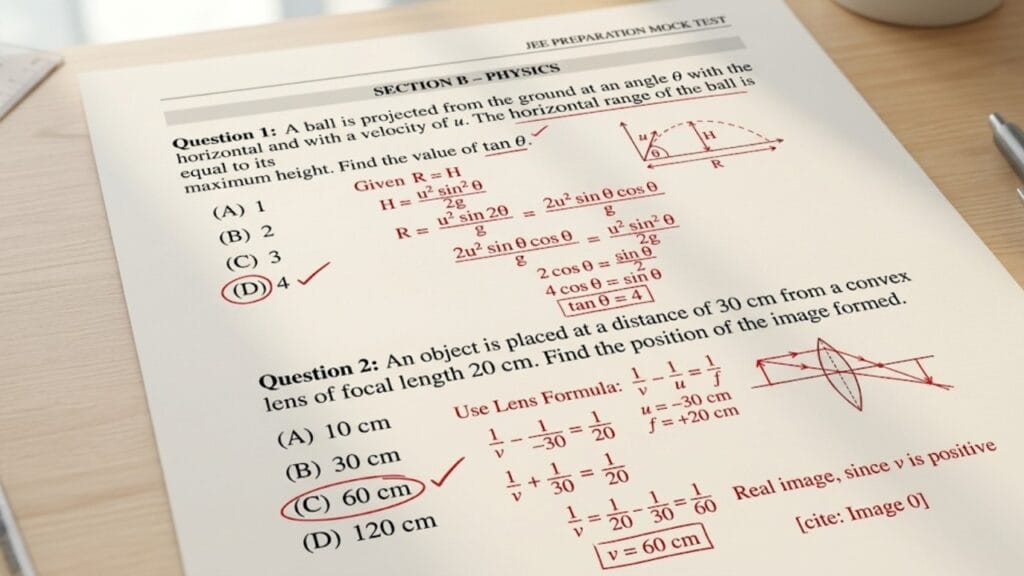
Based on the pattern of recent JEE Main sessions, these are the specific scenarios that have appeared most frequently and are likely to continue appearing:
- Dimensions of combinations of fundamental constants — especially \( \frac{e^2}{\varepsilon_0 hc} \), \( \frac{h}{e} \), \( \frac{\mu_0 \varepsilon_0}{c^2} \) and similar expressions. Recognize what physical quantity each combination represents.
- Percentage error in quantities involving powers — especially \( g \) from pendulum experiments, \( \rho \) from mass and volume measurements and \( Y \) (Young’s modulus) from wire stretching experiments.
- Vernier caliper or screw gauge with positive/negative zero error — reading given in description, answer requires both the scale reading and the zero error correction.
- Identifying which formula is dimensionally incorrect — given four options, three have the correct dimensions for both sides, one does not. Find the odd one out.
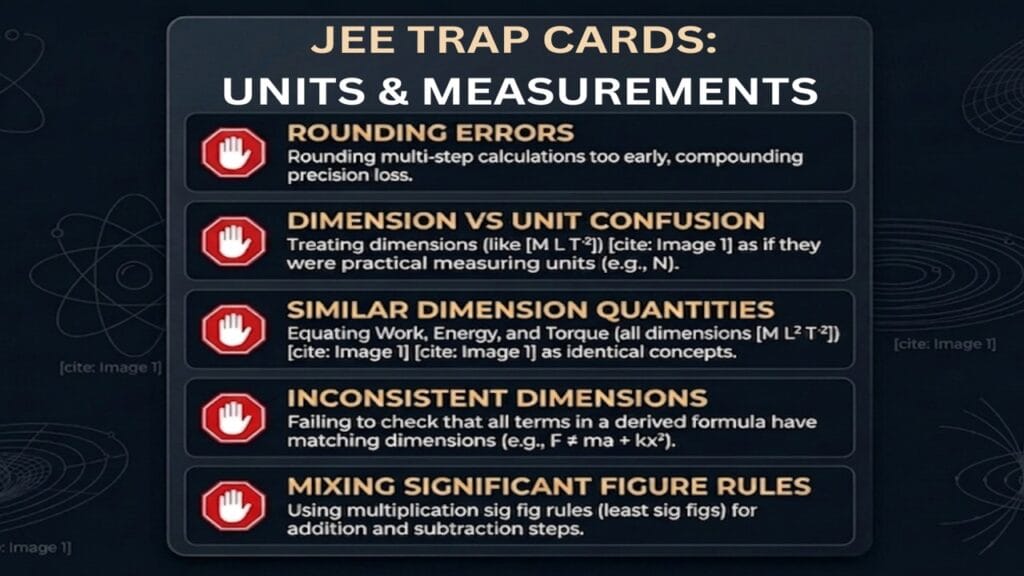
- Addition/subtraction significant figures — typically a trap question where students apply multiplication rules and get the wrong answer.
Common Mistakes That Cost Marks in JEE
Mistake 1 — Forgetting to double the relative error when a variable is squared. In \( T \propto \sqrt{L/g} \), the error in g is: \[ \frac{\Delta g}{g} = \frac{\Delta L}{L} + 2\frac{\Delta T}{T} \] The 2 comes from the square of T in the rearranged formula. Students who rearrange casually often forget it.
Mistake 2 — Using decimal places rule for multiplication problems and vice versa. Addition and subtraction → decimal places. Multiplication and division → significant figures. Getting these confused is an extremely common source of wrong answers in MCQ questions with numerically close options.
Mistake 3 — Treating dimensionless quantities as having no dimension when substituting. Dimensionless does not mean irrelevant — it means dimension \( [M^0L^0T^0] \). When checking homogeneity, every term must reduce to this same form.
Mistake 4 — Missing the negative sign in zero error. Corrected Reading = Observed Reading − Zero Error. If the zero error is negative (e.g., −0.03 mm), students often add the magnitude when they should be subtracting a negative (which adds). Work carefully with signs.
Mistake 5 — Confusing torque and energy because they share the same dimensional formula. Both have dimension \( [ML^2T^{-2}] \). If a JEE question asks which of two quantities has the same dimensions, torque and energy are a classic correct pair even though they are physically distinct.
Revision Strategy for JEE Main
This chapter does not need weeks of preparation. It needs one focused session done correctly.
Day 1:
- Derive (do not memorize) dimensional formulas for all quantities in the table above. Derivation is faster than memorization and builds a skill rather than a fact.
- Write out the five error propagation rules with one example each.
Day 2:
- Solve the seven PYQs in this article without looking at solutions. Time yourself at two minutes per question.
- Identify which questions you got wrong and revisit only those sections.
Day 3 (before exam):
- Run through the formula table once.
- Practice two fresh dimensional analysis questions and one error propagation problem.
- Review the common mistakes list.
That is sufficient for this chapter if done with genuine focus. Spending more time on it at the cost of chapters like Mechanics or Electrostatics is not an efficient allocation for JEE Main preparation.
Learn more about Units & Measurements One-Shot Revision: Complete Chapter for JEE & NEET
Learn more about Most Important Formulas in Units & Measurements for Board Exams
Conclusion
Units and Measurements is small, precise and directly testable. Every concept in the chapter has a formula attached to it and every formula can be tested quantitatively in a two-minute MCQ. That is a favorable profile for JEE preparation — no ambiguity, no lengthy reading comprehension, no multi-step reasoning chains that are hard to manage under time pressure.
The students who drop marks here are almost always the ones who assumed they already understood it well enough from Class 11 and never came back for a structured revision. Do not be one of them. One solid preparation session, the seven PYQ solutions and the formula table in this article is everything you need to handle this chapter confidently on exam day.
Frequently Asked Questions
How many questions come from Units and Measurements in JEE Main?
Typically 1 to 2 questions per paper. While this may seem low, the concepts from this chapter — particularly dimensional analysis and error propagation — appear embedded in questions from other chapters as well, making the effective contribution higher than the direct question count suggests.
Is dimensional analysis enough to solve all JEE questions from this chapter?
Dimensional analysis alone handles roughly half the chapter’s questions. The other half requires error propagation rules, significant figures and least count calculations. All four areas must be prepared.
Which physical constants are most commonly asked about in JEE dimensional analysis questions?
The gravitational constant G, Planck’s constant h, the Boltzmann constant k, the universal gas constant R, permittivity \( \varepsilon_0 \) and permeability \( \mu_0 \) appear most frequently. Know their dimensional formulas by derivation, not memorization.
How do I prepare error propagation for JEE Main?
Learn the four rules — sum/difference, product/quotient, power and general formula — and practice applying the general formula to at least five different physical quantities. The pendulum (g), density (ρ) and Young’s modulus (Y) setups are the most commonly tested.
Do significant figures questions appear directly in JEE Main?
Yes, though infrequently. They typically appear as one MCQ where four numerically close options are given and only the correctly rounded one is correct. Missing the significant figures rule gives an answer that is close but wrong.
Should I memorize dimensional formulas for JEE?
Memorizing a short core list is helpful, but more importantly, practice deriving them. Derivation is faster during revision once you have done it a few times and it works for quantities you have never seen before. Memorization fails on unfamiliar combinations; derivation does not.
How important is the NCERT for this chapter in JEE Main?
Very important. The theory in NCERT Class 11 Physics Chapter 2 covers all concepts tested in JEE Main. Solved examples in NCERT are of JEE-relevant difficulty. Read the chapter once carefully, solve all NCERT examples and then move to PYQs.
Leave a Comment