

Introduction
Units and Measurements sits at the very beginning of the Class 11 Physics syllabus and most NEET aspirants treat it exactly that way — something to get through quickly before reaching the chapters that feel more important. That approach is understandable but shortsighted. This chapter supplies the conceptual vocabulary the entire subject runs on. Every measurement, every formula, every experimental result in physics is expressed in units and carries some degree of error. Not understanding that foundation properly creates small gaps that compound throughout the preparation.
More practically: NEET has tested this chapter consistently. Questions are predictable in type, crisp in structure and entirely solvable if your notes are solid. This article gives you those notes — organized, exam-focused and followed by MCQs that mirror the actual NEET question pattern.
How NEET Tests This Chapter
Before notes, it is worth being precise about what NEET actually expects here. The exam typically asks 1 to 2 questions from Units and Measurements. These questions cluster around three areas almost exclusively:
- Dimensional analysis — finding dimensional formulas of physical quantities and constants, checking equation validity, identifying quantities with identical dimensions
- Error analysis — percentage error in a derived quantity, mean absolute error from a set of readings
- Least count and instrument reading — Vernier caliper or screw gauge least count formula and reading with zero error
Occasionally a question on significant figures or SI unit identification appears. Rote recall of unit names appears rarely now — NEET has moved firmly toward application-based questions. Concept clarity and formula fluency matter far more than memorization here.
Section 1: Physical Quantities and Their Units
What Is a Physical Quantity?
Any property of a physical system that can be measured is a physical quantity. Every physical quantity has a numerical value and a unit. Neither alone is a complete measurement.
Physical quantities are classified as:
- Fundamental (Base) Quantities: Cannot be expressed in terms of other quantities. The SI system recognizes seven.
- Derived Quantities: Expressed as combinations of fundamental quantities through defining equations.
The Seven SI Base Units
| Base Quantity | SI Unit | Symbol |
| Length | metre | m |
| Mass | kilogram | kg |
| Time | second | s |
| Electric Current | ampere | A |
| Temperature | kelvin | K |
| Amount of Substance | mole | mol |
| Luminous Intensity | candela | cd |
Learn more about SI Units Explained: The 7 Base Units Every Physics Student Must Know
Supplementary Units
Two supplementary units are used for geometric quantities:
- Radian (rad): Unit of plane angle
- Steradian (sr): Unit of solid angle
These are dimensionless in the strict sense but are retained for clarity.
Important Derived Units for NEET
| Quantity | SI Unit | In Base Units |
| Force | Newton (N) | kg m s⁻² |
| Energy / Work | Joule (J) | kg m² s⁻² |
| Power | Watt (W) | kg m² s⁻³ |
| Pressure | Pascal (Pa) | kg m⁻¹ s⁻² |
| Electric Charge | Coulomb (C) | A s |
| Potential Difference | Volt (V) | kg m² s⁻³ A⁻¹ |
| Resistance | Ohm (Ω) | kg m² s⁻³ A⁻² |
| Magnetic Field | Tesla (T) | kg s⁻² A⁻¹ |
| Frequency | Hertz (Hz) | s⁻¹ |
Section 2: Dimensional Analysis
What Are Dimensions?
The dimensions of a physical quantity express its dependence on the fundamental quantities — mass (M), length (L), time (T), current (A), temperature (K), amount of substance (mol) and luminous intensity (cd). In mechanics, M, L and T cover almost every quantity you will encounter.
The dimensional formula is written using square brackets:
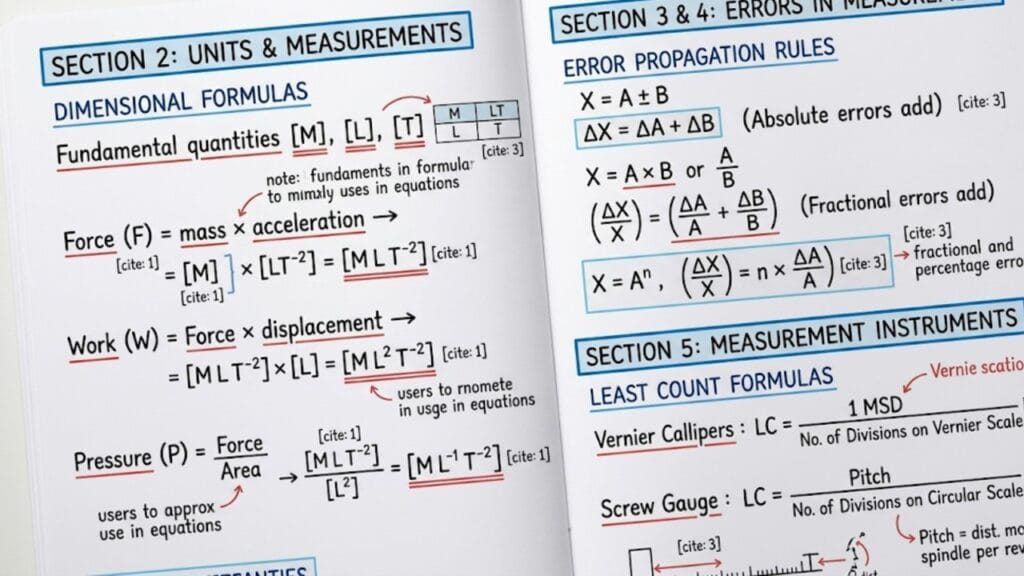
\[ [F] = MLT^{-2} \]
This reads: “Force has dimensions of mass to the power 1, length to the power 1 and time to the power −2.”
Key Dimensional Formulas for NEET
Learn these by derivation, not memorization — deriving them takes ten seconds per quantity once you know the method and it works on unfamiliar quantities too.
| Physical Quantity | Dimensional Formula |
| Velocity | \( [LT^{-1}] \) |
| Acceleration | \( [LT^{-2}] \) |
| Force | \( [MLT^{-2}] \) |
| Work / Energy / Torque | \( [ML^2T^{-2}] \) |
| Power | \( [ML^2T^{-3}] \) |
| Momentum / Impulse | \( [MLT^{-1}] \) |
| Pressure / Stress | \( [ML^{-1}T^{-2}] \) |
| Gravitational Constant G | \( [M^{-1}L^3T^{-2}] \) |
| Planck’s Constant h | \( [ML^2T^{-1}] \) |
| Boltzmann Constant k_B | \( [ML^2T^{-2}K^{-1}] \) |
| Coefficient of Viscosity | \( [ML^{-1}T^{-1}] \) |
| Surface Tension | \( [MT^{-2}] \) |
| Angular Momentum | \( [ML^2T^{-1}] \) |
| Moment of Inertia | \( [ML^2] \) |
| Electric Field | \( [MLT^{-3}A^{-1}] \) |
| Magnetic Field (B) | \( [MT^{-2}A^{-1}] \) |
| Permittivity \( \varepsilon_0 \) | \( [M^{-1}L^{-3}T^4A^2] \) |
| Resistance | \( [ML^2T^{-3}A^{-2}] \) |
| Capacitance | \( [M^{-1}L^{-2}T^4A^2] \) |
Principle of Dimensional Homogeneity
Every term in a physically valid equation must have identical dimensions. This is the bedrock rule of dimensional analysis.
Rule: You can only add or subtract quantities of the same dimension. You can never equate quantities of different dimensions.
Application 1 — Checking validity:
Verify \( v^2 = u^2 + 2as \):
\[ [v^2] = L^2T^{-2} \] \[ [u^2] = L^2T^{-2} \] \[ [2as] = LT^{-2} \times L = L^2T^{-2} \]
All terms match. The equation is dimensionally valid.
Application 2 — Finding dimensions of a constant:
From \( F = \frac{Gm_1m_2}{r^2} \), find dimensions of G:
\[ [G] = \frac{[F][r^2]}{[m_1][m_2]} = \frac{MLT^{-2} \times L^2}{M \times M} = M^{-1}L^3T^{-2} \]
Application 3 — Identifying quantities with the same dimensions:
Work \( = [ML^2T^{-2}] \)
Torque \( = [ML^2T^{-2}] \)
These share dimensional formulas. NEET loves asking this type of question.
Other important pairs with identical dimensions:
| Pair | Shared Dimensional Formula |
| Work and Torque | \( [ML^2T^{-2}] \) |
| Momentum and Impulse | \( [MLT^{-1}] \) |
| Pressure, Stress, Modulus of Elasticity | \( [ML^{-1}T^{-2}] \) |
| Angular Momentum and Planck’s Constant | \( [ML^2T^{-1}] \) |
| Power and Luminous Flux (numerically, not physically) | \( [ML^2T^{-3}] \) |
| Surface Tension and Spring Constant | \( [MT^{-2}] \) |
Learn more about Dimensional Analysis Made Easy: Method, Rules and Practice Problems
Limitations of Dimensional Analysis
NEET occasionally asks a direct question on what dimensional analysis cannot do. Know this list:
- Cannot determine dimensionless constants (like \( 2\pi \), \( \frac{1}{2} \), etc.)
- Cannot be applied to trigonometric, logarithmic, or exponential functions directly
- Cannot distinguish between two physically different quantities that share the same dimensional formula (e.g., work and torque)
- Fails when a formula involves more than three unknowns with only M, L, T as base dimensions
- Cannot establish the exact form of a relationship — only the dependence on variables
Section 3: Significant Figures
Rules for Counting Significant Figures
- All non-zero digits are significant — \( 3.45 \) has 3 significant figures
- Zeros between non-zero digits are significant — \( 1.007 \) has 4 significant figures
- Leading zeros are never significant — \( 0.0032 \) has 2 significant figures
- Trailing zeros after a decimal point are significant — \( 5.300 \) has 4 significant figures
- Trailing zeros in a whole number without a decimal point are ambiguous — \( 2500 \) may have 2, 3, or 4 significant figures
Significant Figures in Calculations
For multiplication and division: Round the result to the same number of significant figures as the input with the fewest significant figures.
For addition and subtraction: Round the result to the same number of decimal places as the input with the fewest decimal places.
Learn more about How to Find Significant Figures: Rules, Examples & Common Mistakes
Section 4: Errors in Measurement
This is the highest-yield topic for NEET numerical MCQs within this chapter. Master the formulas and the propagation rules completely.
Types of Errors
Systematic Errors: Consistent, directional errors arising from instrument calibration faults, improper experimental technique, or personal bias. Cannot be reduced by averaging.
Random Errors: Unpredictable, non-directional fluctuations in repeated measurements. Reduced by taking more readings and averaging.
Gross Errors: Blunders — wrong readings, incorrect recording, computational mistakes. Eliminated by careful observation and checking.
Formulas for Error Analysis
Mean Value:
\[ \bar{x} = \frac{x_1 + x_2 + \cdots + x_n}{n} \]
Absolute Error of each reading:
\[ \Delta x_i = |x_i – \bar{x}| \]
Mean Absolute Error:
\[ \overline{\Delta x} = \frac{\Delta x_1 + \Delta x_2 + \cdots + \Delta x_n}{n} \]
Relative Error:
\[ \delta_r = \frac{\overline{\Delta x}}{\bar{x}} \]
Percentage Error:
\[ \delta_\% = \frac{\overline{\Delta x}}{\bar{x}} \times 100\% \]
Error Propagation Rules
These are the rules NEET tests numerically. Every NEET question on error analysis reduces to one of these:
For sum or difference \( Z = A \pm B \):
\[ \Delta Z = \Delta A + \Delta B \]
For product or quotient \( Z = AB \) or \( Z = \frac{A}{B} \):
\[ \frac{\Delta Z}{Z} = \frac{\Delta A}{A} + \frac{\Delta B}{B} \]
For a power \( Z = A^n \):
\[ \frac{\Delta Z}{Z} = |n| \cdot \frac{\Delta A}{A} \]
General formula \( Z = \frac{A^p \cdot B^q}{C^r} \):
\[ \frac{\Delta Z}{Z} = p\frac{\Delta A}{A} + q\frac{\Delta B}{B} + r\frac{\Delta C}{C} \]
Critical point: Always use the absolute value of exponents. A negative power still contributes positively to the relative error. This trips up students regularly.
Learn more about Absolute Error, Relative Error and Percentage Error: A Complete Guide
Learn more about Propagation of Errors in Physics Calculations: Rules, Formulas & Examples
Section 5: Least Count and Measuring Instruments
Vernier Caliper
Least Count:
\[ \text{LC} = 1 \text{ MSD} – 1 \text{ VSD} = \frac{\text{Smallest main scale division}}{\text{No. of Vernier divisions}} \]
Standard value: 0.1 mm (10-division Vernier) or 0.05 mm (20-division Vernier)
Reading Formula:
\[ \text{Reading} = \text{MSR} + (\text{VSR} \times \text{LC}) – \text{Zero Error} \]
Screw Gauge
Pitch:
\[ \text{Pitch} = \frac{\text{Distance moved by spindle in N rotations}}{N} \]
Standard pitch: 0.5 mm
Least Count:
\[ \text{LC} = \frac{\text{Pitch}}{\text{No. of circular scale divisions}} \]
Standard value: 0.01 mm (pitch 0.5 mm, 50 divisions)
Reading Formula:
\[ \text{Reading} = \text{Sleeve Reading} + (\text{CSR} \times \text{LC}) – \text{Zero Error} \]
Zero Error Correction (both instruments):
\[ \text{Corrected Reading} = \text{Observed Reading} – \text{Zero Error} \]
Positive zero error → subtract from observed reading
Negative zero error → subtracting a negative effectively adds
Learn more about Least Count of Vernier Caliper and Screw Gauge: Formula & Calculation
Section 6: Important Dimensionless Quantities
NEET occasionally includes a question asking students to identify which of the given quantities is dimensionless. Know this list:
- Strain (change in length / original length)
- Refractive index
- Relative density (specific gravity)
- Poisson’s ratio
- Reynolds number
- Fine structure constant \( \alpha = \frac{e^2}{4\pi\varepsilon_0 \hbar c} \)
- Angle (radian is dimensionless)
- Solid angle (steradian is dimensionless)
- Trigonometric ratios (sin, cos, tan)
- Logarithmic quantities
Any argument inside a sin, cos, log, or exponential function must be dimensionless. This is a principle that can itself be tested as a reasoning question.
Section 7: Order of Magnitude
The order of magnitude of a quantity is the power of 10 nearest to its value.
\[ \text{If } N = a \times 10^b, \quad \text{where } 1 \leq a < 10 \]
- If \( a < \sqrt{10} \approx 3.162 \): order of magnitude = \( 10^b \)
- If \( a \geq \sqrt{10} \): order of magnitude = \( 10^{b+1} \)
Examples:
- \( 4.9 \times 10^3 \): since \( 4.9 > 3.162 \), order of magnitude = \( 10^4 \)
- \( 2.1 \times 10^5 \): since \( 2.1 < 3.162 \), order of magnitude = \( 10^5 \)
This concept appears in NEET less frequently than dimensional analysis but is fair game.
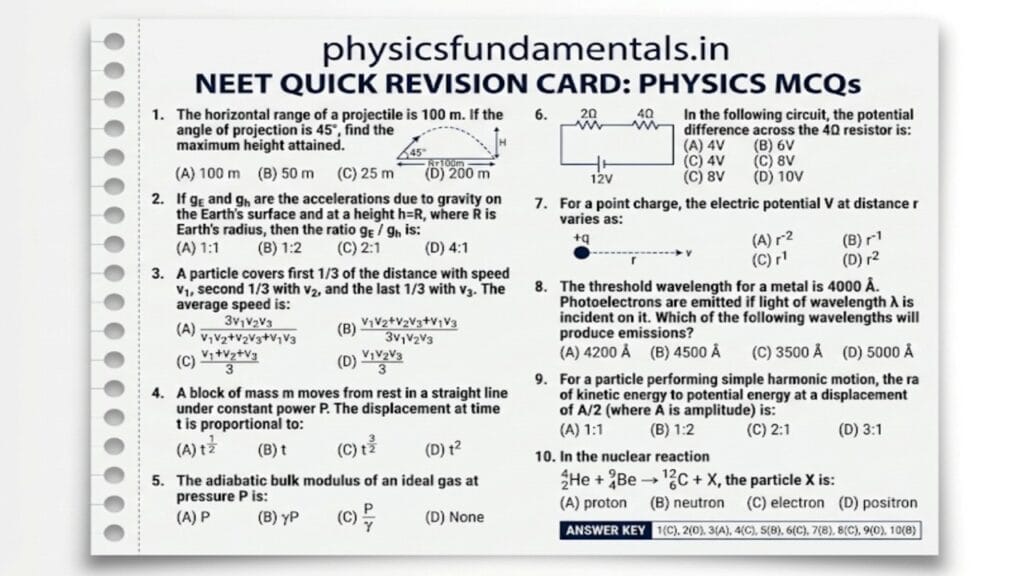
NEET-Style MCQs with Solutions
These questions are written to match the style, difficulty level and concept coverage of actual NEET Physics questions. Attempt each one before reading the solution.
MCQ 1 — Dimensional Formula
Which of the following pairs has the same dimensional formula?
(A) Work and Power
(B) Torque and Angular Momentum
(C) Planck’s Constant and Angular Momentum
(D) Force and Impulse
Solution:
\[ [\text{Work}] = ML^2T^{-2}, \quad [\text{Power}] = ML^2T^{-3} \quad \rightarrow \text{Different} \] \[ [\text{Torque}] = ML^2T^{-2}, \quad [\text{Angular Momentum}] = ML^2T^{-1} \quad \rightarrow \text{Different} \] \[ [\text{Planck’s Constant}] = ML^2T^{-1}, \quad [\text{Angular Momentum}] = ML^2T^{-1} \quad \rightarrow \textbf{Same} \] \[ [\text{Force}] = MLT^{-2}, \quad [\text{Impulse}] = MLT^{-1} \quad \rightarrow \text{Different} \]
Answer: (C)
MCQ 2 — Percentage Error
The period of a simple pendulum is \( T = 2\pi\sqrt{L/g} \). If the error in measurement of L is 2% and the error in measurement of T is 3%, what is the percentage error in the value of g?
(A) 5%
(B) 7%
(C) 8%
(D) 14%
Solution:
Rearranging: \( g = \frac{4\pi^2 L}{T^2} \)
Applying the general error rule:
\[ \frac{\Delta g}{g} \times 100 = \frac{\Delta L}{L} \times 100 + 2 \times \frac{\Delta T}{T} \times 100 \]
\[ = 2\% + 2 \times 3\% = 2\% + 6\% = 8\% \]
Answer: (C)
MCQ 3 — Least Count Identification
A screw gauge has a pitch of 1 mm and 200 divisions on its circular scale. What is its least count?
(A) 0.001 mm
(B) 0.005 mm
(C) 0.01 mm
(D) 0.05 mm
Solution:
\[ \text{LC} = \frac{\text{Pitch}}{\text{No. of divisions}} = \frac{1 \text{ mm}}{200} = 0.005 \text{ mm} \]
Answer: (B)
MCQ 4 — Vernier Caliper Reading with Zero Error
A Vernier caliper has LC = 0.01 cm. Its zero error is −0.04 cm. The main scale reads 3.2 cm and the 7th Vernier division coincides. What is the corrected reading?
(A) 3.23 cm
(B) 3.27 cm
(C) 3.31 cm
(D) 3.19 cm
Solution:
Observed reading: \[ = 3.2 + (7 \times 0.01) = 3.2 + 0.07 = 3.27 \text{ cm} \]
Corrected reading: \[ = 3.27 – (-0.04) = 3.27 + 0.04 = 3.31 \text{ cm} \]
Answer: (C)
MCQ 5 — Identifying Dimensionally Incorrect Formula
Which of the following is dimensionally incorrect?
(A) \( v = u + at \)
(B) \( s = ut + \frac{1}{2}at^2 \)
(C) \( v^2 = u^2 + 2as^2 \)
(D) \( v^2 = u^2 + 2as \)
Solution:
Check option (C): \( [2as^2] = LT^{-2} \times L^2 = L^3T^{-2} \)
But \( [v^2] = L^2T^{-2} \). These do not match.
Check option (D): \( [2as] = LT^{-2} \times L = L^2T^{-2} = [v^2] \) ✓
Options (A) and (B) are also dimensionally correct (standard kinematic equations).
Answer: (C)
MCQ 6 — Mean Absolute Error
Five measurements of a length are: 4.8, 5.0, 4.9, 5.1 and 4.7 cm. What is the mean absolute error?
(A) 0.10 cm
(B) 0.12 cm
(C) 0.08 cm
(D) 0.14 cm
Solution:
Mean: \[ \bar{x} = \frac{4.8 + 5.0 + 4.9 + 5.1 + 4.7}{5} = \frac{24.5}{5} = 4.90 \text{ cm} \]
Absolute errors: \[ |4.8 – 4.9| = 0.1, \quad |5.0 – 4.9| = 0.1, \quad |4.9 – 4.9| = 0.0 \] \[ |5.1 – 4.9| = 0.2, \quad |4.7 – 4.9| = 0.2 \]
Mean absolute error: \[ \overline{\Delta x} = \frac{0.1 + 0.1 + 0.0 + 0.2 + 0.2}{5} = \frac{0.6}{5} = 0.12 \text{ cm} \]
Answer: (B)
MCQ 7 — Dimensions of a Physical Constant
The Van der Waals constant \( b \) in \( \left(P + \frac{a}{V^2}\right)(V – b) = RT \) has the same dimensions as:
(A) Pressure
(B) Energy
(C) Volume
(D) Force
Solution:
Since \( V \) and \( b \) are being subtracted, they must have the same dimensions:
\[ [b] = [V] = L^3 = \text{Volume} \]
Answer: (C)
MCQ 8 — Significant Figures
The value of \( \frac{3.24 \times 0.08666}{5.006} \) to correct significant figures is:
(A) 0.05628
(B) 0.0563
(C) 0.056
(D) 0.06
Solution:
Significant figures in each:
- \( 3.24 \): 3 sig figs
- \( 0.08666 \): 4 sig figs
- \( 5.006 \): 4 sig figs
Limiting value: 3 significant figures.
\[ \frac{3.24 \times 0.08666}{5.006} = \frac{0.280778…}{5.006} \approx 0.05609… \]
Rounded to 3 significant figures: 0.0561 — closest standard option is 0.0563 depending on exact computation, but the key operation is rounding to 3 sig figs.
Answer: (B)
MCQ 9 — Dimensionless Quantity Identification
Which of the following is a dimensionless quantity?
(A) Planck’s constant
(B) Angular momentum
(C) Strain
(D) Gravitational constant
Solution:
Strain = Change in length / Original length = L/L = dimensionless.
\[ [\text{Planck’s constant}] = ML^2T^{-1} \quad \text{(not dimensionless)} \] \[ [\text{Angular momentum}] = ML^2T^{-1} \quad \text{(not dimensionless)} \] \[ [\text{Gravitational constant}] = M^{-1}L^3T^{-2} \quad \text{(not dimensionless)} \]
Answer: (C)
MCQ 10 — Error in a Derived Formula
The density of a sphere is calculated from \( \rho = \frac{6M}{\pi D^3} \), where M is mass and D is diameter. If the percentage errors in M and D are 1% and 2% respectively, what is the percentage error in \( \rho \)?
(A) 5%
(B) 7%
(C) 9%
(D) 3%
Solution:
\[ \frac{\Delta\rho}{\rho} \times 100 = \frac{\Delta M}{M} \times 100 + 3 \times \frac{\Delta D}{D} \times 100 \]
\[ = 1\% + 3 \times 2\% = 1\% + 6\% = 7\% \]
Answer: (B)
Common NEET Traps in This Chapter
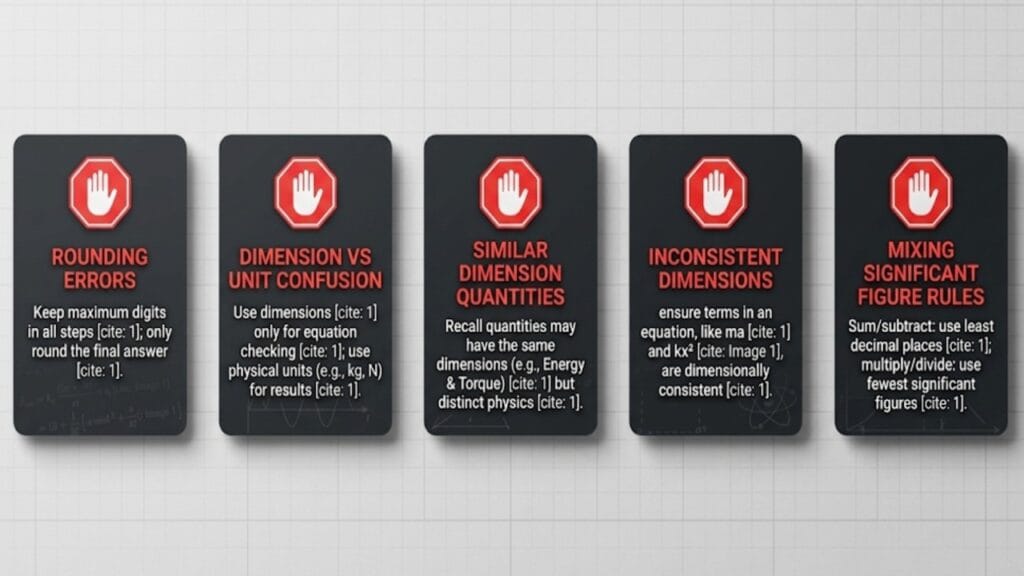
Every repeated mistake in NEET has a pattern. These are the ones that appear in this chapter:
Trap 1 — Torque and energy share dimensions but are not the same physical quantity. A question may list work and torque among options for “which has dimension \( ML^2T^{-2} \)?” — both are correct. The distinction between them is physical, not dimensional.
Trap 2 — The error in \( T^2 \) is not the same as the error in \( T \). If \( \frac{\Delta T}{T} = 3\% \), then \( \frac{\Delta(T^2)}{T^2} = 2 \times 3\% = 6\% \). The power multiplies the relative error. Students who forget the multiplier consistently pick the distractor option.
Trap 3 — Negative zero error increases the corrected reading. Corrected = Observed − Zero Error. If zero error is negative, subtracting it adds to the observed value. This counter-intuitive direction catches students who apply the formula mechanically without thinking about its meaning.
Trap 4 — Trailing zeros without a decimal point are ambiguous, not automatically significant. The number 3500 does not automatically have 4 significant figures. Without a decimal point, those trailing zeros are ambiguous. NEET rarely tests this specific case, but when it does, the answer choices are specifically designed to exploit the misconception.
Trap 5 — The least count of a Vernier caliper is not the same as the value of one main scale division. LC = 1 MSD − 1 VSD. Students who write LC = 1 MSD are skipping the Vernier scale entirely.
Revision Checklist Before NEET
Use this as a pre-exam checkpoint. If you cannot do each item confidently, revisit that section.
- \[ \] Can state and write the seven SI base units with symbols
- \[ \] Can derive dimensional formulas for all 20 quantities in the table above
- \[ \] Can identify pairs of quantities with identical dimensional formulas
- \[ \] Can state at least four limitations of dimensional analysis
- \[ \] Can apply all four error propagation rules to a fresh formula
- \[ \] Can calculate mean absolute error from a set of five readings
- \[ \] Can calculate the least count of a Vernier caliper and screw gauge from given specifications
- \[ \] Can read a Vernier caliper and screw gauge with positive and negative zero error
- \[ \] Can count significant figures in numbers with leading zeros, trailing zeros and captive zeros
- \[ \] Can apply the addition/subtraction rule (decimal places) and multiplication/division rule (significant figures) correctly and separately
Learn more about Units & Measurements One-Shot Revision: Complete Chapter for JEE & NEET
Conclusion
Units and Measurements is not a chapter you score marks in despite spending little time on it. It is a chapter you score marks in because you spent focused time on it once — correctly. The notes in this article cover every concept NEET has tested from this chapter. The ten MCQs reflect the actual difficulty and question style of the exam. The trap list addresses the specific reasoning failures that lead to wrong answers even when students have studied the material.
Do not treat this chapter as a warm-up. Treat it as the first chapter of a well-structured syllabus — because that is exactly what it is.
Frequently Asked Questions
How many questions come from Units and Measurements in NEET?
NEET typically includes 1 to 2 questions from this chapter per paper. While this appears modest, the concepts — particularly dimensional analysis and error analysis — appear embedded within questions from other chapters as well. Strong understanding here supports the entire Physics section.
Is NCERT enough for Units and Measurements in NEET?
Yes, for this chapter specifically, NCERT Class 11 Physics Chapter 2 is sufficient. All NEET questions from this chapter are within NCERT scope. Ensure that all solved examples and exercises in NCERT are completed before moving to previous year questions.
Which topics from this chapter are most important for NEET?
Dimensional analysis (including finding dimensions of constants and identifying dimensionally identical quantities) and error propagation (particularly percentage error in derived quantities) are the two highest-priority topics. Least count and instrument reading questions appear regularly as well.
What is the difference between systematic and random errors?
Systematic errors are consistent, directional and cannot be reduced by averaging — they arise from instrument faults or methodological bias. Random errors are unpredictable fluctuations in both directions and can be reduced by taking more readings and averaging. Gross errors are outright blunders, eliminated by careful checking.
How do I find the dimensions of a physical constant in NEET?
Use the formula in which the constant appears. Rearrange to isolate the constant on one side, then substitute dimensional formulas for all other quantities. For example, from \( F = Gm_1m_2/r^2 \), rearrange to get G alone, substitute dimensional formulas and simplify.
Why does the error in \( T^2 \) equal twice the percentage error in T?
From the power rule: \( \frac{\Delta(T^n)}{T^n} = n \cdot \frac{\Delta T}{T} \). When \( n = 2 \), the relative error doubles. This is because squaring a quantity amplifies the sensitivity of the result to errors in the input.
Can dimensional analysis derive the formula for the time period of a pendulum?
Yes, partially. Dimensional analysis can correctly establish that \( T \propto \sqrt{L/g} \), giving the form of the relationship. However, it cannot determine the numerical constant \( 2\pi \) — that requires the full theoretical derivation from Newton’s second law.
Leave a Comment