

Introduction
Most physics students encounter dimensional analysis early in Class 11 and treat it as a minor bookkeeping exercise — something to verify that an answer has the right units before moving on. That is a serious underestimation of what this tool actually does.
Dimensional analysis is one of the most powerful reasoning techniques in all of physics. It can verify equations, expose errors, derive unknown formulas, convert between unit systems and estimate answers to problems that seem impossibly complex. Physicists use it routinely, not just students. Once you genuinely understand it, you will find yourself reaching for it instinctively.
This guide walks through the method from scratch, explains all the rules clearly and then puts them to work through a set of carefully chosen practice problems.
What Are Dimensions in Physics?
Before jumping into the method, it is worth being precise about what “dimension” actually means.
In physics, a dimension is the nature of a physical quantity — what kind of thing it fundamentally is. The dimension of a quantity is independent of the unit system being used. Length is always length, whether you measure it in metres, feet, or astronomical units.
The seven fundamental dimensions correspond to the seven SI base quantities:
| Dimension | Symbol | Base Quantity |
| Mass | M | kilogram (kg) |
| Length | L | metre (m) |
| Time | T | second (s) |
| Electric Current | I or A | ampere (A) |
| Temperature | Θ | kelvin (K) |
| Amount of Substance | N | mole (mol) |
| Luminous Intensity | J | candela (cd) |
In mechanics — which covers the vast majority of Class 11 and most JEE/NEET problems — you will work almost exclusively with M, L and T.
Learn more about SI Units Explained: The 7 Base Units Every Physics Student Must Know
What Is a Dimensional Formula?
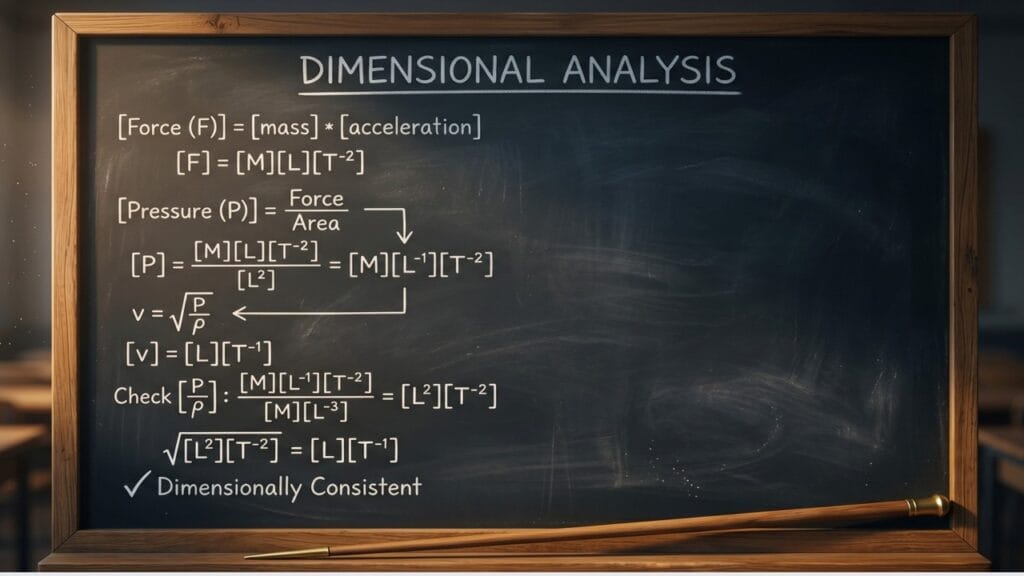
The dimensional formula of a physical quantity expresses it in terms of the fundamental dimensions M, L and T (and others where relevant), each raised to appropriate powers.
For example:
- Velocity = Distance / Time → Dimensional formula: \( [LT^{-1}] \)
- Force = Mass × Acceleration → \( [MLT^{-2}] \)
- Energy = Force × Displacement → \( [ML^2T^{-2}] \)
The notation uses square brackets to indicate “the dimensions of.” So when you write \( [F] = MLT^{-2} \), you are saying that the dimensions of force are mass to the power 1, length to the power 1 and time to the power −2.
Learn more about What Is Dimensional Formula? Derivation, Applications & Limitations
The Principle of Dimensional Homogeneity
This is the core rule that makes dimensional analysis work.
Every term in a physically valid equation must have the same dimensions.
You cannot add a velocity to an acceleration. You cannot equate energy to momentum. Any equation that claims to describe physical reality must be dimensionally consistent — every term on both sides and every term being added or subtracted, must carry identical dimensions.
This principle is called the Principle of Dimensional Homogeneity and it is the engine behind every application of dimensional analysis.
Three Major Applications of Dimensional Analysis
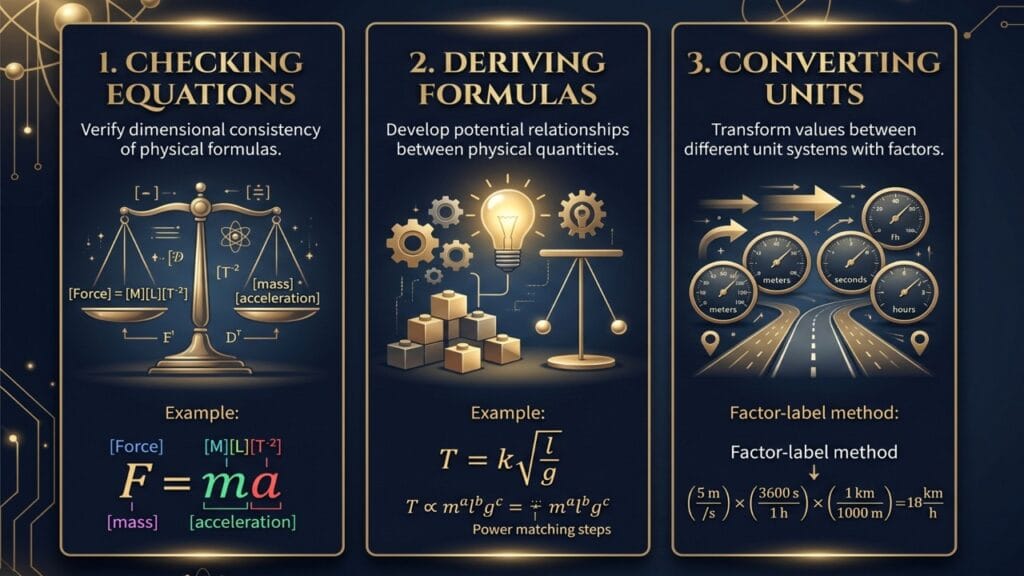
Application 1: Checking the Dimensional Consistency of Equations
If a proposed equation is dimensionally inconsistent, it is definitely wrong. If it is dimensionally consistent, it may be correct — but dimensional analysis alone cannot confirm it.
Example: Verify whether \( v = u + at \) is dimensionally consistent.
Left-hand side:
\[ [v] = LT^{-1} \]
Right-hand side, first term:
\[ [u] = LT^{-1} \]
Right-hand side, second term:
\[ [at] = LT^{-2} \times T = LT^{-1} \]
All three terms carry the dimension \( LT^{-1} \). The equation is dimensionally consistent.
Counter-example: Check \( s = ut^2 \).
\[ [s] = L \] \[ [ut^2] = LT^{-1} \times T^2 = LT \]
\( L \neq LT \). The equation fails the dimensional check. It is not physically valid.
Application 2: Deriving Relationships Between Physical Quantities
If you know which physical quantities a variable depends on, dimensional analysis can help you find the form of that relationship.
This is remarkable. You do not need the full theory — just a reasonable guess about the relevant variables and dimensional analysis does the rest.
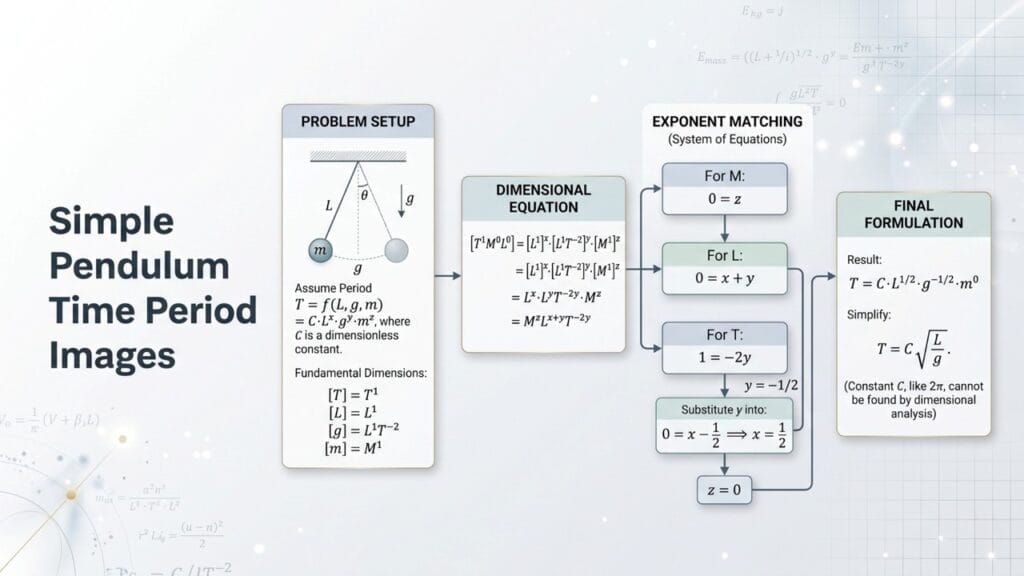
Example: Derive an expression for the time period T of a simple pendulum.
Assume the time period depends on:
- Length of pendulum \( l \) with dimension \( [L] \)
- Mass of bob \( m \) with dimension \( [M] \)
- Acceleration due to gravity \( g \) with dimension \( [LT^{-2}] \)
Write:
\[ T = k \cdot l^a \cdot m^b \cdot g^c \]
where k is a dimensionless constant and a, b, c are unknown exponents.
Taking dimensions on both sides:
\[ [T] = [L]^a [M]^b [LT^{-2}]^c \]
\[ M^0 L^0 T^1 = M^b L^{a+c} T^{-2c} \]
Comparing exponents:
- For M: \( b = 0 \)
- For T: \( -2c = 1 \Rightarrow c = -\frac{1}{2} \)
- For L: \( a + c = 0 \Rightarrow a = \frac{1}{2} \)
So:
\[ T = k \cdot l^{1/2} \cdot m^0 \cdot g^{-1/2} = k\sqrt{\frac{l}{g}} \]
The actual formula (from full theory) is \( T = 2\pi\sqrt{\frac{l}{g}} \). Dimensional analysis correctly identified the form. The constant \( 2\pi \) is dimensionless and cannot be determined this way.
Application 3: Converting Units Between Systems
This is covered in depth in unit conversion guides, but here is the dimensional approach in brief.
The general conversion formula is:
\[ n_2 = n_1 \left[\frac{M_1}{M_2}\right]^a \left[\frac{L_1}{L_2}\right]^b \left[\frac{T_1}{T_2}\right]^c \]
Where \( n_1 \) is the numerical value in system 1, \( n_2 \) is the numerical value in system 2 and \( a, b, c \) are the dimensional exponents of the quantity.
Learn more about How to Convert Units in Physics: Step-by-Step with Solved Examples
Rules of Dimensional Analysis
Follow these rules carefully to avoid errors.
- Dimensions of all terms being added or subtracted must be identical. You can add two lengths. You cannot add a length and a time.
- Dimensions on the left-hand side of any equation must equal dimensions on the right-hand side.
- Pure numbers and dimensionless constants have no dimensions. \( \pi \), \( e \), \( \sin\theta \) and numerical coefficients like 2 or \( \frac{1}{2} \) contribute nothing dimensionally.
- Arguments of transcendental functions must be dimensionless. The argument of \( \sin \), \( \cos \), \( \log \), or \( e^x \) must have zero dimension. Writing \( \sin(5 \text{ m}) \) is physically meaningless.
- Dimensional analysis cannot determine dimensionless constants. The method tells you the form of a formula, not its exact numerical prefactor.
- Dimensional analysis cannot distinguish between two quantities with the same dimensions. Kinetic energy and potential energy both have dimensions \( [ML^2T^{-2}] \), but dimensional analysis cannot tell them apart.
Limitations of Dimensional Analysis
Being honest about what dimensional analysis cannot do is just as important as knowing what it can.
- It cannot determine dimensionless constants like \( 2\pi \), \( \frac{1}{2} \), or \( \frac{4}{3} \).
- It cannot derive equations that involve more than three unknown exponents when using only M, L and T — the system of equations becomes under-determined.
- It cannot tell you whether a dimensionally consistent formula is physically meaningful in all regimes.
- It is not applicable to empirical relations that involve quantities without well-defined dimensions, or to equations involving functions of dimensionless groups.
Despite these limits, the technique remains invaluable. Understanding its boundaries is part of using it wisely.
Dimensional Formulas of Common Physical Quantities
This table is worth having memorized for exams. Build it yourself rather than just reading it — the process of deriving each one from scratch is the fastest way to internalize the logic.
| Physical Quantity | Relation Used | Dimensional Formula |
| Velocity | Distance / Time | \( [LT^{-1}] \) |
| Acceleration | Velocity / Time | \( [LT^{-2}] \) |
| Force | Mass × Acceleration | \( [MLT^{-2}] \) |
| Work / Energy | Force × Displacement | \( [ML^2T^{-2}] \) |
| Power | Work / Time | \( [ML^2T^{-3}] \) |
| Momentum | Mass × Velocity | \( [MLT^{-1}] \) |
| Pressure | Force / Area | \( [ML^{-1}T^{-2}] \) |
| Density | Mass / Volume | \( [ML^{-3}] \) |
| Angular Velocity | Angle / Time | \( [T^{-1}] \) |
| Torque | Force × Distance | \( [ML^2T^{-2}] \) |
| Surface Tension | Force / Length | \( [MT^{-2}] \) |
| Viscosity | Force / (Area × velocity gradient) | \( [ML^{-1}T^{-1}] \) |
| Gravitational Constant G | From \( F = Gm_1m_2/r^2 \) | \( [M^{-1}L^3T^{-2}] \) |
| Planck’s Constant h | Energy / Frequency | \( [ML^2T^{-1}] \) |
Practice Problems with Full Solutions
Practice Problem 1: Verify a Kinematic Equation
Problem: Verify the dimensional consistency of \( s = ut + \frac{1}{2}at^2 \).
Solution:
Dimensions of each term:
\[ [s] = L \]
\[ [ut] = LT^{-1} \times T = L \]
\[ \left[\frac{1}{2}at^2\right] = LT^{-2} \times T^2 = L \]
All three terms have dimension L. The equation is dimensionally consistent.
Practice Problem 2: Derive the Formula for Escape Velocity
Problem: Escape velocity \( v_e \) is expected to depend on the mass of the planet M, the radius of the planet R and the universal gravitational constant G. Use dimensional analysis to find the relationship.
Solution:
Write:
\[ v_e = k \cdot M^a \cdot R^b \cdot G^c \]
Dimensional formula of G: \( [M^{-1}L^3T^{-2}] \)
Taking dimensions:
\[ LT^{-1} = M^a \cdot L^b \cdot (M^{-1}L^3T^{-2})^c \]
\[ LT^{-1} = M^{a-c} \cdot L^{b+3c} \cdot T^{-2c} \]
Comparing exponents:
- For T: \( -2c = -1 \Rightarrow c = \frac{1}{2} \)
- For M: \( a – c = 0 \Rightarrow a = \frac{1}{2} \)
- For L: \( b + 3c = 1 \Rightarrow b = 1 – \frac{3}{2} = -\frac{1}{2} \)
Therefore:
\[ v_e = k \cdot M^{1/2} \cdot R^{-1/2} \cdot G^{1/2} = k\sqrt{\frac{GM}{R}} \]
The actual formula is \( v_e = \sqrt{\frac{2GM}{R}} \). Dimensional analysis gives the correct form. The factor \( \sqrt{2} \) is dimensionless and cannot be recovered here.
Practice Problem 3: Convert the Value of Pressure
Problem: The pressure at the base of a water column is \( 10^5 \) Pa (SI). Convert this to CGS units (dyne/cm²).
Solution:
Dimensional formula of pressure: \( [ML^{-1}T^{-2}] \)
So \( a = 1, b = -1, c = -2 \).
Using the conversion formula:
\[ n_2 = n_1 \left[\frac{M_1}{M_2}\right]^1 \left[\frac{L_1}{L_2}\right]^{-1} \left[\frac{T_1}{T_2}\right]^{-2} \]
SI → CGS:
- \( M_1 = 1 \text{ kg}, \quad M_2 = 1 \text{ g} \Rightarrow \frac{M_1}{M_2} = 1000 \)
- \( L_1 = 1 \text{ m}, \quad L_2 = 1 \text{ cm} \Rightarrow \frac{L_1}{L_2} = 100 \)
- \( T_1 = T_2 = 1 \text{ s} \Rightarrow \frac{T_1}{T_2} = 1 \)
\[ n_2 = 10^5 \times (1000)^1 \times (100)^{-1} \times (1)^{-2} \]
\[ = 10^5 \times 10^3 \times 10^{-2} = 10^{5+3-2} = 10^6 \]
So \( 10^5 \) Pa \( = 10^6 \) dyne/cm².
Practice Problem 4: Identify the Physically Invalid Equation
Problem: From the following, identify which equation cannot be physically valid.
(a) \( F = mv^2/r \) (b) \( E = mc^3 \) (c) \( p = mv \)
Solution:
Check dimensions of each:
(a) \( [mv^2/r] = M \cdot (LT^{-1})^2 \cdot L^{-1} = MLT^{-2} = [F] \) ✓
(b) \( [mc^3] = M \cdot (LT^{-1})^3 = ML^3T^{-3} \) But \( [E] = ML^2T^{-2} \). \( ML^3T^{-3} \neq ML^2T^{-2} \) ✗
(c) \( [mv] = M \cdot LT^{-1} = MLT^{-1} = [p] \) ✓
Equation (b) is dimensionally invalid. The correct relation is \( E = mc^2 \), not \( mc^3 \).
Practice Problem 5: Find Dimensions of an Unknown Constant
Problem: The Van der Waals equation for a real gas is:
\[ \left(P + \frac{a}{V^2}\right)(V – b) = nRT \]
Find the dimensions of constants \( a \) and \( b \).
Solution:
By the principle of dimensional homogeneity, terms being added must have the same dimensions.
So \( P \) and \( \frac{a}{V^2} \) must have the same dimensions:
\[ \left[\frac{a}{V^2}\right] = [P] = ML^{-1}T^{-2} \]
\[ [a] = [P] \times [V^2] = ML^{-1}T^{-2} \times L^6 = ML^5T^{-2} \]
Similarly, \( V \) and \( b \) must have the same dimensions (both are subtracted):
\[ [b] = [V] = L^3 \]
This is a classic question in JEE and Class 11 board exams. The key insight is that any two quantities being added or subtracted must have identical dimensions.
Dimensional Analysis in Real-World Physics
It might seem like dimensional analysis is purely an exam technique. In reality, it is used at the frontiers of physics.
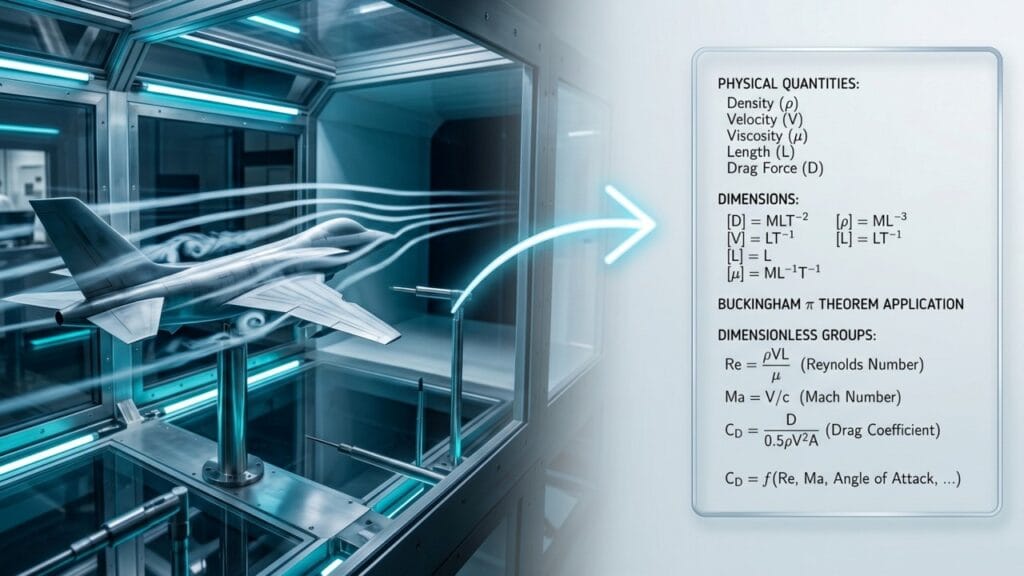
Fluid dynamicists use the Buckingham Pi theorem — a formal extension of dimensional analysis — to identify the dimensionless groups that govern fluid flow, such as the Reynolds number. Engineers apply it to model scale experiments: a small model tested in a wind tunnel can predict the behaviour of a full-scale aircraft if the relevant dimensionless numbers match.
In theoretical physics, dimensional analysis guided Planck in his early work on radiation and it played a significant role in identifying the natural units of the universe — what are now called Planck units — by combining fundamental constants to produce quantities of mass, length and time.
Learn more about 7 Real-World Applications of Dimensional Analysis You Never Knew
Learn more about Planck Units: The Natural Unit System That Defined the Universe’s Scale
Summary: The Key Rules at a Glance
| Rule | What It Means |
| Homogeneity principle | All terms in an equation must have equal dimensions |
| Dimensionless constants | Numbers like \( \pi \) and \( 2 \) do not affect dimensional checks |
| Function arguments | Arguments of sin, cos, log, exp must be dimensionless |
| Cannot find constants | Dimensional analysis gives the form, not the coefficient |
| Power rule for units | When a unit is raised to power n, so are its dimensions |
| Addition/subtraction rule | Only quantities with identical dimensions can be added or subtracted |
Conclusion
Dimensional analysis sits at an unusual intersection of simplicity and power. The rules are not complicated — they follow directly from the logical requirement that physical equations must make sense in terms of what each quantity actually represents. But the consequences of applying those rules carefully are far-reaching.
For students, mastering dimensional analysis means fewer careless errors, faster checks on numerical answers and a deeper understanding of why physics equations take the forms they do. For anyone going beyond textbooks, it is an indispensable first step before attempting any new derivation.
Work through the practice problems without looking at the solutions first. If you get stuck on the exponent-matching steps, go back and rederive a few dimensional formulas from scratch. That process — understanding where the dimensions come from, not just what they are — is what makes this technique genuinely yours.
Frequently Asked Questions
What is dimensional analysis in physics?
Dimensional analysis is a method of checking or deriving physical relationships by analyzing the dimensions (M, L, T, etc.) of the quantities involved. It is based on the principle that every valid physical equation must be dimensionally consistent — all terms must carry the same dimensions.
What are the three main uses of dimensional analysis?
The three main applications are: (1) checking whether an equation is dimensionally consistent, (2) deriving the form of a physical formula when the relevant variables are known and (3) converting a physical quantity from one system of units to another.
Why can dimensional analysis not find dimensionless constants?
Dimensionless constants like \( 2\pi \), \( \frac{1}{2} \), or \( \sqrt{2} \) have no units and therefore no dimensions. When you compare dimensions on both sides of an equation, these constants are invisible to the analysis. They can only be determined through detailed theoretical derivation or experimental measurement.
What does it mean for an equation to be dimensionally homogeneous?
A dimensionally homogeneous equation is one in which every term — on both sides, including terms being added or subtracted — has the same dimensional formula. If even one term differs dimensionally, the equation cannot be physically valid.
Can dimensional analysis prove that an equation is correct?
No. Dimensional analysis can only prove that an equation is definitely wrong (if it fails the dimensional check) or that it is possibly correct (if it passes). Many different equations can share the same dimensional form. The actual correctness of a physical law requires derivation from theory or verification through experiment.
What is the Buckingham Pi theorem?
The Buckingham Pi theorem is a formal generalization of dimensional analysis. It states that any physical equation involving n variables with k independent dimensions can be expressed as a relationship between \( n – k \) dimensionless groups (called Pi groups). It is widely used in fluid mechanics and engineering to identify the governing dimensionless parameters of a system.
Is dimensional analysis useful for JEE and NEET preparation?
Yes, very much. Dimensional analysis appears directly in both JEE Main and NEET as questions on checking equations, finding dimensional formulas of constants, deriving relations and unit conversion. It is also an indirect tool that helps across all of mechanics — any time you are unsure about a formula, a quick dimensional check can confirm or eliminate it.
Leave a Comment