

Introduction
Walk into any physics lab during Class 11 practicals and you will find students doing one of two things with a Vernier caliper: either reading it correctly with quiet confidence, or staring at the sliding scale with visible uncertainty, unsure which division to trust. The difference almost always comes down to one thing — whether they genuinely understand least count, or whether they memorized a formula without knowing what it means.
Least count is not just a formula you plug numbers into. It is the fundamental limit of what a measuring instrument can tell you. Once you understand that, reading a Vernier caliper or screw gauge becomes logical rather than procedural. This guide covers the concept from scratch, derives the formulas and walks through enough examples that the reading process becomes second nature.
What Is Least Count?
Least count (LC) is the smallest measurement that an instrument can make reliably. It is the minimum division that can be read directly — or inferred with confidence — from the instrument’s scale.
Every measuring instrument has a least count. A standard metre ruler graduated in millimetres has a least count of 1 mm. You simply cannot read anything smaller from it without guessing. A Vernier caliper extends that capability. A screw gauge extends it further still.
The significance of least count goes beyond the lab. It sets the number of significant figures your measurement can carry, it defines the absolute error of the instrument and it determines whether your instrument is appropriate for the measurement you are trying to make.
\[ \text{Absolute Error due to instrument} = \pm \frac{1}{2} \times \text{Least Count} \]
Or in many textbook conventions, simply:
\[ \text{Instrument Error} = \pm \text{Least Count} \]
Learn more about Absolute Error, Relative Error and Percentage Error: A Complete Guide
Part 1: The Vernier Caliper
What Is a Vernier Caliper?
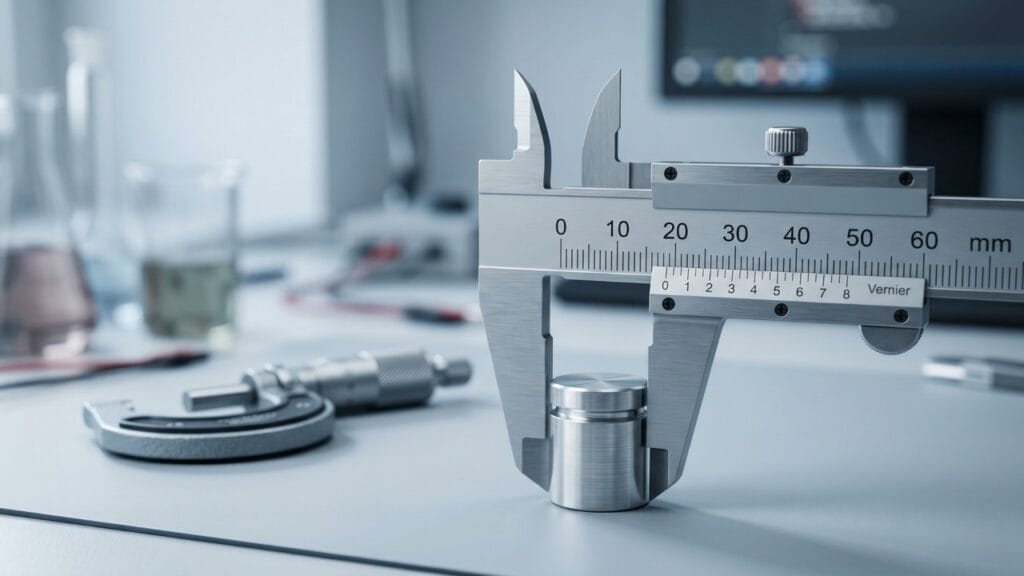
A Vernier caliper is a precision measuring instrument used to measure internal dimensions, external dimensions and depths with greater accuracy than a standard ruler. It achieves this through a clever secondary scale — the Vernier scale — that slides alongside the main scale.
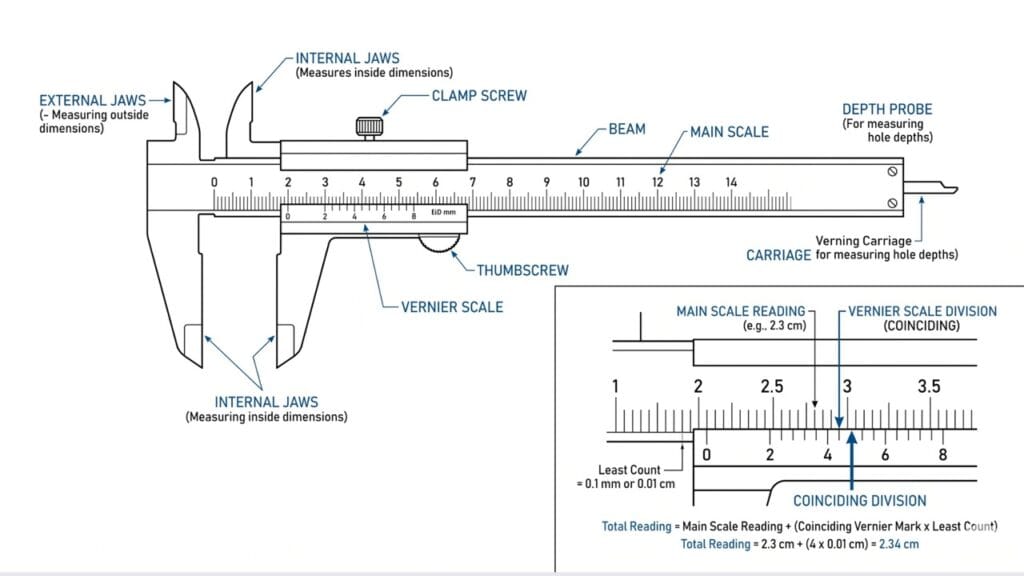
The instrument typically consists of:
- Main scale (also called the fixed scale): graduated in millimetres or centimetres
- Vernier scale (also called the sliding scale): a shorter scale that moves with the jaws
- External jaws: for measuring outer dimensions (length, diameter of a rod)
- Internal jaws: for measuring inner dimensions (diameter of a hollow cylinder)
- Depth probe: a thin rod at the tail end for measuring depths
How the Vernier Scale Works
The genius of Pierre Vernier’s design is that the Vernier scale is deliberately made slightly shorter than an equivalent number of main scale divisions. This small difference is what allows sub-division of the main scale.
On a standard Vernier caliper:
- 10 divisions of the Vernier scale = 9 divisions of the main scale
- 1 main scale division (MSD) = 1 mm
- Therefore, 1 Vernier scale division (VSD) = 0.9 mm
The difference between one MSD and one VSD:
\[ 1 \text{ MSD} – 1 \text{ VSD} = 1 \text{ mm} – 0.9 \text{ mm} = 0.1 \text{ mm} \]
That 0.1 mm difference is exactly the least count.
Formula for Least Count of Vernier Caliper
The least count of a Vernier caliper is defined as:
\[ \text{LC} = 1 \text{ MSD} – 1 \text{ VSD} \]
Which can also be written as:
\[ \text{LC} = \frac{\text{Smallest division on main scale}}{\text{Total number of divisions on Vernier scale}} \]
For a standard metric Vernier caliper:
\[ \text{LC} = \frac{1 \text{ mm}}{10} = 0.1 \text{ mm} = 0.01 \text{ cm} \]
For a Vernier caliper with 20 Vernier divisions:
\[ \text{LC} = \frac{1 \text{ mm}}{20} = 0.05 \text{ mm} \]
For a Vernier caliper with 50 Vernier divisions:
\[ \text{LC} = \frac{1 \text{ mm}}{50} = 0.02 \text{ mm} \]
The more divisions on the Vernier scale, the smaller the least count and the more precise the instrument.
How to Read a Vernier Caliper: Step-by-Step
Step 1: Read the main scale. Note the main scale reading immediately to the left of the zero of the Vernier scale. This gives you the value in whole millimetres (or centimetres).
Step 2: Find the coinciding Vernier division. Look along the Vernier scale and find the division that lines up most precisely with any division on the main scale. Note the number of that Vernier division — this is the Vernier scale reading (VSR).
Step 3: Apply the formula.
\[ \text{Total Reading} = \text{Main Scale Reading} + (\text{VSR} \times \text{LC}) \]
Solved Example 1: Reading a Vernier Caliper
Given:
- Least count = 0.01 cm
- Main scale reading = 2.3 cm (the 2.3 mark is just to the left of the Vernier zero)
- Vernier scale reading = 6 (the 6th Vernier division coincides with a main scale division)
Solution:
\[ \text{Total Reading} = 2.3 \text{ cm} + (6 \times 0.01 \text{ cm}) \]
\[ = 2.3 \text{ cm} + 0.06 \text{ cm} = 2.36 \text{ cm} \]
The measured value is 2.36 cm.
Solved Example 2: Vernier Caliper with 20 Divisions
Given:
- 20 Vernier scale divisions = 19 main scale divisions
- 1 MSD = 1 mm
- Main scale reading = 14 mm
- Vernier scale reading = 12th division coincides
Step 1: Find LC
\[ 1 \text{ VSD} = \frac{19}{20} \text{ mm} = 0.95 \text{ mm} \]
\[ \text{LC} = 1 \text{ MSD} – 1 \text{ VSD} = 1 – 0.95 = 0.05 \text{ mm} \]
Step 2: Total reading
\[ \text{Total Reading} = 14 + (12 \times 0.05) = 14 + 0.60 = 14.60 \text{ mm} \]
The measured value is 14.60 mm or 1.460 cm.
Explorer more with Vernier Caliper Simulator
What Is Zero Error in a Vernier Caliper?
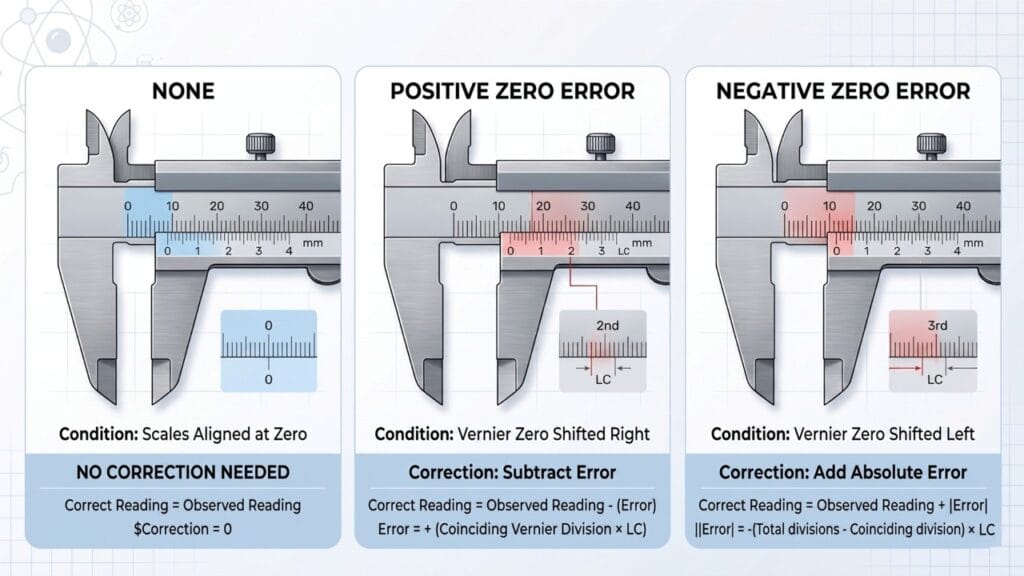
When the jaws of the Vernier caliper are completely closed, the zero of the Vernier scale should align perfectly with the zero of the main scale. If it does not, there is a zero error.
Positive zero error: The Vernier zero is to the right of the main scale zero when jaws are closed. The instrument reads a positive value when it should read zero.
Negative zero error: The Vernier zero is to the left of the main scale zero when jaws are closed. The instrument reads a negative value.
Correction:
\[ \text{Corrected Reading} = \text{Observed Reading} – \text{Zero Error} \]
If zero error is +0.02 cm and observed reading is 3.45 cm:
\[ \text{Corrected Reading} = 3.45 – 0.02 = 3.43 \text{ cm} \]
If zero error is −0.03 cm and observed reading is 3.45 cm:
\[ \text{Corrected Reading} = 3.45 – (-0.03) = 3.48 \text{ cm} \]
Part 2: The Screw Gauge
What Is a Screw Gauge?
A screw gauge (also called a micrometer screw gauge or simply a micrometer) is a precision instrument that uses the mechanical advantage of a finely threaded screw to achieve measurements accurate to 0.01 mm — and in some instruments, 0.001 mm.
The underlying principle is simple. When a screw rotates by one full revolution, it advances linearly by a fixed distance called the pitch. By dividing that linear advance into a large number of circular divisions, very small linear distances can be measured by counting partial rotations.
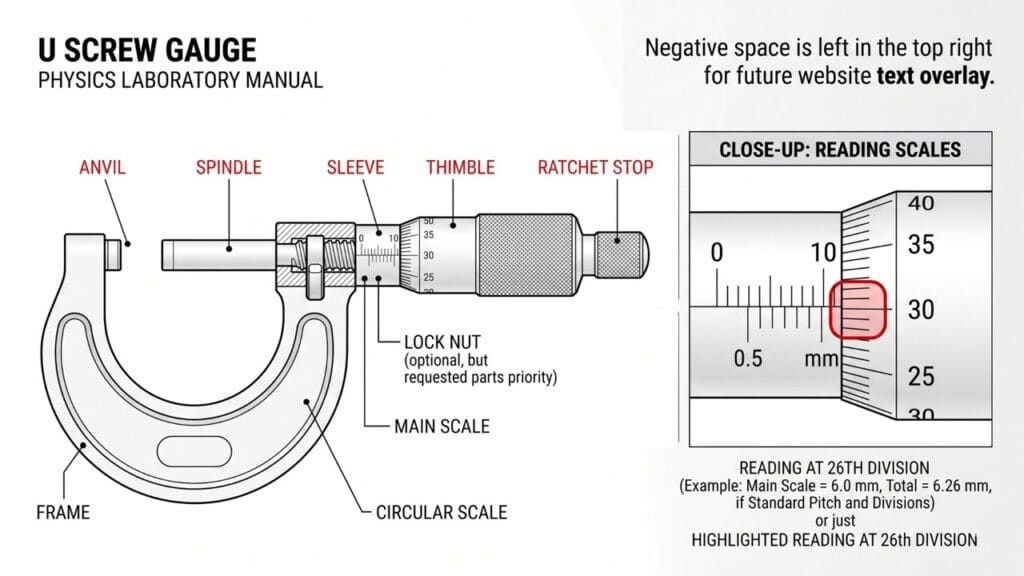
The key components are:
- Sleeve (barrel): Fixed scale with a horizontal reference line, graduated in 0.5 mm or 1 mm divisions
- Thimble: Rotates around the sleeve; its edge is divided into equal circular divisions (usually 50)
- Spindle: Advances linearly as the thimble rotates; makes contact with the object
- Anvil: Fixed contact surface opposite the spindle
- Ratchet stop: Ensures consistent, controlled pressure during measurement
Pitch of the Screw Gauge
The pitch of a screw is the distance the spindle advances in one complete rotation of the thimble.
\[ \text{Pitch} = \frac{\text{Distance moved by spindle}}{\text{Number of complete rotations}} \]
For a standard screw gauge:
- 1 full rotation advances the spindle by 0.5 mm
- Pitch = 0.5 mm
For some screw gauges:
- 1 full rotation advances the spindle by 1 mm
- Pitch = 1 mm
Formula for Least Count of Screw Gauge
\[ \text{LC} = \frac{\text{Pitch}}{\text{Number of divisions on the circular (thimble) scale}} \]
For a standard screw gauge with pitch = 0.5 mm and 50 circular scale divisions:
\[ \text{LC} = \frac{0.5 \text{ mm}}{50} = 0.01 \text{ mm} \]
For a screw gauge with pitch = 1 mm and 100 circular scale divisions:
\[ \text{LC} = \frac{1 \text{ mm}}{100} = 0.01 \text{ mm} \]
Both give the same least count. What changes is the pitch and number of divisions chosen to achieve it.
How to Read a Screw Gauge: Step-by-Step
Step 1: Read the main scale (sleeve reading). Look at the linear scale on the sleeve. Note the last fully visible mm marking. Also check whether the 0.5 mm graduation just above the reference line is visible — if it is, add 0.5 mm.
Step 2: Read the circular scale (thimble reading). Note which division on the circular scale aligns with the horizontal reference line on the sleeve. Multiply this number by the least count.
Step 3: Apply the formula.
\[ \text{Total Reading} = \text{Main Scale Reading} + (\text{Circular Scale Reading} \times \text{LC}) \]
Solved Example 3: Reading a Screw Gauge
Given:
- Pitch = 0.5 mm, Circular scale divisions = 50
- LC = 0.01 mm
- Main scale reading = 7.5 mm (the 7 mm mark is visible; the 0.5 mm mark above the reference line is also visible)
- Circular scale reading = 26 (the 26th division aligns with the reference line)
Solution:
\[ \text{Total Reading} = 7.5 \text{ mm} + (26 \times 0.01 \text{ mm}) \]
\[ = 7.5 + 0.26 = 7.76 \text{ mm} \]
The measured diameter is 7.76 mm.
Solved Example 4: Screw Gauge with 1 mm Pitch
Given:
- Pitch = 1 mm, Circular scale divisions = 100
- LC = 0.01 mm
- Main scale reading = 12 mm
- Circular scale reading = 38
Solution:
\[ \text{Total Reading} = 12 \text{ mm} + (38 \times 0.01 \text{ mm}) \]
\[ = 12 + 0.38 = 12.38 \text{ mm} \]
The measured value is 12.38 mm.
Explorer more with Screw Gauge Simulator
Zero Error in a Screw Gauge
Just like the Vernier caliper, a screw gauge must be checked for zero error before use.
Close the spindle against the anvil gently (using the ratchet). Observe where the circular scale zero aligns with the sleeve reference line.
No zero error: The 0 of the circular scale aligns exactly with the reference line.
Positive zero error: The zero of the circular scale is below the reference line when fully closed. The instrument shows a positive reading at zero gap.
Negative zero error: The zero is above the reference line. The instrument shows a reading above 0 when the gap should read zero.
Correction:
\[ \text{Corrected Reading} = \text{Observed Reading} – \text{Zero Error} \]
Example: Positive zero error = +0.03 mm, observed reading = 5.78 mm.
\[ \text{Corrected Reading} = 5.78 – 0.03 = 5.75 \text{ mm} \]
Example: Negative zero error = −0.04 mm, observed reading = 5.78 mm.
\[ \text{Corrected Reading} = 5.78 – (-0.04) = 5.82 \text{ mm} \]
Comparison: Vernier Caliper vs Screw Gauge
| Feature | Vernier Caliper | Screw Gauge |
| Operating principle | Vernier scale subdivides MSD | Screw rotation converts to linear motion |
| Standard least count | 0.1 mm or 0.01 mm | 0.01 mm |
| Range of measurement | Up to 15–30 cm | Up to 25 mm (typical) |
| Measurement types | Length, inner diameter, outer diameter, depth | Diameter, thickness, small lengths |
| Typical application | Ball bearings, pipes, blocks | Wire diameter, glass plate thickness |
| Accuracy | 0.01 mm (with 10 division Vernier) | 0.01 mm standard |
| Zero error type | Positive or negative | Positive or negative |
Both instruments measure to the same standard least count in their most common configurations. The practical difference is the range — Vernier calipers handle larger objects while screw gauges achieve the same precision over a much smaller measurement range.
LC Formula Summary Table
| Instrument | Formula | Standard Value |
| Vernier Caliper (10 div) | \( \frac{1 \text{ MSD}}{\text{No. of VSD}} = \frac{1 \text{ mm}}{10} \) | 0.1 mm |
| Vernier Caliper (20 div) | \( \frac{1 \text{ mm}}{20} \) | 0.05 mm |
| Vernier Caliper (50 div) | \( \frac{1 \text{ mm}}{50} \) | 0.02 mm |
| Screw Gauge (pitch 0.5 mm, 50 div) | \( \frac{0.5 \text{ mm}}{50} \) | 0.01 mm |
| Screw Gauge (pitch 1 mm, 100 div) | \( \frac{1 \text{ mm}}{100} \) | 0.01 mm |
Common Mistakes in Least Count Problems
Students consistently make a handful of predictable errors. Being aware of them is the first step to eliminating them.
1. Forgetting to check and correct for zero error. Always check for zero error before taking any reading. An uncorrected zero error propagates through every single measurement you take.
2. Confusing main scale reading with total reading. The main scale reading alone is not the answer. Always add the Vernier or circular scale component.
3. Missing the 0.5 mm mark on the screw gauge sleeve. On a 0.5 mm pitch screw gauge, if the 0.5 mm line is visible above the reference line, you must add 0.5 mm to your sleeve reading. Missing this gives an answer that is exactly 0.5 mm too low — a very obvious error that is also very commonly made.
4. Multiplying the wrong Vernier division by LC. The Vernier scale reading is the number of the division that coincides — not the value of that division on any scale. It is a count of divisions, multiplied by the LC.
5. Applying the zero error correction in the wrong direction. Subtract zero error (including its sign) from the observed reading. A positive zero error means the instrument reads too high — subtract it. A negative zero error means it reads too low — subtracting a negative adds the correction.
Learn more about Top 5 Errors in Physics Measurements and How to Minimize Them
Why Least Count Matters Beyond the Lab
Understanding least count connects directly to deeper ideas in physics — particularly the notion that every measurement has an inherent limit of precision and that this limit is not a failure of the experimenter but a physical property of the instrument and method.
The least count is the instrument’s contribution to measurement uncertainty. Even the most careful, experienced experimenter cannot extract information that the instrument simply does not have. Recognizing this is what separates thoughtful experimental physics from mechanical number-collection.
Learn more about Measurement Uncertainty in Physics: What It Is and Why It Always Exists
Learn more about How to Find Significant Figures: Rules, Examples & Common Mistakes
The least count also determines how many significant figures your measurement can meaningfully carry. A screw gauge reading of 7.76 mm is a 3-significant-figure result and that third figure (the 6 in 0.06 mm) is the one the instrument has just barely earned the right to report.
Learn more about How to Read a Measuring Instrument Correctly: Tips for Physics Lab
Practice Problems
Test yourself on these before looking at the solutions.
Problem 1: A Vernier caliper has 25 Vernier scale divisions equal to 24 main scale divisions. If 1 MSD = 1 mm, find the least count.
Solution: \[ 1 \text{ VSD} = \frac{24}{25} \text{ mm} = 0.96 \text{ mm} \] \[ \text{LC} = 1 – 0.96 = 0.04 \text{ mm} \]
Problem 2: A screw gauge has a pitch of 0.5 mm and 50 divisions on the circular scale. The main scale reads 4.0 mm and the circular scale reads 35. Zero error = +0.05 mm. Find the corrected reading.
Solution: \[ \text{LC} = \frac{0.5}{50} = 0.01 \text{ mm} \] \[ \text{Observed Reading} = 4.0 + (35 \times 0.01) = 4.0 + 0.35 = 4.35 \text{ mm} \] \[ \text{Corrected Reading} = 4.35 – 0.05 = 4.30 \text{ mm} \]
Problem 3: A Vernier caliper with LC = 0.01 cm has a zero error of −0.02 cm. The main scale reads 3.1 cm and the Vernier scale reads 7. Find the corrected reading.
Solution: \[ \text{Observed Reading} = 3.1 + (7 \times 0.01) = 3.1 + 0.07 = 3.17 \text{ cm} \] \[ \text{Corrected Reading} = 3.17 – (-0.02) = 3.17 + 0.02 = 3.19 \text{ cm} \]
Conclusion
Least count is the foundation of precision measurement. Without knowing it, an instrument reading is just a number — you have no idea whether to trust the last digit or whether you are missing a digit entirely. Once you do know it, every scale reading becomes a structured, confident process with a clear formula and a known uncertainty.
The Vernier caliper and screw gauge are the two instruments most likely to appear in your physics practicals, board exams and competitive exam theory questions. Learn the least count formulas for both, understand where zero error comes from and how to correct it and practice reading actual scales until the steps feel automatic.
The measurement you report is only as good as your understanding of the instrument you used. That is not just good exam technique — it is good physics.
Frequently Asked Questions
What is the least count of a standard Vernier caliper?
The least count of a standard Vernier caliper with 10 Vernier scale divisions is 0.1 mm or 0.01 cm. Some Vernier calipers have 20 or 50 divisions, giving least counts of 0.05 mm and 0.02 mm respectively.
What is the least count of a standard screw gauge?
A standard screw gauge with a pitch of 0.5 mm and 50 circular scale divisions has a least count of 0.01 mm. This is ten times more precise than the standard Vernier caliper, though it has a much smaller measurement range.
How do you calculate the least count of a Vernier caliper?
Use the formula: LC = 1 MSD − 1 VSD, or equivalently, LC = (smallest main scale division) ÷ (number of Vernier scale divisions). For a standard instrument: LC = 1 mm ÷ 10 = 0.1 mm.
How do you calculate the least count of a screw gauge?
Use the formula: LC = Pitch ÷ Number of circular scale divisions. For a standard screw gauge: LC = 0.5 mm ÷ 50 = 0.01 mm.
What is zero error and how do you correct for it?
Zero error occurs when the instrument shows a non-zero reading when the gap between measuring surfaces is zero. The correction is: Corrected Reading = Observed Reading − Zero Error. A positive zero error is subtracted; a negative zero error results in addition when you subtract a negative number.
Which is more precise — a Vernier caliper or a screw gauge?
In their standard configurations, both achieve the same least count of 0.01 mm. However, specialized screw gauges can achieve 0.001 mm, making them more precise. The Vernier caliper is more versatile in terms of measurement range and types of measurement (length, depth, internal and external diameters).
Why do we add 0.5 mm in a screw gauge reading sometimes?
On a screw gauge with 0.5 mm pitch, the sleeve has graduations at every 0.5 mm. When the thimble has moved past the 0.5 mm mark on the sleeve — making that mark visible above the reference line — you must add 0.5 mm to your sleeve reading before adding the circular scale reading. Missing this step gives a result that is 0.5 mm too low.
Leave a Comment