

Introduction
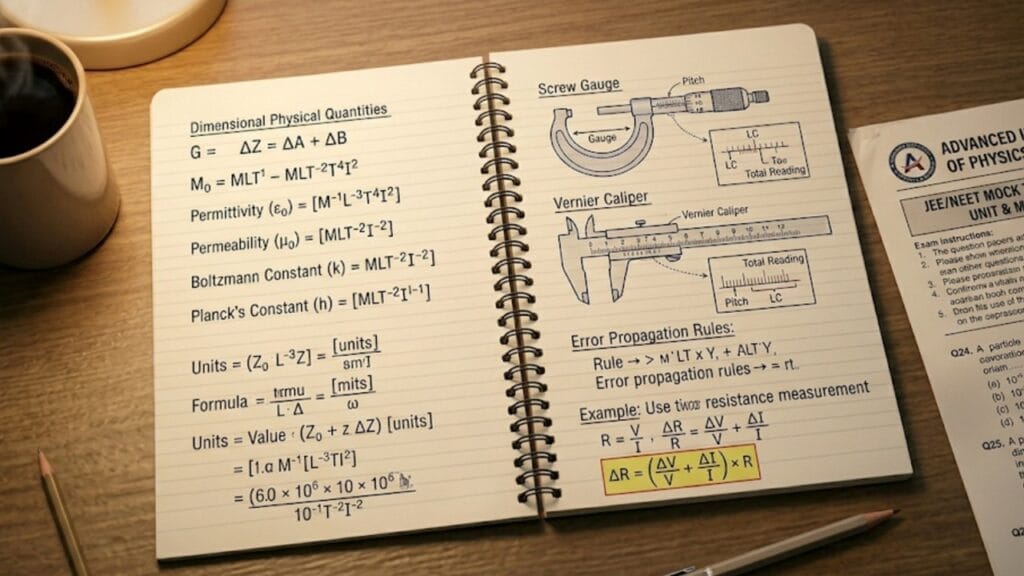
One-shot revision has a specific meaning in competitive exam preparation. It is not a casual re-read of the textbook. It is a single, intensive, cover-everything session designed to consolidate an entire chapter — concepts, formulas, question patterns, traps — so that nothing in the exam catches you off guard. Done well, one good session on a chapter like this should mean you never need to reopen it separately again.
This article is built as that session for Units and Measurements. Everything the chapter contains that JEE Main and NEET test is here, organized in the order most efficient for a single sitting. Work through it front to back without skipping sections. The chapter is not large. One focused session is genuinely sufficient.
Before You Begin: Know What the Exam Actually Tests
Most students spend time on this chapter proportional to how much they enjoy it, not proportional to how much it is tested. Here is the actual distribution of questions to calibrate your effort:
| Exam | Direct Questions | Marks | Concepts Tested |
| JEE Main | 1–2 per paper | 4–8 marks | Dimensional analysis, error propagation, sig figs, LC |
| NEET | 1–2 per paper | 4–8 marks | Dimensional formulas, error analysis, instrument reading |
| CBSE Board | 2–4 questions | 5–8 marks | All topics, practical component included |
Beyond direct questions, dimensional analysis and error concepts appear embedded inside questions from other chapters — mechanics, thermodynamics, optics, electromagnetism. Understanding this chapter properly pays compounding returns across the entire paper.
Block 1: Physical Quantities, Units and the SI System
What Makes a Complete Measurement
A physical quantity requires both a numerical value and a unit. Neither alone is meaningful. The product \( n \times u \) stays constant when the unit changes:
\[ n_1 u_1 = n_2 u_2 \]
If the unit doubles in size, the numerical value halves. The physical reality does not change.
The Seven SI Base Units — Exam-Ready Format
| Quantity | Unit | Symbol | Base of Definition |
| Length | metre | m | Speed of light |
| Mass | kilogram | kg | Planck’s constant |
| Time | second | s | Caesium-133 transition |
| Electric Current | ampere | A | Elementary charge |
| Temperature | kelvin | K | Boltzmann constant |
| Amount of Substance | mole | mol | Avogadro constant |
| Luminous Intensity | candela | cd | Luminous efficacy |
The 2019 revision redefined all seven base units in terms of fixed values of fundamental constants. JEE has tested this directly — know that the kilogram is now defined via Planck’s constant, not a physical artefact.
Learn more about The Revised SI System (2019): How Constants Redefined Our Units of Measurement
SI Prefixes: The Fast Conversion Tool
These prefixes appear constantly in numerical problems. Know them without pausing:
| Prefix | Symbol | Power |
| Tera | T | \( 10^{12} \) |
| Giga | G | \( 10^{9} \) |
| Mega | M | \( 10^{6} \) |
| Kilo | k | \( 10^{3} \) |
| Milli | m | \( 10^{-3} \) |
| Micro | μ | \( 10^{-6} \) |
| Nano | n | \( 10^{-9} \) |
| Pico | p | \( 10^{-12} \) |
| Femto | f | \( 10^{-15} \) |
Learn more about All SI Prefixes from Pico to Tera: Quick Reference Chart with Examples
Supplementary Units
- Plane angle: radian (rad)
- Solid angle: steradian (sr)
Both are dimensionless but retained for geometric clarity.
Special Units Worth Knowing
Some units appear in problems even though they are not SI. Know the conversions:
| Unit | Quantity | SI Equivalent |
| Angstrom (Å) | Length | \( 10^{-10} \) m |
| Fermi (fm) | Nuclear length | \( 10^{-15} \) m |
| Light Year | Astronomical distance | \( 9.46 \times 10^{15} \) m |
| Astronomical Unit (AU) | Solar system distance | \( 1.496 \times 10^{11} \) m |
| Parsec | Distance | \( 3.08 \times 10^{16} \) m |
| Electron Volt (eV) | Energy | \( 1.6 \times 10^{-19} \) J |
| Atomic Mass Unit (u) | Mass | \( 1.66 \times 10^{-27} \) kg |
Learn more about How Physicists Measure Astronomical Distances: From AU to Light Years
Block 2: Dimensional Analysis — The Highest-Yield Topic
Dimensional analysis generates more JEE and NEET questions than any other topic in this chapter. Every minute invested here has the highest return.
The Dimensional Formula
Every physical quantity \( Q \) can be expressed as:
\[ [Q] = M^a L^b T^c A^d K^e \cdots \]
In mechanics, only M, L and T are needed. For electromagnetism, A appears. For thermodynamics, K appears.
Master Table: Dimensional Formulas for JEE and NEET
Build intuition by deriving each one rather than memorizing. The defining formula is shown so you can reproduce the derivation under exam pressure.
Mechanics:
| Quantity | Defining Relation | Dimensional Formula |
| Velocity | displacement/time | \( [LT^{-1}] \) |
| Acceleration | velocity/time | \( [LT^{-2}] \) |
| Force | \( ma \) | \( [MLT^{-2}] \) |
| Momentum | \( mv \) | \( [MLT^{-1}] \) |
| Impulse | \( F \cdot t \) | \( [MLT^{-1}] \) |
| Work / Energy | \( F \cdot s \) | \( [ML^2T^{-2}] \) |
| Torque | \( F \times r \) | \( [ML^2T^{-2}] \) |
| Power | \( W/t \) | \( [ML^2T^{-3}] \) |
| Pressure / Stress | \( F/A \) | \( [ML^{-1}T^{-2}] \) |
| Density | \( m/V \) | \( [ML^{-3}] \) |
| Angular Velocity | \( \theta/t \) | \( [T^{-1}] \) |
| Angular Momentum | \( I\omega \) | \( [ML^2T^{-1}] \) |
| Moment of Inertia | \( mr^2 \) | \( [ML^2] \) |
| Surface Tension | \( F/l \) | \( [MT^{-2}] \) |
| Coefficient of Viscosity | Newton’s viscosity law | \( [ML^{-1}T^{-1}] \) |
| Spring Constant | \( F/x \) | \( [MT^{-2}] \) |
| Gravitational Constant G | \( F = Gm_1m_2/r^2 \) | \( [M^{-1}L^3T^{-2}] \) |
Modern Physics and Thermodynamics:
| Quantity | Defining Relation | Dimensional Formula |
| Planck’s Constant h | \( E = h\nu \) | \( [ML^2T^{-1}] \) |
| Boltzmann Constant k | \( E = kT \) | \( [ML^2T^{-2}K^{-1}] \) |
| Gas Constant R | \( PV = nRT \) | \( [ML^2T^{-2}K^{-1}mol^{-1}] \) |
| Stefan’s Constant σ | \( P = \sigma A T^4 \) | \( [MT^{-3}K^{-4}] \) |
Electromagnetism:
| Quantity | Defining Relation | Dimensional Formula |
| Charge | \( I \cdot t \) | \( [AT] \) |
| Electric Field | \( F/q \) | \( [MLT^{-3}A^{-1}] \) |
| Electric Potential | \( W/q \) | \( [ML^2T^{-3}A^{-1}] \) |
| Resistance | \( V/I \) | \( [ML^2T^{-3}A^{-2}] \) |
| Capacitance | \( q/V \) | \( [M^{-1}L^{-2}T^4A^2] \) |
| Magnetic Field B | \( F = qvB \) | \( [MT^{-2}A^{-1}] \) |
| Magnetic Flux | \( B \cdot A \) | \( [ML^2T^{-2}A^{-1}] \) |
| Inductance | \( V = L \cdot dI/dt \) | \( [ML^2T^{-2}A^{-2}] \) |
| Permittivity \( \varepsilon_0 \) | Coulomb’s law | \( [M^{-1}L^{-3}T^4A^2] \) |
| Permeability \( \mu_0 \) | Biot–Savart law | \( [MLT^{-2}A^{-2}] \) |
Learn more about What Is Dimensional Formula? Derivation, Applications & Limitations
Quantities That Share the Same Dimensional Formula
This is a dedicated exam question type. The four highest-frequency pairs:
| Shared Formula | Quantities |
| \( [ML^2T^{-2}] \) | Work, Energy, Torque, Heat |
| \( [MLT^{-1}] \) | Momentum, Impulse |
| \( [ML^2T^{-1}] \) | Angular Momentum, Planck’s Constant |
| \( [MT^{-2}] \) | Surface Tension, Spring Constant |
| \( [ML^{-1}T^{-2}] \) | Pressure, Stress, Bulk Modulus, Young’s Modulus |
| \( [T^{-1}] \) | Frequency, Angular Velocity |
The Three Applications of Dimensional Analysis
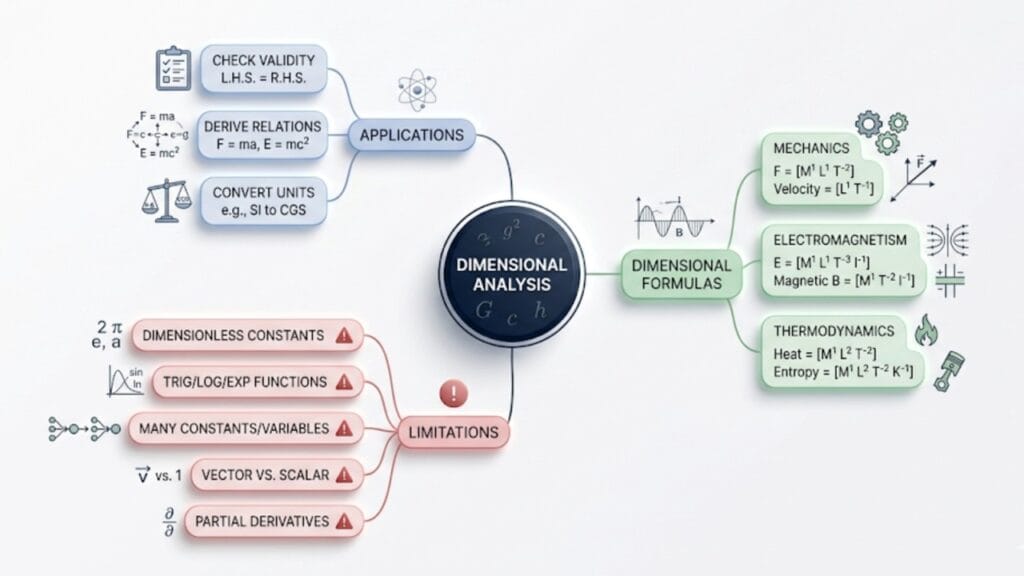
Application 1 — Checking Equation Validity
Verify that every term in the equation has the same dimensional formula. A single mismatched term invalidates the equation completely.
Rule: Arguments of \( \sin \), \( \cos \), \( \log \), \( e^x \) must be dimensionless. If a proposed formula has \( \sin(vt) \) where \( [vt] = L \neq M^0L^0T^0 \), that formula is immediately wrong.
Application 2 — Deriving Relationships
Assume the unknown quantity depends on specified variables. Write the expression with unknown exponents. Take dimensions of both sides and compare. Solve the three simultaneous equations for the exponents.
Application 3 — Unit System Conversion
\[ n_2 = n_1 \left[\frac{M_1}{M_2}\right]^a \left[\frac{L_1}{L_2}\right]^b \left[\frac{T_1}{T_2}\right]^c \]
The exponents \( a, b, c \) are taken directly from the dimensional formula of the quantity.
Learn more about How to Convert Units in Physics: Step-by-Step with Solved Examples
Limitations of Dimensional Analysis — Exam Direct Questions
Know all five. NEET has asked this as a direct MCQ:
- Cannot determine dimensionless constants — \( 2\pi \), \( \frac{1}{2} \), \( \frac{4}{3} \) etc.
- Cannot be applied to transcendental functions — \( \sin \), \( \cos \), \( \log \), \( e^x \)
- Cannot distinguish between quantities sharing the same dimensional formula — torque and work, for example
- Fails when more than three unknowns appear in a mechanics problem (only three equations from M, L, T)
- Cannot confirm an equation is physically correct — only that it is dimensionally consistent
Block 3: Significant Figures
This block is shorter than the others because the rules are fixed and the question types are limited. Master the rules and move on.
Six Rules for Identifying Significant Figures
| Rule | Example | Significant Figures |
| All non-zero digits count | 3572 | 4 |
| Captive zeros count | 3072 | 4 |
| Leading zeros never count | 0.00372 | 3 |
| Trailing zeros with decimal point count | 37.20 | 4 |
| Trailing zeros without decimal point: ambiguous | 3700 | 2, 3, or 4 |
| Exact numbers have infinite sig figs | 2 in \( \frac{1}{2}mv^2 \) | ∞ |
Two Calculation Rules
Multiplication and Division:
Sig figs in result = Fewest sig figs among all inputs
Addition and Subtraction:
Decimal places in result = Fewest decimal places among all inputs
This distinction is a trap question in competitive exams. The addition/subtraction rule uses decimal places — not significant figures. Students who apply the multiplication rule to addition problems consistently pick the wrong answer.
Learn more about How to Find Significant Figures: Rules, Examples & Common Mistakes
Block 4: Errors in Measurement
Error analysis is the most formula-dense part of this chapter and generates the largest share of numerical questions in both JEE and NEET. Every formula here is directly testable.
Types of Errors — Definitional Summary
Systematic Errors: Consistent, directional, repeatable. Cannot be reduced by averaging. Sources: instrument calibration, faulty technique, environmental factors, personal bias.
Random Errors: Bidirectional and unpredictable across readings. Reduced by averaging more readings. Sources: observation limitations, genuine variability in the system.
Gross Errors: Outright blunders. Eliminated by careful observation and checking.
The Complete Error Formula Chain
Every formula below must be applied in sequence for full-credit board answers. In JEE and NEET, numerical questions draw from any point in this chain.
Step 1 — Mean Value:
\[ \bar{x} = \frac{\sum_{i=1}^{n} x_i}{n} \]
Step 2 — Absolute Error of each reading:
\[ \Delta x_i = |x_i – \bar{x}| \]
Step 3 — Mean Absolute Error:
\[ \overline{\Delta x} = \frac{\sum_{i=1}^{n} \Delta x_i}{n} \]
Step 4 — Result with uncertainty:
\[ x = \bar{x} \pm \overline{\Delta x} \]
Step 5 — Relative Error:
\[ \delta_r = \frac{\overline{\Delta x}}{\bar{x}} \]
Step 6 — Percentage Error:
\[ \delta_\% = \frac{\overline{\Delta x}}{\bar{x}} \times 100\% \]
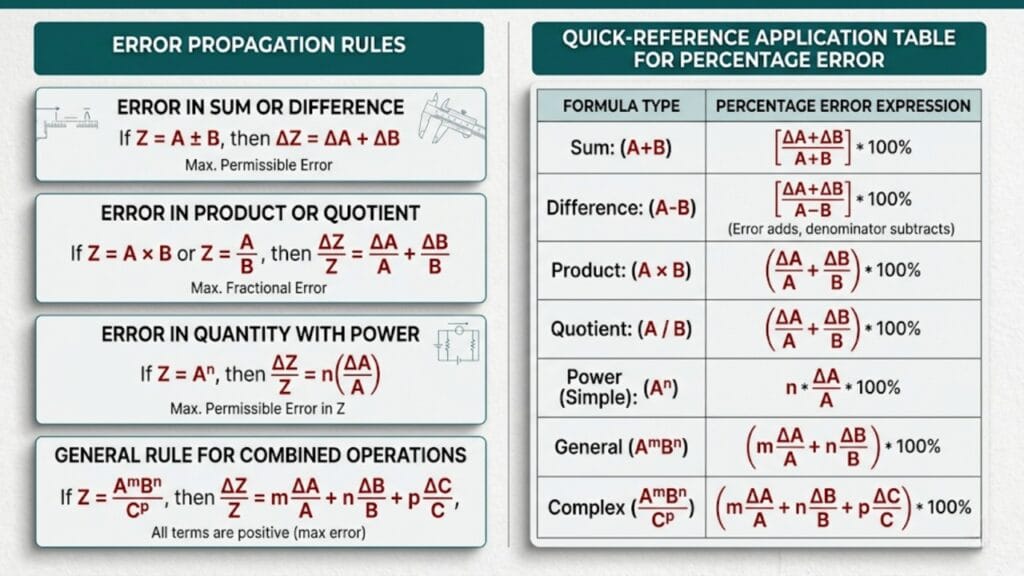
Error Propagation — The Four Rules
These four rules cover every numerical question on error propagation in JEE and NEET. No exceptions.
Rule 1 — Sum or Difference:
For \( Z = A \pm B \):
\[ \Delta Z = \Delta A + \Delta B \]
Rule 2 — Product or Quotient:
For \( Z = AB \) or \( Z = A/B \):
\[ \frac{\Delta Z}{Z} = \frac{\Delta A}{A} + \frac{\Delta B}{B} \]
Rule 3 — Power:
For \( Z = A^n \):
\[ \frac{\Delta Z}{Z} = |n| \cdot \frac{\Delta A}{A} \]
Rule 4 — General Formula:
For \( Z = \frac{A^p \cdot B^q}{C^r} \):
\[ \frac{\Delta Z}{Z} = p\frac{\Delta A}{A} + q\frac{\Delta B}{B} + r\frac{\Delta C}{C} \]
All exponents in Rule 4 are taken as positive values. A quantity in the denominator raised to power \( r \) still contributes \( +r \cdot \frac{\Delta C}{C} \) to the relative error.
Learn more about Propagation of Errors in Physics Calculations: Rules, Formulas & Examples
Error Propagation: Quick-Reference Application Table
| Formula for Z | Percentage Error in Z |
| \( Z = A + B \) or \( Z = A – B \) | \( \Delta Z = \Delta A + \Delta B \) (absolute) |
| \( Z = AB \) | \( \%Z = \%A + \%B \) |
| \( Z = A/B \) | \( \%Z = \%A + \%B \) |
| \( Z = A^2 \) | \( \%Z = 2 \times \%A \) |
| \( Z = \sqrt{A} = A^{1/2} \) | \( \%Z = \frac{1}{2} \times \%A \) |
| \( Z = A^2B \) | \( \%Z = 2\%A + \%B \) |
| \( Z = \frac{A^2}{\sqrt{B}} \) | \( \%Z = 2\%A + \frac{1}{2}\%B \) |
| \( Z = \frac{A^p B^q}{C^r} \) | \( \%Z = p\%A + q\%B + r\%C \) |
Rapid-Fire Solved Examples
Example 1: The percentage error in the measurement of mass is 1% and in volume is 3%. Find the percentage error in density.
\[ \rho = \frac{m}{V} \Rightarrow \%\rho = \%m + \%V = 1 + 3 = 4\% \]
Example 2: The period of a pendulum is \( T = 2\pi\sqrt{L/g} \). Percentage errors: L = 2%, T = 1%. Find percentage error in g.
\[ g = \frac{4\pi^2 L}{T^2} \Rightarrow \%g = \%L + 2(\%T) = 2 + 2(1) = 4\% \]
Example 3: The kinetic energy \( KE = \frac{1}{2}mv^2 \). Errors: m = 2%, v = 3%. Find percentage error in KE.
\[ \%KE = \%m + 2(\%v) = 2 + 6 = 8\% \]
Example 4: The Young’s modulus \( Y = \frac{FL}{A \Delta l} \). Errors: F = 1%, L = 1%, A = 2%, \( \Delta l \) = 4%. Find percentage error in Y.
\[ \%Y = \%F + \%L + \%A + \%\Delta l = 1 + 1 + 2 + 4 = 8\% \]
Block 5: Measuring Instruments — Least Count
Vernier Caliper
Least Count:
\[ \text{LC} = 1\text{ MSD} – 1\text{ VSD} = \frac{\text{Value of smallest main scale division}}{\text{Number of Vernier scale divisions}} \]
| Vernier Divisions | Least Count |
| 10 | 0.1 mm |
| 20 | 0.05 mm |
| 25 | 0.04 mm |
| 50 | 0.02 mm |
Reading:
\[ \text{Reading} = \text{MSR} + (\text{VSR} \times \text{LC}) – \text{Zero Error} \]
Screw Gauge (Micrometer)
Pitch:
Pitch = Distance moved by spindle in N rotations / N
Standard pitch: 0.5 mm
Least Count:
LC = Pitch / Number of circular scale divisions
Standard LC: \( 0.5 \text{ mm} \div 50 = 0.01 \text{ mm} \)
Reading:
Reading = Sleeve Reading + CSR × LC – Zero Error
Zero Error Correction (both instruments):
Corrected Reading = Observed Reading – Zero Error
Positive zero error → subtract it → corrected reading is lower
Negative zero error → subtracting a negative → corrected reading is higher
Learn more about Least Count of Vernier Caliper and Screw Gauge: Formula & Calculation
Block 6: Dimensionless Quantities — Fast Identification
NEET frequently asks which of the given quantities is dimensionless. JEE uses this concept to check formula arguments. Know this list completely:
- Strain (change in length ÷ original length)
- Refractive index
- Relative density (specific gravity)
- Poisson’s ratio
- Reynolds number
- Mach number
- Fine structure constant \( \alpha \)
- Angle in radians
- Solid angle in steradians
- Trigonometric ratios — sin, cos, tan
- Any argument inside sin, cos, log, or \( e^x \)
Block 7: Order of Magnitude
The order of magnitude of a number \( N = a \times 10^b \) (where \( 1 \leq a < 10 \) \):
\[ \text{Order of magnitude} = \begin{cases} 10^b & \text{if } a < \sqrt{10} \approx 3.162 \ 10^{b+1} & \text{if } a \geq \sqrt{10} \end{cases} \]
Examples:
- \( 2.9 \times 10^4 \): \( 2.9 < 3.162 \), order = \( 10^4 \)
- \( 4.1 \times 10^4 \): \( 4.1 > 3.162 \), order = \( 10^5 \)
- \( 0.007 = 7 \times 10^{-3} \): \( 7 > 3.162 \), order = \( 10^{-2} \)
Learn more about Fermi Estimation in Physics: Using Order of Magnitude to Solve Real Problems
Block 8: JEE and NEET Specific Traps
These are not general mistakes — they are the specific wrong-answer traps that paper-setters build into questions from this chapter. Knowing them explicitly is the difference between 4 marks and 0 marks on an otherwise-understood topic.
Trap 1 — Torque and Work Share Dimensions But Are Not Equivalent
Both have \( [ML^2T^{-2}] \). A question asking “which pair has the same dimensions” will list work and torque as a correct option. A question asking “which formula is dimensionally correct” will use this to construct a plausible but wrong equation. Know the distinction is physical, not dimensional.
Trap 2 — Error in \( T^2 \) Is Double the Error in \( T \)
From Rule 3: if \( \%\text{ error in } T = x\% \), then \( \%\text{ error in } T^2 = 2x\% \).
The pendulum formula rearranges to \( g = 4\pi^2 L/T^2 \). The error in g from T is doubled. Students who write \( \%g = \%L + \%T \) instead of \( \%L + 2\%T \) will get the distractor answer.
Trap 3 — Negative Zero Error Increases the Corrected Reading
Corrected = Observed − Zero Error. If zero error = −0.04 mm, then: \[ \text{Corrected} = \text{Observed} – (-0.04) = \text{Observed} + 0.04 \] Students who subtract the magnitude instead of the signed value lose marks here consistently.
Trap 4 — The 0.5 mm Graduation on the Screw Gauge Sleeve
On a 0.5 mm pitch screw gauge, the sleeve has markings at every 0.5 mm. If the thimble has moved past the 0.5 mm mark, that mark becomes visible and must be added to the sleeve reading. Missing it gives an answer exactly 0.5 mm too low — close enough to appear correct but wrong enough to miss.
Trap 5 — Significant Figures Rule for Addition Uses Decimal Places
The addition/subtraction rule is decimal places. A question presenting numbers with different significant figures in an addition problem is almost always designed to catch students applying the multiplication rule. Read the operation before deciding which rule to apply.
Trap 6 — Dimensional Consistency Does Not Prove Physical Correctness
A dimensionally consistent equation may still be physically wrong. Dimensional analysis is a necessary but not sufficient condition for correctness. Option questions sometimes include dimensionally valid formulas that are physically incorrect — be careful not to select an answer solely because it passes dimensional checking.
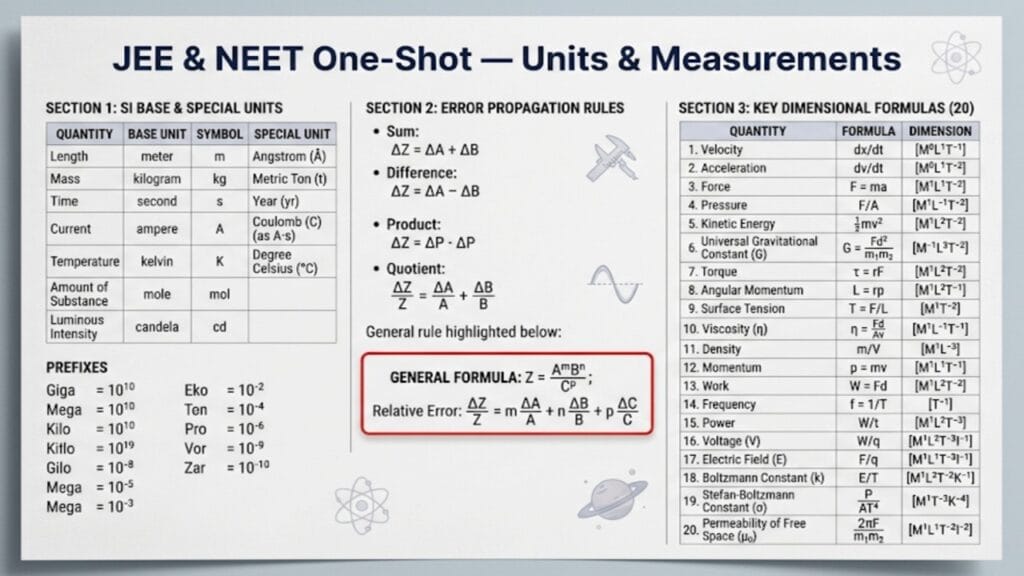
Complete Formula Reference: One-Shot Edition
| Category | Formula | What It Gives |
| Unit Conversion | \( n_1u_1 = n_2u_2 \) | Equivalence across unit systems |
| \( n_2 = n_1[M_1/M_2]^a[L_1/L_2]^b[T_1/T_2]^c \) | Dimensional conversion | |
| Significant Figures | Fewest sig figs (×÷) | Rounding products/quotients |
| Fewest decimal places (+−) | Rounding sums/differences | |
| Dimensional Analysis | \( [LHS] = [RHS] \) | Homogeneity check |
| \( Q = kA^x B^y C^z \) | Undetermined exponents method | |
| Error: Basic | \( \bar{x} = \sum x_i/n \) | Mean value |
| \( \Delta x_i = \|x_i – \bar{x}\| \) | Individual absolute error | |
| \( \overline{\Delta x} = \sum \Delta x_i / n \) | Mean absolute error | |
| \( x = \bar{x} \pm \overline{\Delta x} \) | Result statement | |
| \( \delta_r = \overline{\Delta x}/\bar{x} \) | Relative error | |
| \( \delta_\% = (\overline{\Delta x}/\bar{x}) \times 100 \) | Percentage error | |
| Error: Propagation | \( \Delta Z = \Delta A + \Delta B \) | Sum/difference |
| \( \Delta Z/Z = \Delta A/A + \Delta B/B \) | Product/quotient | |
| \( \Delta Z/Z = \|n\| \cdot \Delta A/A \) | Power | |
| \( \Delta Z/Z = p\Delta A/A + q\Delta B/B + r\Delta C/C \) | General | |
| Vernier Caliper | \( \text{LC} = 1\text{MSD}/n_\text{VSD} \) | Least count |
| \( R = \text{MSR} + \text{VSR} \times \text{LC} – \text{ZE} \) | Reading | |
| Screw Gauge | \( \text{LC} = \text{Pitch}/n_\text{CSD} \) | Least count |
| \( R = \text{SR} + \text{CSR} \times \text{LC} – \text{ZE} \) | Reading |
10-Question Self-Test: Assess Your Readiness
Attempt all ten before checking answers. Two minutes maximum per question — that is the exam pace.
Q1. Which of the following has the same dimensional formula as Planck’s constant?
(A) Angular velocity (B) Angular momentum (C) Linear momentum (D) Moment of inertia
Q2. The percentage error in mass is 1% and in velocity is 2%. The percentage error in kinetic energy \( \frac{1}{2}mv^2 \) is:
(A) 3% (B) 4% (C) 5% (D) 6%
Q3. A Vernier caliper has 20 Vernier divisions equal to 19 main scale divisions. If 1 MSD = 1 mm, what is the least count?
(A) 0.02 mm (B) 0.05 mm (C) 0.10 mm (D) 0.20 mm
Q4. Which formula is dimensionally incorrect?
(A) \( F = mv^2/r \) (B) \( E = mc^2 \) (C) \( v = \sqrt{P/\rho} \) (D) \( T = 2\pi\sqrt{m/k} \cdot r \)
Q5. The zero error of a screw gauge is −0.03 mm. The observed reading is 4.67 mm. What is the corrected reading?
(A) 4.64 mm (B) 4.70 mm (C) 4.67 mm (D) 4.34 mm
Q6. Five readings of a measurement are: 2.63, 2.56, 2.42, 2.71, 2.68 cm. What is the mean absolute error?
(A) 0.09 cm (B) 0.08 cm (C) 0.10 cm (D) 0.07 cm
Q7. Which of these quantities is dimensionless?
(A) Strain (B) Stress (C) Surface tension (D) Coefficient of viscosity
Q8. The dimensional formula of the universal gas constant R is:
(A) \( [ML^2T^{-2}K^{-1}] \) (B) \( [ML^2T^{-2}K^{-1}mol^{-1}] \) (C) \( [MLT^{-2}K^{-1}] \) (D) \( [ML^2T^{-3}K^{-1}] \)
Q9. The result of \( 2.56 + 38.4 + 1.234 \) to correct significant figures is:
(A) 42.194 (B) 42.2 (C) 42.19 (D) 42
Q10. In the formula \( Y = \frac{FL}{A\Delta l} \), errors in F, L, A and Δl are 1%, 1%, 2% and 4% respectively. The percentage error in Y is:
(A) 6% (B) 7% (C) 8% (D) 9%
Answer Key
| Q | Answer | Key Reasoning |
| 1 | B | \( [ML^2T^{-1}] \) — shared by angular momentum and Planck’s constant |
| 2 | C | \( 1\% + 2 \times 2\% = 5\% \) |
| 3 | B | \( 1\text{ VSD} = 19/20 = 0.95\text{ mm} \), \( \text{LC} = 1 – 0.95 = 0.05\text{ mm} \) |
| 4 | D | Option D has an extra factor r making dimensions wrong for time period |
| 5 | B | \( 4.67 – (-0.03) = 4.70\text{ mm} \) |
| 6 | A | Mean = 2.60; errors: 0.03, 0.04, 0.18, 0.11, 0.08; mean = 0.44/5 ≈ 0.09 cm |
| 7 | A | Strain = ΔL/L = dimensionless |
| 8 | B | R from \( PV = nRT \): \( [ML^2T^{-2}K^{-1}mol^{-1}] \) |
| 9 | B | Fewest decimal places: 38.4 has 1 decimal place → round to 42.2 |
| 10 | C | \( 1+1+2+4 = 8\% \) |
Revision Checklist: Do Not Enter the Exam Without These
Work through this list honestly. Every unchecked item is a potential mark lost.
- [ ] Can write all 7 SI base units and their symbols from memory
- [ ] Can state what physical constant defines each base unit (post-2019 SI)
- [ ] Can derive (not just state) dimensional formulas for 20+ quantities
- [ ] Can identify 5+ pairs of quantities with identical dimensional formulas
- [ ] Can state all 5 limitations of dimensional analysis
- [ ] Can apply the method of undetermined exponents to a fresh derivation problem
- [ ] Can state the significant figures rule for multiplication/division correctly
- [ ] Can state the significant figures rule for addition/subtraction correctly — and distinguish it from the multiplication rule
- [ ] Can write the complete error formula chain from mean to percentage error
- [ ] Can apply all four error propagation rules without hesitation
- [ ] Can calculate least count for any Vernier caliper specification
- [ ] Can calculate least count for any screw gauge specification
- [ ] Can read a Vernier caliper with positive and negative zero error
- [ ] Can read a screw gauge with positive and negative zero error
- [ ] Can identify at least 8 dimensionless quantities
- [ ] Can determine the order of magnitude of any number using the \( \sqrt{10} \) rule
Conclusion
The chapter is done. Every concept, every formula, every trap, every question type — covered in one sitting. What you do next determines whether this revision holds.
Close the article. Open a blank notebook. Write out the formula reference table from memory. Check it against the one here. Any formula you could not reproduce is the one to spend ten more minutes on. Then attempt five fresh problems from a previous year paper — JEE or NEET depending on your target.
That combination — one focused reading, one memory-recall test, five timed problems — is a proven revision cycle. Run it once for this chapter and it is done. The marks from Units and Measurements should be automatic from here.
Learn more about Units and Measurements for JEE Main: Important Topics, Formulas & PYQs
Frequently Asked Questions
How long does one-shot revision of Units and Measurements take?
A focused, uninterrupted reading of this article with active note-taking takes approximately 90 minutes. Add 30 minutes for the self-test and memory-recall exercise. Two hours total is sufficient for a complete revision session on this chapter for JEE and NEET.
Which block should I prioritize if I am short on time?
Block 2 (Dimensional Analysis) and Block 4 (Errors in Measurement) together account for approximately 80% of the direct questions from this chapter in both JEE Main and NEET. If time is genuinely limited, these two blocks and the formula reference table are the non-negotiable revision items.
Are the same topics tested in JEE Main and NEET from this chapter?
Largely yes, but with different emphasis. JEE Main tends toward more mathematically involved dimensional analysis questions and multi-step error propagation. NEET questions are more direct — identify a dimensional formula, find a percentage error, determine least count. Both exams test the same underlying concepts.
Is the order of magnitude topic important for JEE Main?
It appears occasionally — typically once every few years. The \( \sqrt{10} \) rule for determining order of magnitude is the specific detail most often tested. It is a small topic that takes five minutes to master, so there is no reason to skip it.
How do I avoid the significant figures trap in addition problems?
Before applying any significant figures rule, identify the arithmetic operation. If the operation is addition or subtraction, apply the decimal places rule. If it is multiplication or division, apply the significant figures rule. Making this two-step check a habit before every rounding step will eliminate this error category completely.
Should I practice instrument reading problems from NCERT or from other sources?
Start with NCERT examples — they cover the standard cases. Then practice from previous year JEE and NEET papers, which include the non-standard cases: uncommon Vernier division counts, screw gauges with non-standard pitch and zero error scenarios. The NCERT examples alone are not sufficient preparation for competitive exam instrument questions.
What is the most common reason students lose marks in error analysis?
Forgetting to multiply the relative error by the absolute value of the exponent when a variable appears as a power. The formula \( \Delta Z/Z = |n| \cdot \Delta A/A \) must use \( |n| \), not \( n \). In the pendulum formula where g is proportional to \( T^{-2} \), the contribution of T to the error in g is \( 2 \times \%T \), not \( -2 \times \%T \) and certainly not \( 1 \times \%T \).
Leave a Comment