

Introduction
Significant figures are one of those topics that seem deceptively simple at first glance. Count the digits, right? Except students consistently lose marks on them — in board exams, in JEE, in NEET and in physics lab reports. The rules have specific edge cases that trip people up repeatedly and the mistakes are almost always the same ones.
This guide covers everything you need: what significant figures actually mean, all the rules for identifying them, how they work in calculations, worked examples and the common mistakes to avoid. By the end, you should be able to handle any significant figures problem without second-guessing yourself.
What Are Significant Figures and Why Do They Matter?
Every measurement you take in a physics lab carries a degree of uncertainty. A ruler can measure to the nearest millimetre. A Vernier calliper can go further. A laser interferometer can go much, much further. The number of significant figures in a measurement tells the reader exactly how precise that measurement is — how many of its digits are actually meaningful.
When you write a length as 4.5 m, you are saying you know it to the nearest 0.1 m. When you write 4.500 m, you are saying you know it to the nearest 0.001 m. These two numbers are mathematically equal but scientifically very different statements. The trailing zeros in 4.500 are not decoration — they are claims about precision.
This is why significant figures matter. They are a compact, universally understood way of communicating measurement confidence. Ignore them and you either overclaim precision you do not have or throw away precision you worked hard to achieve.
Learn more about Accuracy vs Precision in Physics: Definition, Difference & Real-World Examples
The Rules for Identifying Significant Figures
There are six rules. Learn them in order — each one handles a specific category of digit.
Rule 1: All Non-Zero Digits Are Significant
This is the baseline. Any digit from 1 through 9 is always significant.
- \( 347 \) → 3 significant figures
- \( 8.192 \) → 4 significant figures
- \( 56.7823 \) → 6 significant figures
No ambiguity here. Non-zero digits are always counted.
Rule 2: Zeros Between Non-Zero Digits Are Significant
A zero sandwiched between two non-zero digits is called a captive zero or trapped zero. It is always significant — it has to be there and it carries real information about the measurement.
- \( 4008 \) → 4 significant figures (the two zeros are captive)
- \( 30.07 \) → 4 significant figures
- \( 1.0005 \) → 5 significant figures
Think about it physically: if you measure something as 4008 m and not 4008 m, those zeros tell you it is not 4100 m or 3900 m. They matter.
Rule 3: Leading Zeros Are Never Significant
Leading zeros are zeros that appear before the first non-zero digit. They are placeholders only — they communicate the magnitude of the number but carry no precision information.
- \( 0.0042 \) → 2 significant figures (4 and 2)
- \( 0.00700 \) → 3 significant figures (7, 0, 0)
- \( 0.305 \) → 3 significant figures (3, 0, 5 — the leading zero is not counted)
A useful test: convert the number to scientific notation. Whatever digits appear in the coefficient are the significant figures. \( 0.0042 = 4.2 \times 10^{-3} \) — two significant figures, clearly.
Rule 4: Trailing Zeros in a Number With a Decimal Point Are Significant
If a number has a decimal point written explicitly, trailing zeros (zeros at the right end) are significant. They represent real precision.
- \( 4.500 \) → 4 significant figures
- \( 120.0 \) → 4 significant figures
- \( 3.00 \times 10^8 \) → 3 significant figures
Writing 4.500 instead of 4.5 is a deliberate choice. It is a claim that the measurement is known to the nearest 0.001 — not just 0.1.
Rule 5: Trailing Zeros in a Whole Number Without a Decimal Point Are Ambiguous
This is where genuine ambiguity exists in the standard notation.
- \( 1200 \) — could be 2, 3, or 4 significant figures. There is no way to tell.
Does 1200 mean “roughly 1200” (2 significant figures), or was it measured to the nearest 10 (3 sig figs), or to the nearest 1 (4 sig figs)? Without additional context, you cannot know.
The solution is to use scientific notation, which removes all ambiguity:
- \( 1.2 \times 10^3 \) → 2 significant figures
- \( 1.20 \times 10^3 \) → 3 significant figures
- \( 1.200 \times 10^3 \) → 4 significant figures
For this reason, significant figures problems in exams usually either provide a decimal point explicitly or give values in scientific notation. When they do not, pay attention to the context.
Rule 6: Exact Numbers Have Infinite Significant Figures
Some quantities are defined exactly, not measured. These carry infinite significant figures and do not limit the precision of a calculation.
- The number 2 in \( KE = \frac{1}{2}mv^2 \) is exact.
- Counting numbers: if there are exactly 12 students in a lab, that 12 is exact.
- Defined conversion factors: \( 1 \text{ km} = 1000 \text{ m} \) exactly.
When you multiply \( 5.34 \text{ m} \) by the exact number 2, the result should have 3 significant figures — the same as 5.34. The exact 2 does not constrain precision.
Summary Table: Significant Figure Rules
| Type of Zero | Example | Significant? |
| Captive zero (between non-zeros) | 4008 | Yes |
| Leading zero (before first non-zero digit) | 0.0042 | No |
| Trailing zero with decimal point present | 4.500 | Yes |
| Trailing zero without decimal point | 1200 | Ambiguous |
| Non-zero digit | 7, 3, 9… | Always yes |
| Exact numbers | 2, 12, 1000 (defined) | Infinite sig figs |
Significant Figures in Calculations
Identifying significant figures in a single number is only half the story. The real skill is knowing how many significant figures your calculated answer should carry.
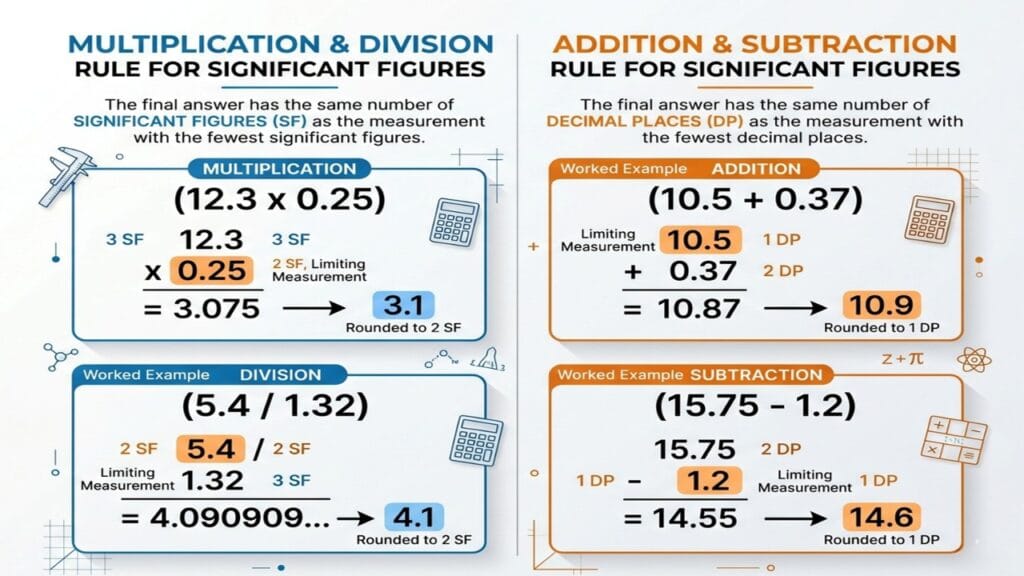
Rule for Multiplication and Division
The result should have the same number of significant figures as the measurement with the fewest significant figures.
Example:
\[ \frac{4.836 \times 1.2}{3.67} \]
- 4.836 → 4 sig figs
- 1.2 → 2 sig figs
- 3.67 → 3 sig figs
The limiting measurement is 1.2 with 2 significant figures. So the answer must be rounded to 2 significant figures.
\[ \frac{4.836 \times 1.2}{3.67} = \frac{5.8032}{3.67} \\ \approx 1.581… \approx 1.6 \]
Answer: 1.6 (2 significant figures)
Rule for Addition and Subtraction
The result should be rounded to the same number of decimal places as the measurement with the fewest decimal places.
Note carefully — this rule is about decimal places, not total significant figures. This distinction matters.
Example:
\[ 12.52 + 349.0 + 8.24 \]
- 12.52 → 2 decimal places
- 349.0 → 1 decimal place
- 8.24 → 2 decimal places
The limiting measurement is 349.0 with 1 decimal place. Round the result to 1 decimal place.
\[ 12.52 + 349.0 + 8.24 = 369.76 \\ \approx 369.8 \]
Answer: 369.8
Rounding Rules for Significant Figures
After determining how many significant figures your answer needs, you must round correctly.
- If the digit being dropped is less than 5, round down (leave the preceding digit unchanged).
- If the digit being dropped is greater than 5, round up.
- If the digit being dropped is exactly 5:
- If followed by non-zero digits, round up.
- If it is the last digit (or followed only by zeros), use the round-half-to-even rule (banker’s rounding): round to whichever preceding digit is even. This minimizes cumulative rounding error.
Examples:
- \( 3.745 \) rounded to 3 sig figs → \( 3.74 \) (the 4 is even, so round down)
- \( 3.755 \) rounded to 3 sig figs → \( 3.76 \) (the 6 is even, so round up)
- \( 3.7451 \) rounded to 3 sig figs → \( 3.75 \) (5 followed by non-zero digit → round up)
In practice, for most school and competitive exam problems, the simpler rule — round 5 up always — is used and accepted. The round-half-to-even convention is more important in computational and experimental contexts.
Worked Examples: Counting Significant Figures
Work through each of these and check your reasoning against the explanation.
Example Set 1: Identify the Number of Significant Figures
| Number | Significant Figures | Reasoning |
| 503 | 3 | Captive zero between 5 and 3 |
| 0.00304 | 3 | Leading zeros not counted; captive zero is counted |
| 5.00 | 3 | Trailing zeros after decimal point are significant |
| 10,000 | Ambiguous (1–5) | No decimal point; use scientific notation to clarify |
| \( 1.00 \times 10^4 \) | 3 | Scientific notation: 1, 0, 0 all significant |
| 0.08060 | 4 | Leading zero not counted; 8, 0, 6, 0 are significant |
| 200.0 | 4 | Decimal point present; trailing zero is significant |
| 3600 | 2 or more | Ambiguous without decimal point |
Example Set 2: Significant Figures in Calculations
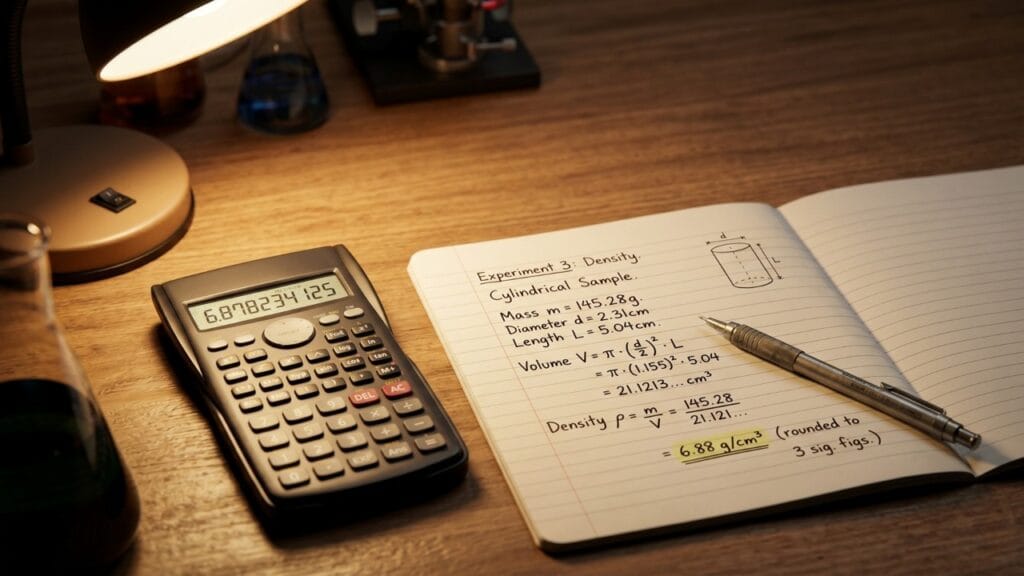
Problem 1: Calculate the density of an object with mass \( 12.5 \text{ g} \) and volume \( 4.13 \text{ cm}^3 \).
\[ \rho = \frac{m}{V} = \frac{12.5}{4.13} = 3.0266… \text{ g/cm}^3 \]
- 12.5 → 3 sig figs
- 4.13 → 3 sig figs
Result rounded to 3 significant figures: \( \rho = 3.03 \text{ g/cm}^3 \)
Problem 2: A student records three length measurements: 23.1 cm, 0.82 cm and 100.0 cm. Find the total length.
\[ 23.1 + 0.82 + 100.0 = 123.92 \text{ cm} \]
Decimal places:
- 23.1 → 1 decimal place
- 0.82 → 2 decimal places
- 100.0 → 1 decimal place
Limit: 1 decimal place.
Answer: \( 123.9 \text{ cm} \)
Problem 3: Find the area of a rectangle with sides \( 5.7 \text{ m} \) and \( 3.25 \text{ m} \).
\[ A = 5.7 \times 3.25 = 18.525 \text{ m}^2 \]
- 5.7 → 2 sig figs
- 3.25 → 3 sig figs
Limit: 2 significant figures.
Answer: \( A = 19 \text{ m}^2 \)
Common Mistakes Students Make with Significant Figures
These are the errors that appear again and again — in lab reports, in exam papers, in competitive exam marking schemes. Knowing them explicitly makes them easier to avoid.
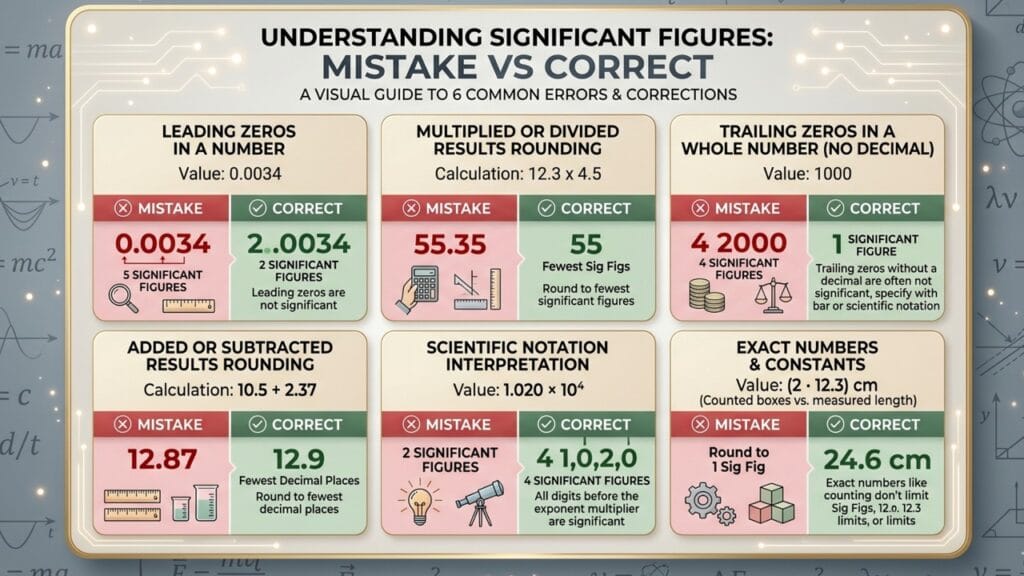
Mistake 1: Counting Leading Zeros as Significant
\( 0.0056 \) has 2 significant figures, not 4. The zeros before 5 are placeholders. They vanish entirely when you write the number in scientific notation: \( 5.6 \times 10^{-3} \).
Mistake 2: Ignoring Trailing Zeros After a Decimal Point
Writing \( 3.80 \) and \( 3.8 \) look almost identical, but they are not the same scientific statement. \( 3.80 \) has 3 significant figures. \( 3.8 \) has 2. Dropping the trailing zero when it is meaningful loses precision information.
Mistake 3: Applying the Multiplication Rule to Addition Problems
This is extremely common. Students see a calculation and instinctively think “use the fewest significant figures.” But for addition and subtraction, the rule is about decimal places, not total significant figures.
\( 100.0 + 1.234 \) is not limited to 1 significant figure just because 100.0 appears to have 4 sig figs while 1.234 has 4. The rule says round to 1 decimal place — giving 101.2, which has 4 significant figures.
Mistake 4: Rounding Intermediate Results
Never round intermediate steps in a multi-step calculation. Carry all digits through each step and round only the final answer. Rounding at every step compounds rounding errors and can push your final answer significantly off target.
Mistake 5: Treating Ambiguous Trailing Zeros as Always Significant
\( 8500 \) is not automatically 4 significant figures. Without a decimal point or scientific notation, those trailing zeros are ambiguous. Do not assume. If a problem provides this number, use the context to judge; if you are writing it yourself, use scientific notation.
Mistake 6: Confusing Significant Figures with Decimal Places
These are different things. Significant figures count all meaningful digits starting from the first non-zero digit. Decimal places count only digits after the decimal point. \( 0.00450 \) has 3 significant figures but 5 decimal places.
Significant Figures vs Significant Digits vs Decimal Places
These three terms describe related but different ideas. Confusing them is the source of many errors.
| Term | What It Counts | Example: 0.00450 |
| Significant figures | All meaningful digits, starting from first non-zero | 3 (4, 5, 0) |
| Decimal places | Digits after the decimal point | 5 |
| Significant digits | Same as significant figures | 3 |
“Significant figures” and “significant digits” mean exactly the same thing. “Decimal places” is a completely separate concept.
Significant Figures in the Context of Measurement and Error
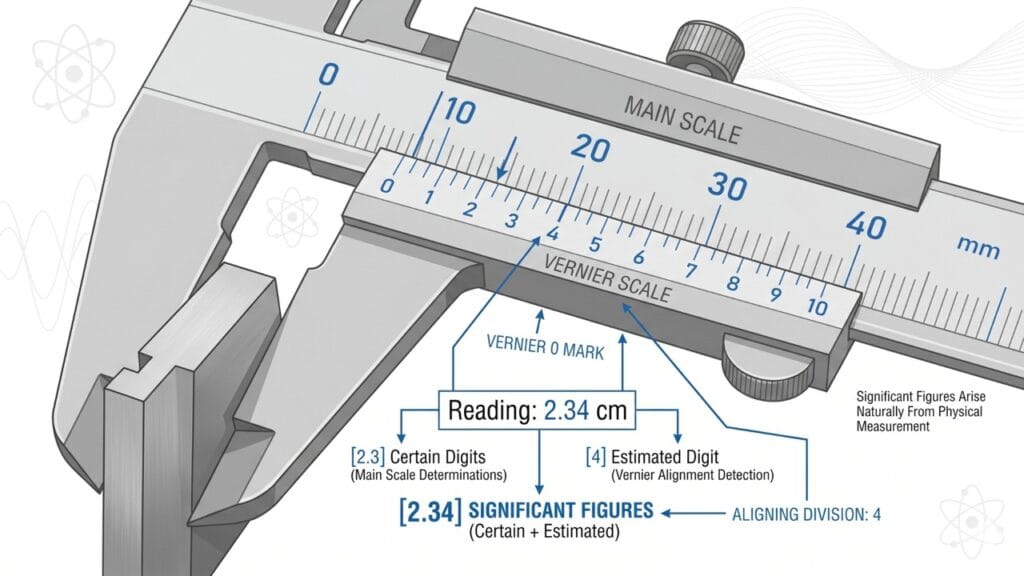
Significant figures are directly linked to the precision of measuring instruments and the concept of experimental error. When you read a length from a ruler graduated in millimetres, your measurement is reliable to the nearest mm. You might estimate one further digit, giving you uncertainty in the last place.
This connection — between significant figures and the least count of an instrument — is something every physics student doing lab work needs to understand properly.
Learn more about Absolute Error, Relative Error and Percentage Error: A Complete Guide
Learn more about Least Count of Vernier Caliper and Screw Gauge: Formula & Calculation
The number of significant figures in your measured value directly determines how many significant figures are meaningful in any quantity you calculate from it. This is not just a bookkeeping convention — it reflects the actual limits of knowledge imposed by your measurement.
Learn more about Measurement Uncertainty in Physics: What It Is and Why It Always Exists
Quick Reference: Significant Figures Rules for Exams
If you are doing a last-minute revision before an exam, these are the essential points to carry into the hall:
- Non-zero digits → always significant
- Captive zeros → always significant
- Leading zeros → never significant
- Trailing zeros with decimal point → significant
- Trailing zeros without decimal point → ambiguous; scientific notation resolves this
- For multiplication/division: match the fewest significant figures in the inputs
- For addition/subtraction: match the fewest decimal places in the inputs
- Round only the final answer, not intermediate steps
- Exact numbers do not limit significant figures
Conclusion
Significant figures are the physics community’s way of being honest about what a measurement actually knows. They are not arbitrary rules imposed to make calculations tedious — they exist because numbers without context about their precision are incomplete scientific statements.
The rules themselves are not complicated. Six rules for identification, two rules for calculations. What makes the topic challenging is the edge cases: the ambiguous trailing zeros, the distinction between decimal places and significant figures in the addition rule and the instinct to round too early in multi-step problems.
Work through the examples in this article until the rules feel intuitive rather than memorized. Test yourself on the mistake list — if any of those six errors sound unfamiliar rather than obvious, spend more time there. Significant figures will show up in every physics calculation you do, in every lab report you write and in every exam you sit. Getting them right, consistently, is a habit worth building now.
Frequently Asked Questions
How do I find the number of significant figures in a decimal number?
Start from the first non-zero digit and count every digit from there to the right, including all zeros after that point. For example, in 0.003040, start from 3: count 3, 0, 4, 0 — that gives 4 significant figures.
Are trailing zeros significant?
It depends. Trailing zeros after a decimal point are always significant (4.500 has 4 sig figs). Trailing zeros in a whole number without a decimal point are ambiguous (1200 could be 2, 3, or 4 sig figs). Scientific notation removes all ambiguity.
How many significant figures should my answer have?
For multiplication and division, your answer should have the same number of significant figures as the input with the fewest. For addition and subtraction, your answer should have the same number of decimal places as the input with the fewest decimal places.
Is 0.050 two or three significant figures?
Three. The leading zero is not significant, but the 5 is and the trailing zero after the decimal point is significant because it indicates measured precision. So 0.050 = \( 5.0 \times 10^{-2} \) — three significant figures.
Why do significant figures matter in physics experiments?
Because every measurement has uncertainty and significant figures communicate the degree of that uncertainty. Reporting more digits than your instrument can reliably measure is a false claim of precision. Reporting fewer throws away real information. Significant figures ensure your reported result is honest about what you actually know.
What is the difference between precision and significant figures?
Precision describes how reproducible or fine-grained a measurement is. Significant figures are the notation used to express that precision numerically. A measurement reported as 4.500 m is more precise than one reported as 4.5 m — and the significant figures (4 vs 2) encode that difference directly.
Do exact numbers affect the number of significant figures in a result?
No. Exact numbers — defined constants, counting numbers and exact conversion factors — have infinite significant figures by definition. When you use an exact number in a calculation, it does not limit the significant figures of the result. Only measured quantities impose that limit.
Leave a Comment