

Introduction: The One Thing Physics Cannot Function Without
Before you learn about force, motion, energy, or anything else in physics — there is one concept that quietly underpins all of it. Units of measurement.
Here is a simple way to see why they matter. Suppose someone tells you: “The train will arrive in 45.” Forty-five what? Minutes? Hours? Seconds? That single missing word changes everything. Now carry that problem into a physics experiment, an engineering calculation, or a space mission — and you begin to understand why an undefined or incorrect unit is not just confusing. It is dangerous.
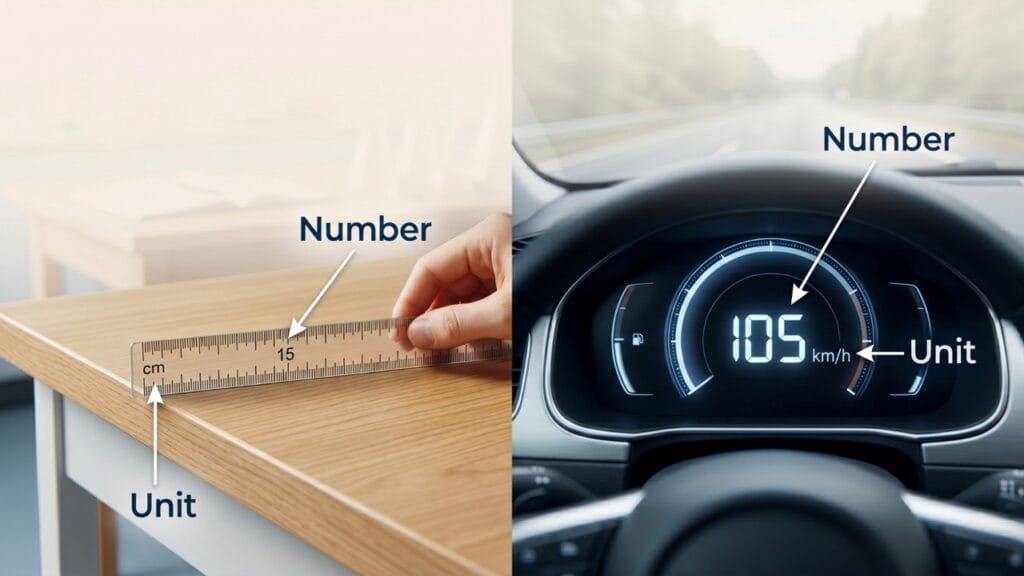
Units of measurement are the agreed-upon standards that allow us to quantify the physical world. They are what make a number meaningful. In physics, every measured quantity consists of two parts: a numerical value and a unit. Remove the unit and the number alone tells you almost nothing.
This guide is for students who are just getting started with physics — particularly the chapter on Units and Measurements under Mechanics. We will go from the ground up: what units are, how they are organised, how to work with them and why getting them right is non-negotiable.
What Exactly Is a Unit of Measurement?
A unit of measurement is a definite, standardised magnitude of a physical quantity, adopted by convention, against which all other quantities of the same kind are compared.
Put simply: it is the reference. When you say a desk is 120 cm long, the centimetre is the reference length. The number 120 tells you how many times that reference fits into the actual length of the desk.
Every physical measurement follows this structure:
\[ \text{Physical Quantity} = \text{Numerical Value} \times \text{Unit} \]
Or more compactly:
\[ Q = n \cdot u \]
Where:
- \( Q \) is the physical quantity
- \( n \) is the numerical value
- \( u \) is the chosen unit
This is the foundational equation of measurement. It looks almost trivially simple. But the implication is profound: if you change the unit, the numerical value changes too — the physical quantity \( Q \) itself does not. A length of 1 metre is also 100 centimetres. Same physical length, different unit, different number.
Types of Physical Quantities: Fundamental and Derived
Not all physical quantities are measured independently. In fact, the entire framework of measurement is built on a small set of base quantities, from which everything else is constructed.
Fundamental (Base) Quantities
These are quantities that are defined independently — they cannot be expressed in terms of other physical quantities. The internationally accepted system uses seven fundamental quantities.
| Fundamental Quantity | SI Unit | Symbol |
| Length | Metre | m |
| Mass | Kilogram | kg |
| Time | Second | s |
| Electric Current | Ampere | A |
| Thermodynamic Temperature | Kelvin | K |
| Amount of Substance | Mole | mol |
| Luminous Intensity | Candela | cd |
These seven are the pillars. Everything else in physics — speed, force, pressure, energy — is built on top of them.
Derived Quantities
Derived quantities are combinations of fundamental ones. Their units are obtained by multiplying or dividing the base units.
A few examples:
- Speed = Distance / Time → Unit: \( \text{m/s} \) or \( \text{m s}^{-1} \)
- Force = Mass × Acceleration → Unit: \( \text{kg m s}^{-2} \) → called the Newton (N)
- Pressure = Force / Area → Unit: \( \text{N m}^{-2} \) → called the Pascal (Pa)
- Energy = Force × Distance → Unit: \( \text{N m} \) → called the Joule (J)
Here is something worth pausing on: the unit of force — the Newton — is not arbitrary. It directly follows from Newton’s second law:
\[ F = ma \]
Where \( F \) is force in Newtons, \( m \) is mass in kilograms and \( a \) is acceleration in \( \text{m s}^{-2} \). One Newton is precisely the force that gives a 1 kg object an acceleration of \( 1 \, \text{m s}^{-2} \). The unit encodes the physics.
The SI System: Why the World Agreed on One Standard
For most of human history, measurement systems were local, inconsistent and often chaotic. A “foot” literally referred to the length of a king’s foot — and kings came in different sizes.
The International System of Units (SI), established in 1960, ended that chaos for science. It is now the global standard in physics, engineering, chemistry and medicine. The SI system is:
- Decimal-based — conversions between sub-units involve powers of 10
- Coherent — derived units are formed without numerical factors other than 1
- Universal — adopted by virtually every country in the world for scientific work
Learn more about SI Units Explained: The 7 Base Units Every Physics Student Must Know
SI Prefixes: Scaling Up and Down
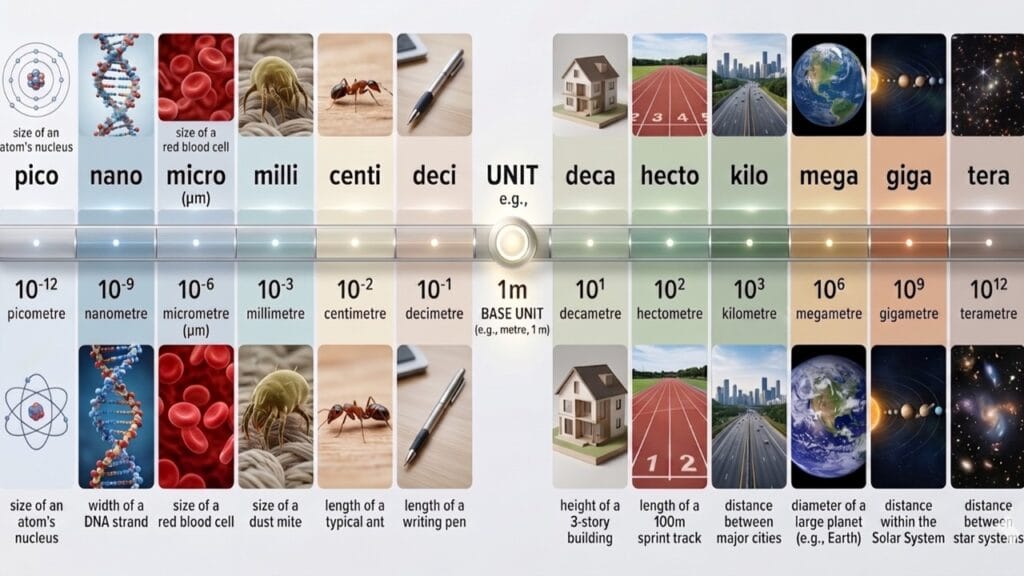
One of the most practical features of the SI system is its prefix structure. Rather than creating entirely new units for very large or very small quantities, we simply attach a prefix to the base unit.
| Prefix | Symbol | Factor |
| Tera | T | \( 10^{12} \) |
| Giga | G | \( 10^{9} \) |
| Mega | M | \( 10^{6} \) |
| Kilo | k | \( 10^{3} \) |
| Centi | c | \( 10^{-2} \) |
| Milli | m | \( 10^{-3} \) |
| Micro | μ | \( 10^{-6} \) |
| Nano | n | \( 10^{-9} \) |
| Pico | p | \( 10^{-12} \) |
So when a physicist talks about a wavelength of 500 nm, they mean \( 500 \times 10^{-9} \) metres — a number that would be cumbersome to write every time. The prefix handles it cleanly.
Real-Life Examples of Units of Measurement in Physics
Units are not an abstract classroom exercise. They appear in every corner of the physical world.
Example 1: Speed on a Highway
A car moving at 90 km/h. That unit — kilometres per hour — is a derived unit of speed. In SI base units, it converts to:
\[ 90 \, \text{km/h} = 90 \times \frac{1000 \, \text{m}}{3600 \, \text{s}} = 25 \, \text{m/s} \]
The physics does not change. But for calculations in dynamics, you always need SI — which means converting to metres per second first.
Example 2: Body Weight vs. Body Mass
This one confuses students constantly. When you step on a scale and it reads 60 kg, that is your mass — the amount of matter in your body, measured in kilograms. Your weight, however, is the gravitational force acting on that mass:
\[ W = mg \]
\[ W = 60 \times 9.8 = 588 \, \text{N} \]
Weight is a force, measured in Newtons. Mass is a quantity of matter, measured in kilograms. They are related — but they are not the same thing.
Example 3: Electrical Energy on Your Utility Bill
Your electricity bill charges you in kilowatt-hours (kWh). Now, the SI unit of energy is the Joule. But a Joule is an incredibly small amount of energy for everyday use. So electrical engineers use kWh as a practical unit:
\[ 1 \, \text{kWh} = 1000 \, \text{W} \times 3600 \, \text{s} \\ = 3{,}600{,}000 \, \text{J} = 3.6 \times 10^6 \, \text{J} \]
The unit kWh is not SI — but it is derived from SI units and it illustrates how units are adapted for practical contexts without abandoning the underlying framework.
Why This Concept Matters
Students often treat units as a formality — something to write at the end of an answer so the teacher does not take marks off. That is entirely the wrong way to think about it.
Units are a built-in verification system in physics. If you derive an expression for speed and find that the units on both sides of the equation do not match, you have made an error somewhere — guaranteed. This method of checking equations using units is called dimensional analysis and it is one of the most powerful tools in all of physics.
Beyond checking, units matter because:
- Communication — Scientific results are meaningless without agreed units. A measurement in an Indian lab and one in a German lab must speak the same language.
- Conversion — Problems routinely mix km and m, or hours and seconds. Mishandling this causes real errors in real calculations.
- Formulae interpretation — Understanding what units a quantity carries tells you something deep about its physical nature. The unit \( \text{kg m}^2 \text{s}^{-2} \) is an energy — whether you call it a Joule, electron-volt, or kilowatt-hour.
- Scaling — In advanced physics, choosing the right unit system can simplify equations enormously. Planck units, for instance, are chosen so that several fundamental constants equal exactly 1.
Common Mistakes and Misconceptions
These are the errors that appear most often — in assignments, lab reports and examinations alike.
1. Confusing Mass and Weight
Already covered above, but worth repeating: mass is in kilograms, weight is in Newtons. Do not write “weight = 70 kg.” Write “mass = 70 kg” and “weight = 686 N.”
2. Forgetting to Convert Units Before Calculating
If a problem gives you speed in km/h and time in seconds, you cannot multiply them directly to get distance in metres. Convert first. Always.
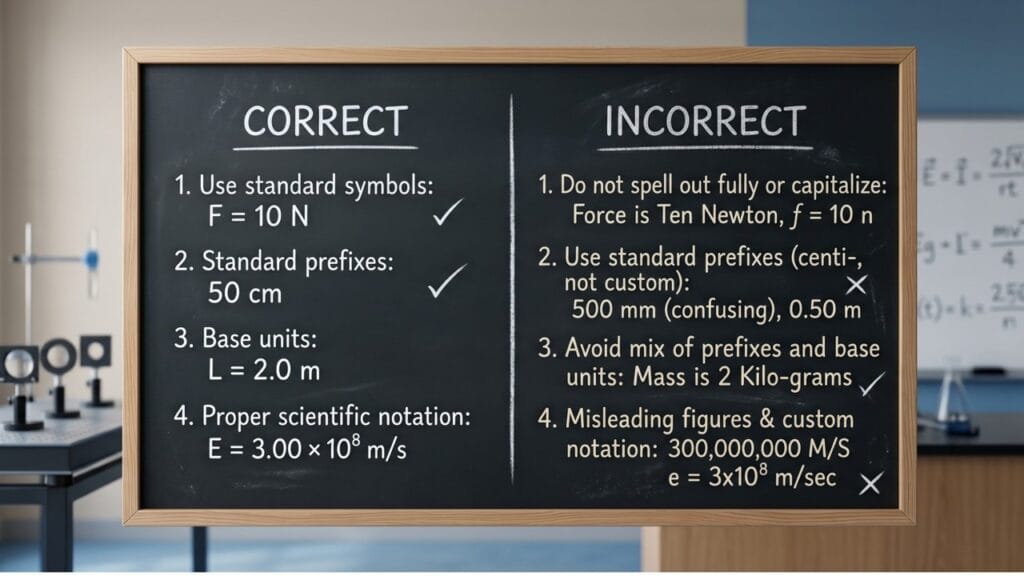
3. Dropping Units Mid-Calculation
Some students write numbers without units through intermediate steps and then tack units onto the final answer. This makes dimensional verification impossible and often leads to errors that go undetected.
4. Mixing Unit Systems
Do not use grams in one step and kilograms in the next. Choose a system — almost always SI — and stay in it throughout.
5. Treating All “Metres” as Identical Without Prefix Awareness
1 mm is not 1 m. 1 nm is not 1 μm. Prefix errors by powers of 10 are astonishingly common, especially in optics and modern physics where very small lengths appear constantly.
6. Thinking Units Are Optional in Formulas
Every symbol in a physics formula carries a unit. When you write \( v = u + at \), the unit of \( at \) must equal the unit of \( v \) and \( u \). If it does not, the equation is wrong. Units are not decoration — they are part of the formula.
Frequently Asked Questions
What is a unit of measurement in simple terms?
A unit of measurement is a standard reference quantity used to express how large or small a physical quantity is. For example, the metre is a unit of length. When you say something is 5 metres long, you mean it is 5 times the length of one metre.
What are the 7 fundamental units in physics?
The seven fundamental (base) SI units are: metre (length), kilogram (mass), second (time), ampere (electric current), kelvin (temperature), mole (amount of substance) and candela (luminous intensity). All other units in physics are derived from these seven.
Why do we need standard units of measurement?
Without agreed standards, measurements from different people, laboratories, or countries cannot be compared. Standard units — particularly the SI system — ensure that “1 kilogram” means the same thing in every scientific context, anywhere in the world.
What is the difference between fundamental and derived units?
Fundamental units are base units that are defined independently — like the metre and kilogram. Derived units are combinations of base units — like the Newton (kg m s⁻²) or the Joule (kg m² s⁻²). Every derived unit can be broken down into fundamental ones.
How do units relate to dimensional analysis?
Every unit carries a dimension — length, mass, time, etc. Dimensional analysis uses these dimensions to verify whether a physics equation is consistent, to convert between units and sometimes to derive relationships between physical quantities. It is one of the most practically useful skills in all of physics.
Can a number in physics be meaningful without a unit?
Rarely. A few quantities — such as refractive index or strain — are dimensionless and therefore have no units. But for the vast majority of physical quantities, a number without a unit is physically incomplete and scientifically meaningless.
What is the SI unit of force and how is it derived?
The SI unit of force is the Newton (N). It is derived from Newton’s second law: \( F = ma \). Since mass is in kilograms and acceleration is in m s⁻², force has units of kg m s⁻², which is given the special name “Newton.”
Leave a Comment