

Introduction: The Invisible Framework Behind All of Physics
Ask any physics student what the hardest part of the subject is and you will get a range of answers — Newton’s laws, thermodynamics, quantum mechanics. Very few will say units. And yet, a shaky understanding of the SI system is quietly responsible for more calculation errors, more lost exam marks and more conceptual confusion than almost any other foundational gap.
Here is the truth: you cannot do physics without units. You can memorise every formula in the textbook, but if you do not understand what units those quantities are expressed in — and why — the formulas become hollow. The SI system is not an administrative burden. It is the agreed-upon language that lets physicists across the world compare results, verify experiments and build on each other’s work without confusion.
In this post, we are going to go through the seven base units of the SI system — what they measure, how they are defined and why they matter more than most introductory courses let on. Whether you are preparing for your Class 11 board exams, JEE, NEET, or simply trying to build a solid foundation in Mechanics, this is the page to bookmark.
What Is the SI System and Why Does It Exist?
The International System of Units — known by its French abbreviation SI (Système International d’Unités) — is the modern, globally adopted standard for measurement. It was formally established in 1960 by the General Conference on Weights and Measures (CGPM) and has been refined several times since, most significantly in 2019 when all seven base units were redefined in terms of fixed fundamental constants of nature.
Before the SI system, different countries and disciplines used wildly incompatible measurement systems. The CGS system (centimetre-gram-second), the FPS system (foot-pound-second) and various regional standards coexisted — and the results were messy. Science thrives on reproducibility. If two physicists in two different countries cannot compare their measurements without converting through a tangle of unit systems, progress slows.
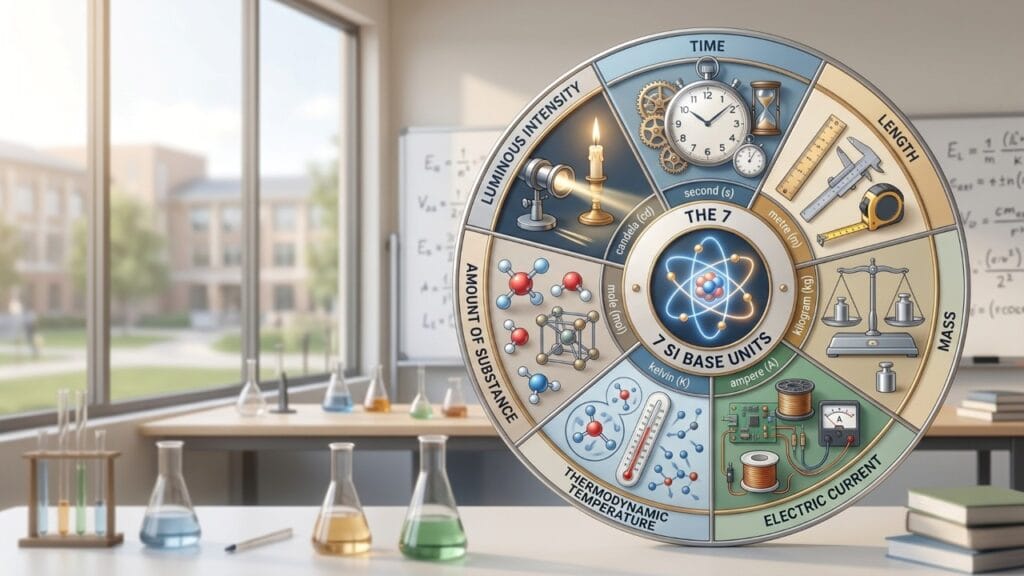
The SI system solved this. It is built on seven base units — one for each of seven independently defined physical quantities. Every other unit used in physics, chemistry and engineering is derived from these seven.
Learn more about What Are Units of Measurement? Physics Beginner’s Guide
The 7 Base SI Units: Complete Reference Table
Before we go through each unit in detail, here is the full reference at a glance.
| Physical Quantity | SI Base Unit | Symbol | Dimension Symbol |
| Length | Metre | m | L |
| Mass | Kilogram | kg | M |
| Time | Second | s | T |
| Electric Current | Ampere | A | I |
| Thermodynamic Temperature | Kelvin | K | Θ |
| Amount of Substance | Mole | mol | N |
| Luminous Intensity | Candela | cd | J |
Memorise this table. Not just the names and symbols — understand what physical quantity each one represents. That understanding is what separates a student who merely recalls facts from one who can actually use them.
The 7 Base Units Explained One by One
1. The Metre (m) — Unit of Length
The metre is the SI unit of length and it is the one most students are most comfortable with from everyday experience. Distances, heights, displacements, wavelengths — all of these are measured in metres or some prefixed variant (km, cm, mm, nm).
Current definition (post-2019): The metre is defined by fixing the speed of light in vacuum at exactly:
\[ c = 299{,}792{,}458 \, \text{m/s} \]
In other words, 1 metre is the distance light travels in vacuum in \( \frac{1}{299{,}792{,}458} \) of a second.
This definition ties the metre to a universal physical constant — the speed of light — rather than any physical object. That is intentional. Physical objects change over time; constants of nature do not.
Real-world scale: From the diameter of an atom ( \( \sim 10^{-10} \) m) to the distance to the nearest star ( \( \sim 4 \times 10^{16} \) m), the metre — scaled using SI prefixes — covers the full range of lengths encountered in physics.
2. The Kilogram (kg) — Unit of Mass
The kilogram is the SI unit of mass and it has the most interesting history of any base unit. Until 2019, it was the only SI base unit still defined by a physical artefact: a platinum-iridium cylinder stored in a vault in Sèvres, France — the International Prototype Kilogram (IPK). Every kilogram on Earth was defined relative to that one object.
Current definition (post-2019): The kilogram is now defined by fixing the value of the Planck constant at exactly:
\[ h = 6.626 \times 10^{-34} \, \text{J·s} = 6.626 \times 10^{-34} \, \text{kg·m}^2\text{·s}^{-1} \]
This connects the unit of mass to a quantum mechanical constant, making it reproducible in any well-equipped laboratory worldwide — not just the one in France.
Critical point for students: Do not confuse mass with weight. Mass is a measure of the quantity of matter in an object, expressed in kilograms. Weight is the gravitational force on that mass, expressed in Newtons:
\[ W = mg \]
Where \( g \approx 9.8 \, \text{m/s}^2 \) on Earth’s surface.
3. The Second (s) — Unit of Time
The second is the SI unit of time and its modern definition is the most precise of all seven base units.
Current definition (post-2019): The second is defined by fixing the frequency of radiation corresponding to the hyperfine transition of caesium-133 atoms at exactly:
\[ \Delta \nu_{Cs} = 9{,}192{,}631{,}770 \, \text{Hz} \]
One second is the duration of exactly 9,192,631,770 cycles of this radiation. Atomic clocks based on this principle are so precise that they would not gain or lose a single second over hundreds of millions of years.
This level of precision matters in GPS navigation, telecommunications and high-energy physics experiments — fields where timing errors of even microseconds can have significant consequences.
4. The Ampere (A) — Unit of Electric Current
The ampere is the SI unit of electric current and it is the gateway to the entire discipline of electromagnetism.
Current definition (post-2019): The ampere is defined by fixing the value of the elementary charge (the charge of one electron) at exactly:
\[ e = 1.602 \times 10^{-19} \, \text{C} \]
Since current is charge per unit time, one ampere corresponds to approximately \( 6.24 \times 10^{18} \) electrons passing a point per second.
In practical terms: a standard 60W light bulb draws about 0.5 A of current at 120V. A phone charger draws roughly 1–2 A. Industrial motors can run on hundreds of amperes.
5. The Kelvin (K) — Unit of Thermodynamic Temperature
The kelvin is the SI unit of thermodynamic temperature and it is different from the Celsius scale in one crucial way: it starts at absolute zero — the point at which all thermal motion of particles theoretically ceases.
Current definition (post-2019): The kelvin is defined by fixing the Boltzmann constant at exactly:
\[ k_B = 1.380 \times 10^{-23} \, \text{J/K} \]
The relationship between Celsius and Kelvin is straightforward:
\[ T(K) = T(°C) + 273.15 \]
So water freezes at 273.15 K and boils at 373.15 K. Absolute zero is 0 K — equivalent to −273.15°C.
Now here is the interesting part: in thermodynamics and statistical mechanics, you will almost always work in Kelvin, not Celsius. Equations like the ideal gas law — \( PV = nRT \) — require absolute temperature. Celsius does not work there. The distinction is not pedantic; it is physically meaningful.
6. The Mole (mol) — Unit of Amount of Substance
The mole is perhaps the least intuitive of the seven base units for physics students — it is more commonly encountered in chemistry. But it appears in thermodynamics, statistical mechanics and physical chemistry.
Current definition (post-2019): The mole is defined by fixing the Avogadro constant at exactly:
\[ N_A = 6.022 \times 10^{23} \, \text{mol}^{-1} \]
One mole of any substance contains exactly \( 6.022 \times 10^{23} \) elementary entities (atoms, molecules, ions, etc.). This is Avogadro’s number and it is the bridge between the microscopic world of atoms and the macroscopic world of grams and litres.
For example, in the ideal gas equation:
\[ PV = nRT \]
\( n \) is the number of moles of gas and \( R = 8.314 \, \text{J·mol}^{-1}\text{·K}^{-1} \) is the universal gas constant. The mole is doing essential quantitative work there.
7. The Candela (cd) — Unit of Luminous Intensity
The candela is the SI unit of luminous intensity — the power of light emitted in a particular direction, as perceived by the human eye.
Current definition (post-2019): The candela is defined by fixing the luminous efficacy of monochromatic radiation at 540 × 10¹² Hz (green light, the peak sensitivity of the human eye) at exactly:
\[ K_{cd} = 683 \, \text{lm/W} \]
This makes the candela unique among the seven base units: it is explicitly defined in relation to human visual perception, not just a physical process.
In everyday life: a single birthday candle emits roughly 1 cd. A standard 100W incandescent bulb emits about 120 cd. LED streetlights can reach thousands of candela.
How the Seven Base Units Connect: Derived Units
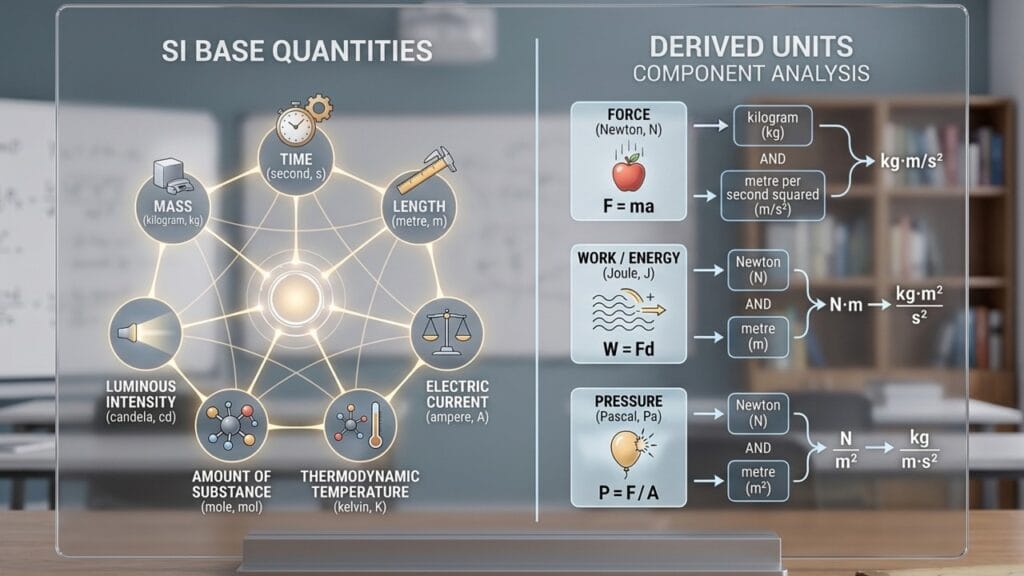
The real power of this system becomes visible when you start forming derived units. Every quantity in physics — no matter how complex — can be expressed in terms of these seven.
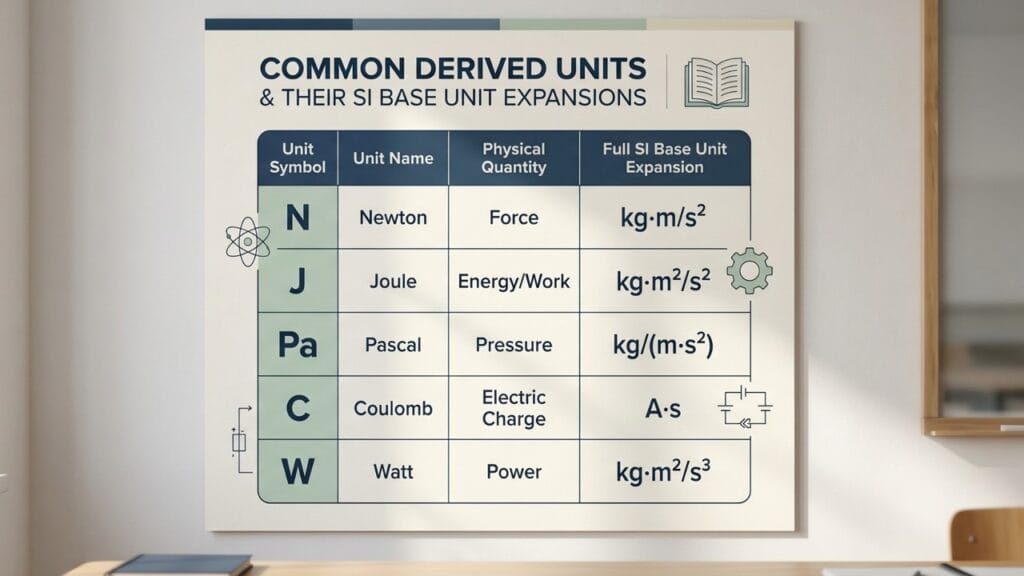
Some common derived units and their base-unit expressions:
- Force (Newton): \( 1 \, \text{N} = 1 \, \text{kg·m·s}^{-2} \)
- Energy (Joule): \( 1 \, \text{J} = 1 \, \text{kg·m}^2\text{·s}^{-2} \)
- Pressure (Pascal): \( 1 \, \text{Pa} = 1 \, \text{kg·m}^{-1}\text{·s}^{-2} \)
- Electric Charge (Coulomb): \( 1 \, \text{C} = 1 \, \text{A·s} \)
- Power (Watt): \( 1 \, \text{W} = 1 \, \text{kg·m}^2\text{·s}^{-3} \)
Notice that each of these is a combination of base units — no new fundamental quantities are introduced. The seven base units are genuinely sufficient to express all of classical and modern physics.
Learn more about Fundamental vs Derived Units: Key Differences with Examples
Why This Concept Matters
Students sometimes approach the SI base units as a memorisation exercise — learn the table, move on. That is a mistake and here is why.
In examinations: JEE, NEET and board-level papers regularly ask students to derive the dimensional formula of a quantity, check dimensional consistency, or convert between unit systems. You cannot do any of this without knowing what the base units are and what physical quantities they represent.
In problem-solving: Every time you use a formula in physics, you are implicitly using the SI system. When you apply \( F = ma \), you are asserting that force is in Newtons, mass in kilograms and acceleration in m/s². Substitute the wrong unit — say, grams instead of kilograms — and your numerical answer is off by a factor of 1000.
In advanced study: Fields like thermodynamics, electromagnetism, optics and modern physics introduce additional derived quantities — entropy, electric flux, luminous flux and more. Every single one traces back to the seven base units. A clear mental model of the base system makes advanced content dramatically easier to absorb.
In scientific communication: Physics is global. A result reported in SI units is immediately interpretable by any trained scientist anywhere in the world. This universality is not trivial — it is what makes international collaboration possible.
Common Mistakes and Misconceptions
These errors appear consistently across all levels of physics education.
Confusing the Kelvin and Celsius scales
Kelvin and Celsius differ by 273.15. In everyday life, Celsius is fine. In physics formulas — especially in thermodynamics and the ideal gas law — you must use Kelvin. Using Celsius where Kelvin is required will give you a completely wrong answer.
Treating the kilogram as a unit of weight
Mass is in kilograms. Weight — the gravitational force — is in Newtons. A 70 kg person has a weight of approximately \( 70 \times 9.8 = 686 \, \text{N} \). These are not interchangeable quantities and using kg for weight is a dimensional error.
Writing unit symbols incorrectly
SI unit symbols follow strict conventions. The symbol for kelvin is K (not °K). The symbol for second is s (not sec). The symbol for ampere is A (not Amp). These may seem like small things, but correct notation is part of scientific literacy.
Assuming the mole is a chemistry-only unit
The mole appears in the ideal gas law, statistical mechanics and thermodynamics — all core physics topics. Dismissing it as a chemistry concept leaves gaps that will surface in higher-level physics.
Forgetting that the candela accounts for human perception
The candela is not a simple energy-per-second unit (that would be the watt). It is weighted by the sensitivity of the human eye. This distinction matters in optics and photonics.
Frequently Asked Questions
What are the 7 base units of the SI system?
The seven SI base units are: the metre (length), kilogram (mass), second (time), ampere (electric current), kelvin (thermodynamic temperature), mole (amount of substance) and candela (luminous intensity). All other units in physics are derived from combinations of these seven.
Why are there exactly 7 base units in the SI system?
The seven quantities — length, mass, time, electric current, temperature, amount of substance and luminous intensity — were chosen because they are mutually independent. No one of them can be derived from the others. Together, they are sufficient to express every physical quantity encountered in science.
What is the difference between the SI system and the CGS system?
The CGS (centimetre-gram-second) system uses centimetre, gram and second as base units for length, mass and time respectively. The SI (MKS) system uses metre, kilogram and second. SI is the global standard for modern physics; CGS is still used in some specialised fields like electromagnetism and astrophysics.
Why was the kilogram redefined in 2019?
The kilogram was previously defined by a physical object — the International Prototype Kilogram (IPK). This was problematic because the mass of any physical object can change over time due to contamination or material loss. The 2019 redefinition tied the kilogram to the fixed value of the Planck constant, making it stable, reproducible and independent of any single physical artefact.
Is the candela used in physics or just in everyday life?
The candela is used in the physics of optics and photometry. It appears in quantities like luminous flux (lumen) and illuminance (lux), which are relevant in optical instrument design, lighting engineering and astrophysics when discussing the apparent brightness of stars.
What is the SI unit of temperature and how is it different from Celsius?
The SI unit of temperature is the kelvin (K). Unlike Celsius, the Kelvin scale starts at absolute zero (0 K = −273.15°C) — the theoretical point at which all particle motion ceases. The scales are offset by 273.15, so the conversion is: \( T(K) = T(°C) + 273.15 \). Physics formulas that involve temperature almost always require values in Kelvin.
How do the 7 base units relate to derived units?
Every derived unit in physics — such as the Newton, Joule, Pascal, Watt, or Coulomb — is formed by multiplying or dividing combinations of base units. For example, 1 Newton = 1 kg·m·s⁻². This system ensures that all physics is internally consistent and that any equation can be dimensionally verified.
Leave a Comment