

Introduction: Why This Distinction Actually Matters
Most physics students encounter the terms “fundamental units” and “derived units” in their first chapter and promptly move on without giving them much thought. That is understandable — at first glance, it just seems like a classification exercise. But this distinction runs much deeper than a vocabulary lesson.
Every physical quantity you will ever measure or calculate in physics belongs to one of two categories: it is either something you measure directly and independently, or it is something you calculate from other quantities. That is the real idea behind fundamental and derived units. Once you see it that way, the whole thing clicks.
In this guide, we are going to unpack both types of units properly — what they are, how they differ, why derived units exist, and how to recognize them in formulas and problems. This is foundational material in the Units and Measurements chapter under Mechanics, and getting it right will pay dividends throughout your physics education.
What Are Fundamental Units?
Fundamental units — also called base units — are the units of measurement that are defined independently. They do not depend on any other unit for their definition. You cannot break them down into simpler physical quantities.
The key word here is independent. A fundamental unit stands on its own. It is chosen by convention, defined precisely using a physical constant or reproducible phenomenon, and then used as a building block for everything else.
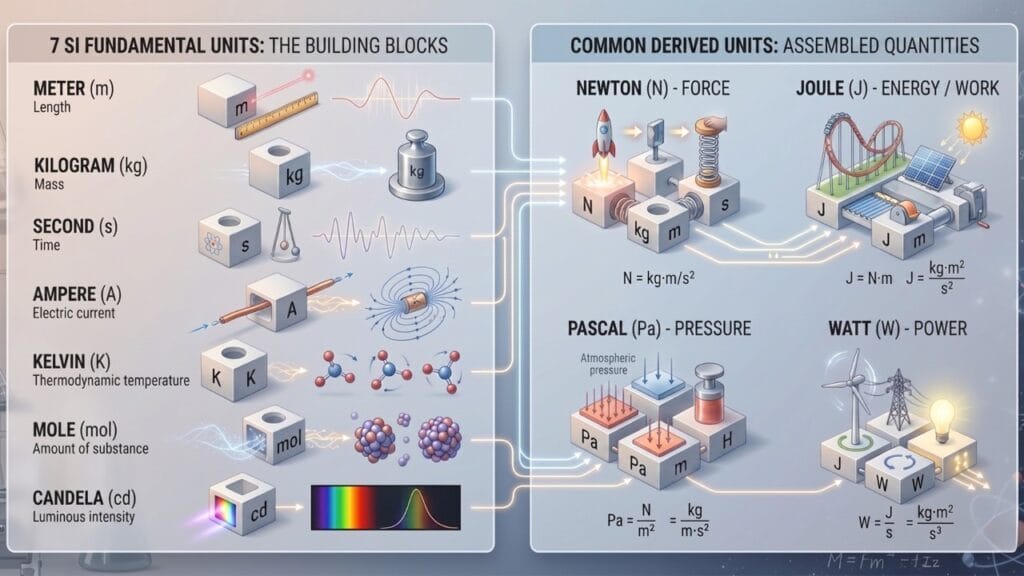
The International System of Units (SI) recognizes exactly seven fundamental quantities, each with its own base unit:
| Fundamental Quantity | SI Base Unit | Symbol |
| Length | Metre | m |
| Mass | Kilogram | kg |
| Time | Second | s |
| Electric Current | Ampere | A |
| Thermodynamic Temperature | Kelvin | K |
| Amount of Substance | Mole | mol |
| Luminous Intensity | Candela | cd |
These seven are the pillars. Everything in physics — every force, every energy, every pressure — ultimately reduces to some combination of these.
It is worth noting that other unit systems exist. The CGS system uses centimetre, gram, and second as its three mechanical base units. The FPS system uses foot, pound, and second. But for modern physics and this course, SI is the standard.
Learn more about SI Units Explained: The 7 Base Units Every Physics Student Must Know
What Are Derived Units?
Derived units are formed by combining two or more fundamental units through multiplication, division, or both. They are not independent — they are defined in terms of the base units, and their meaning follows directly from the formula that defines the physical quantity they measure.
Here is a clean way to think about it: whenever a physical quantity is defined by an equation, its unit is derived from the units in that equation.
Take speed as the simplest example. Speed is defined as distance divided by time:
\[ v = \frac{d}{t} \]
Distance is measured in metres (a fundamental unit). Time is measured in seconds (a fundamental unit). So the unit of speed is metres per second — written as \( \text{m/s} \) or \( \text{m s}^{-1} \). That is a derived unit.
Now look at force. Newton’s second law gives us:
\[ F = ma \]
Mass is in kilograms, acceleration is in \( \text{m s}^{-2} \). So force has the unit \( \text{kg} \cdot \text{m} \cdot \text{s}^{-2} \). This combination is so frequently used that it gets its own name — the Newton (N). But underneath that name, it is still just a combination of base units.
This is true of every named derived unit in physics. The name is a convenience. The physics is in the base units.
Key Differences Between Fundamental and Derived Units
Let us put the comparison on the table clearly.
| Feature | Fundamental Units | Derived Units |
| Definition | Defined independently | Defined from fundamental units |
| Dependence | Self-contained | Depend on base units |
| Number (in SI) | Exactly 7 | Unlimited (as many as needed) |
| Examples | metre, kilogram, second | Newton, Joule, Pascal, Watt |
| Can be broken down further? | No | Yes — into base units |
| Named after scientists? | Rarely | Often (Newton, Ampere as derived contexts, Joule) |
Common Derived Units in Physics and Their Base-Unit Form
This is where students often benefit most from seeing things spelled out. Let us go through the most important derived units in mechanics and show exactly how they connect to the fundamental ones.
Velocity
\[ v = \frac{\Delta x}{\Delta t} \]
Unit: \( \text{m s}^{-1} \) — metres divided by seconds. No special name.
Acceleration
\[ a = \frac{\Delta v}{\Delta t} \]
Unit: \( \text{m s}^{-2} \) — metres per second per second.
Force (Newton)
\[ F = ma \]
Unit: \( \text{kg} \cdot \text{m} \cdot \text{s}^{-2} \) — given the special name Newton (N).
So: \( 1 \, \text{N} = 1 \, \text{kg} \cdot \text{m} \cdot \text{s}^{-2} \)
Work and Energy (Joule)
\[ W = F \cdot d \]
Unit: \( \text{N} \cdot \text{m} = \text{kg} \cdot \text{m}^2 \cdot \text{s}^{-2} \) — given the name Joule (J).
So: \( 1 \, \text{J} = 1 \, \text{kg} \cdot \text{m}^2 \cdot \text{s}^{-2} \)
Power (Watt)
\[ P = \frac{W}{t} \]
Unit: \( \text{J} \cdot \text{s}^{-1} = \text{kg} \cdot \text{m}^2 \cdot \text{s}^{-3} \) — given the name Watt (W).
Pressure (Pascal)
\[ P = \frac{F}{A} \]
Unit: \( \text{N} \cdot \text{m}^{-2} = \text{kg} \cdot \text{m}^{-1} \cdot \text{s}^{-2} \) — given the name Pascal (Pa).
Kinetic Energy
\[ KE = \frac{1}{2}mv^2 \]
Unit: \( \text{kg} \cdot (\text{m s}^{-1})^2 = \text{kg} \cdot \text{m}^2 \cdot \text{s}^{-2} \) — same as Joule, as expected.
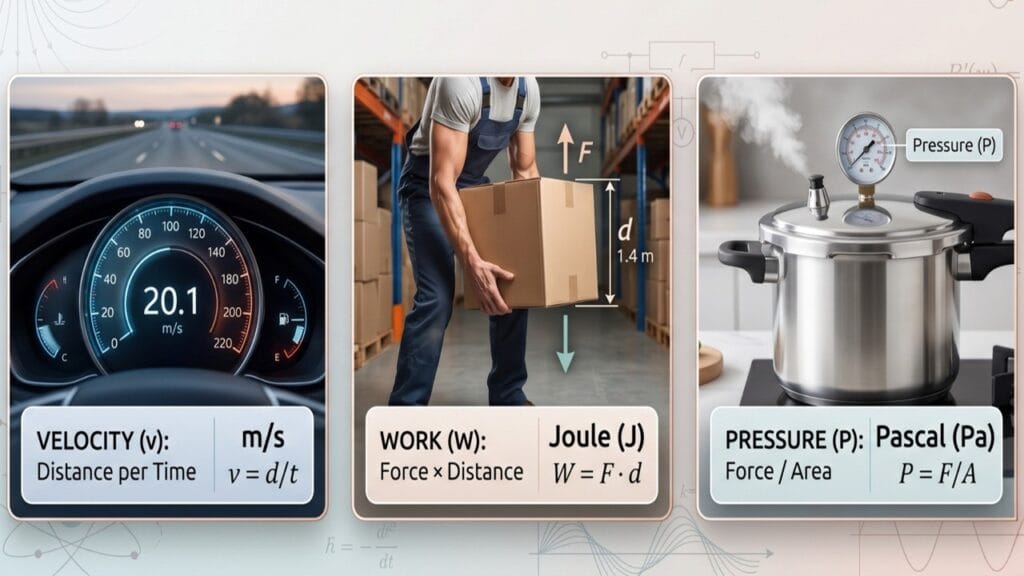
Real-Life Examples
Physics is not abstract. These unit types show up every day in ways that are easy to overlook.
Example 1: Your Car’s Speedometer
The speed reading on a speedometer — say, 80 km/h — is a derived unit. It combines a unit of length (kilometre) and a unit of time (hour). Converting it to SI:
\[ 80 \, \text{km/h} = 80 \times \frac{1000 \, \text{m}}{3600 \, \text{s}} \approx 22.2 \, \text{m s}^{-1} \]
Both km/h and m/s are derived units. Neither is a base unit.
Example 2: Lifting a Heavy Box
When you lift a 10 kg box from the floor, you are doing work against gravity. The force you apply against gravity is:
\[ F = mg = 10 \times 9.8 = 98 \, \text{N} \]
If you lift it 1.5 metres, the work done is:
\[ W = F \cdot d = 98 \times 1.5 = 147 \, \text{J} \]
The kilogram (mass) and metre (height) are fundamental. The Newton (force) and Joule (work) are derived — built from those fundamentals.
Example 3: A Pressure Cooker
The pressure inside a pressure cooker is typically around 200,000 Pa. The Pascal is a derived unit:
\[ 1 \, \text{Pa} = 1 \, \text{N m}^{-2} = 1 \, \text{kg m}^{-1} \text{s}^{-2} \]
The kilogram, metre, and second are fundamental. The Pascal is derived from all three.
Supplementary Units: A Brief Note
The SI system also includes two supplementary units, which occupy a slightly different category:
| Supplementary Quantity | Unit | Symbol |
| Plane Angle | Radian | rad |
| Solid Angle | Steradian | sr |
These are dimensionless in the sense that angles are ratios — a radian is arc length divided by radius, both in metres, so the units cancel. However, they are retained as named units for clarity in formulas involving angles, particularly in optics, rotational mechanics, and wave physics.
Learn more about Physical Quantities in Physics: Scalars, Vectors, and Their Units
Why This Concept Matters
Understanding the fundamental vs derived unit distinction is not just bookwork. It has direct practical applications.
1. Dimensional Analysis
Every derived unit can be traced back to base units. This is the foundation of dimensional analysis — the technique of checking whether an equation is physically valid by verifying that both sides carry the same units. If your derived unit does not reduce to the correct combination of base units, something in your formula is wrong.
Learn more about Dimensional Analysis Made Easy: Method, Rules, and Practice Problems
2. Unit Conversion
Converting between unit systems — say, from CGS to SI — requires knowing which units are fundamental and which are derived. You convert the base units first, and the derived units follow automatically.
3. Exam Problems
In JEE, NEET, and board examinations, a standard question type asks you to express a derived unit in terms of base units, or to identify the dimensions of a given quantity. A clear understanding of how derived units are formed from fundamental ones is essential for these.
4. Building Physical Intuition
When you know that the Joule is \( \text{kg} \cdot \text{m}^2 \cdot \text{s}^{-2} \), you start to see what energy really is in physical terms — mass moving through space over time. That kind of intuition makes the subject genuinely easier to understand, not just to memorise.
Common Mistakes and Misconceptions
Thinking There Are Only 3 Fundamental Units
In the context of mechanics, many students encounter only length, mass, and time — the MKS triplet. That is sufficient for most mechanical problems. But the full SI system has seven base units. Forgetting this causes gaps when dealing with electricity, light, or chemical quantities.
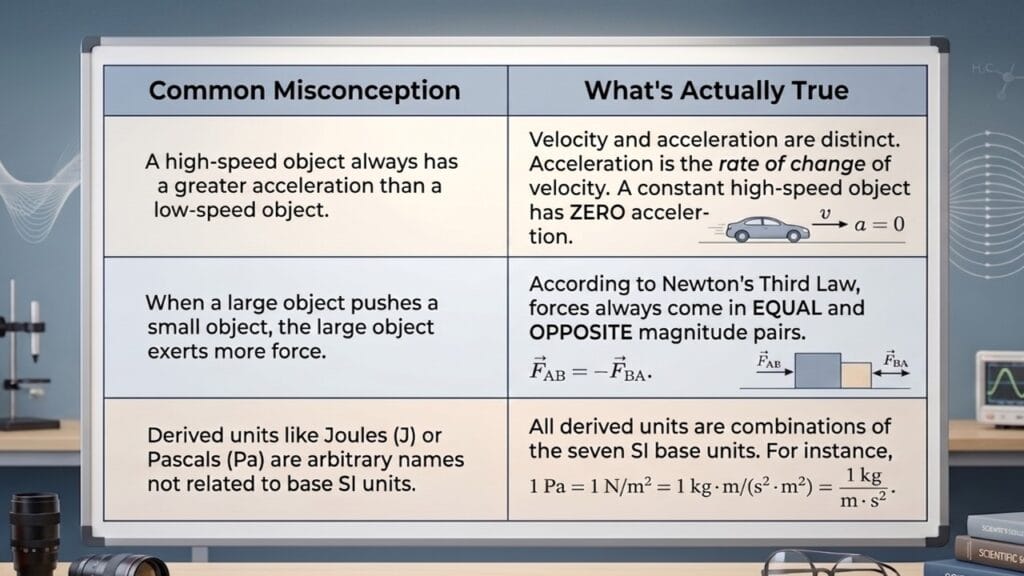
Confusing Named Derived Units with Fundamental Ones
The Newton, Joule, and Pascal all have proper names and symbols. That gives them the feel of fundamental units — but they are not. Every one of them is a derived unit. The name is a shorthand, not a redefinition.
Forgetting That Derived Units Can Be Named After Scientists
Named derived units can create confusion because they look distinct from the base units they are built from. Always ask: can this unit be broken down into base units? If yes, it is derived.
Assuming km/h Is a Fundamental Unit
Speed in km/h seems like a “basic” thing — you see it every day. But it is entirely derived. Length (kilometre) and time (hour) are the base quantities; their ratio gives the derived unit of speed.
Treating All CGS and MKS Units the Same Way
The centimetre and metre are both units of length — but one is CGS and one is SI. Students sometimes mix them in calculations. Always establish which system you are working in before starting a problem.
Conclusion
The distinction between fundamental and derived units is simple in principle but important in practice. Fundamental units are the seven independent base units from which everything else is built. Derived units are combinations of those base units, constructed through the formulas that define physical quantities.
What makes this more than classification is the chain of reasoning it enables. When you understand that a Newton is \( \text{kg} \cdot \text{m} \cdot \text{s}^{-2} \) and a Joule is \( \text{kg} \cdot \text{m}^2 \cdot \text{s}^{-2} \), you can check equations, convert units, and build physical intuition — not just recall definitions. That is the real value of understanding this concept properly.
Frequently Asked Questions
What is the difference between fundamental units and derived units?
Fundamental units are independently defined base units that do not depend on any other unit — such as metre, kilogram, and second. Derived units are formed by combining fundamental units through multiplication or division, based on the formula that defines the physical quantity — such as the Newton (\( \text{kg} \cdot \text{m} \cdot \text{s}^{-2} \)) or the Joule (\( \text{kg} \cdot \text{m}^2 \cdot \text{s}^{-2} \)).
How many fundamental units are there in the SI system?
There are exactly seven fundamental units in the SI system: metre (length), kilogram (mass), second (time), ampere (electric current), kelvin (thermodynamic temperature), mole (amount of substance), and candela (luminous intensity).
Is Newton a fundamental or derived unit?
The Newton is a derived unit. It is derived from Newton’s second law \( F = ma \), which gives the unit \( \text{kg} \cdot \text{m} \cdot \text{s}^{-2} \). The “Newton” is simply a convenient name for that combination of base units.
Can derived units have their own special names?
Yes. Many derived units are named after scientists for convenience: the Newton (N) for force, the Joule (J) for energy, the Pascal (Pa) for pressure, the Watt (W) for power, and so on. Despite having their own names and symbols, they remain derived units that reduce to combinations of SI base units.
What are supplementary units in the SI system?
Supplementary units are two special units recognized by the SI system that are distinct from the seven base units: the radian (rad) for plane angle and the steradian (sr) for solid angle. They are dimensionless ratios but are kept as named units for use in physics formulas.
How do derived units help in dimensional analysis?
Because every derived unit can be expressed in terms of fundamental units, you can check whether a physical equation is dimensionally consistent by reducing each side to base units and verifying they match. If they do not, the formula contains an error.
What is the unit of pressure in terms of fundamental units?
Pressure is defined as force per unit area: \( P = F/A \). Since force is \( \text{kg} \cdot \text{m} \cdot \text{s}^{-2} \) and area is \( \text{m}^2 \), pressure works out to \( \text{kg} \cdot \text{m}^{-1} \cdot \text{s}^{-2} \), which is the Pascal (Pa) in SI units.
Leave a Comment