

Introduction: More Than Just Numbers
Physics is the science of measurement. Every statement in physics — whether it is about the speed of light, the force of gravity, or the temperature of a gas — is ultimately a claim about a measurable quantity. But not all physical quantities behave the same way and that difference is not trivial.
Some quantities can be fully described by a number and a unit. Others require something more — a direction. This is the scalar-vector distinction and it is one of the most practically important ideas in all of Mechanics. Get it wrong and your calculations will give you answers that are not just numerically off but conceptually wrong.
In this guide, we are going to go through what physical quantities are, how they are classified, what units they carry and why the difference between scalars and vectors is something you genuinely need to understand — not just memorise.
What Is a Physical Quantity?
A physical quantity is any property of a material or system that can be measured and expressed as a number with an appropriate unit.
That definition has two essential components:
- It must be measurable — it must correspond to something observable in the physical world.
- It must be expressible with a unit — a number alone is meaningless without the scale it refers to.
For example, “the mass of an apple” is a physical quantity. You can measure it and you express the result in kilograms. “The beauty of a sunset” is not a physical quantity — it cannot be measured in any reproducible, objective way.
Physical quantities are divided into two broad categories based on the kind of information needed to fully define them: scalars and vectors.
Scalar Quantities: Magnitude Only
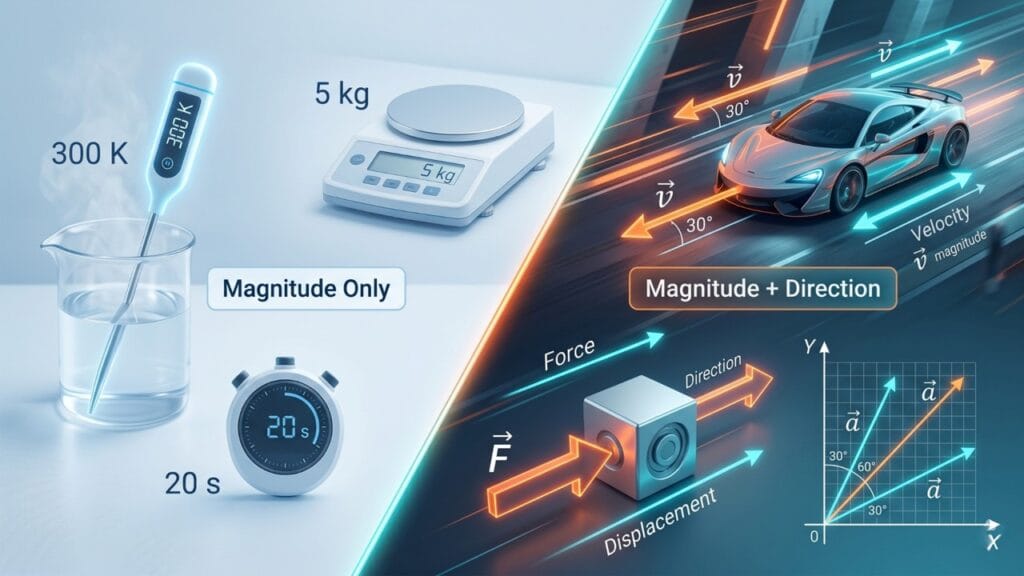
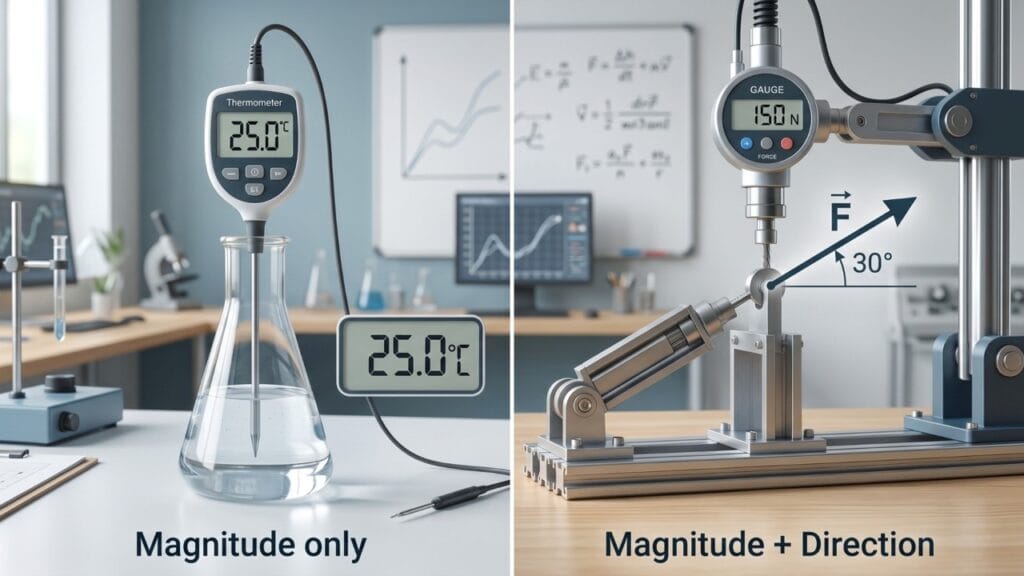
A scalar quantity is one that is completely described by its magnitude — that is, a numerical value and a unit. No direction is needed.
This sounds straightforward and it mostly is. The key test: if knowing “how much” is enough to fully specify the quantity, it is a scalar.
Common Scalar Quantities and Their SI Units
| Scalar Quantity | SI Unit | Symbol |
| Mass | Kilogram | kg |
| Speed | Metre per second | m s⁻¹ |
| Distance | Metre | m |
| Temperature | Kelvin | K |
| Time | Second | s |
| Energy | Joule | J |
| Power | Watt | W |
| Electric Charge | Coulomb | C |
| Density | Kilogram per cubic metre | kg m⁻³ |
Scalars follow the ordinary rules of algebra. You can add, subtract, multiply and divide them without worrying about direction. If you walk 3 km and then another 2 km, the total distance covered is simply 5 km — direction is irrelevant.
Vector Quantities: Magnitude and Direction
A vector quantity requires both magnitude and direction to be fully defined. Specifying one without the other leaves the description incomplete.
Consider force. If someone tells you that a force of 10 N acts on an object, you still do not know what will happen to the object. Will it move to the right? Up? At an angle? The direction of the force is essential. Remove the direction and the information is physically insufficient.
Vectors are typically written in bold (F, v, a) or with an arrow above the symbol (\( \vec{F} \), \( \vec{v} \), \( \vec{a} \)).
Common Vector Quantities and Their SI Units
| Vector Quantity | SI Unit | Symbol |
| Displacement | Metre | m |
| Velocity | Metre per second | m s⁻¹ |
| Acceleration | Metre per second squared | m s⁻² |
| Force | Newton | N |
| Momentum | Kilogram metre per second | kg m s⁻¹ |
| Weight | Newton | N |
| Electric Field | Newton per coulomb | N C⁻¹ |
| Torque | Newton metre | N m |
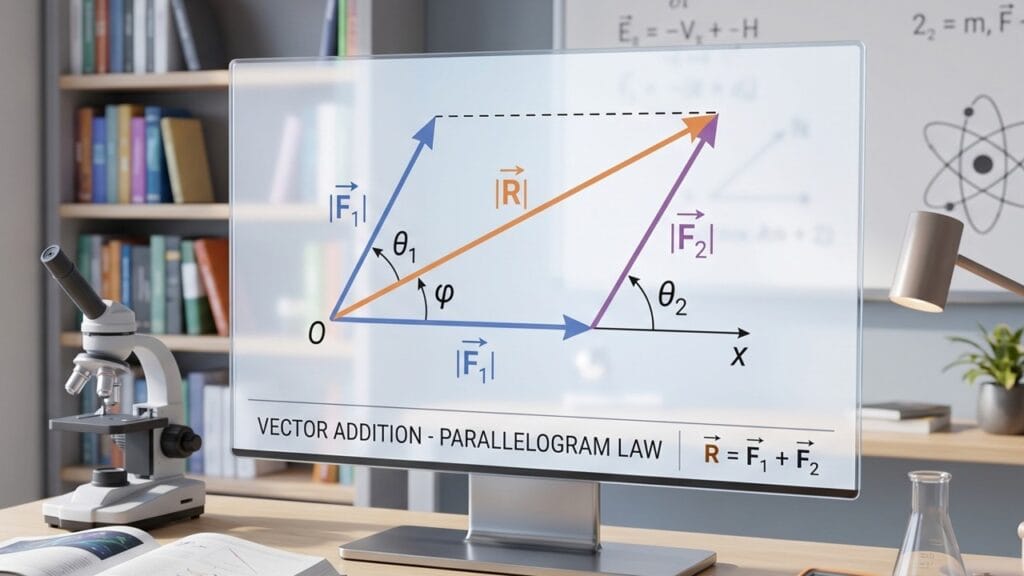
Vectors do not follow ordinary arithmetic. You cannot simply add their magnitudes — you have to account for direction. Two forces of 5 N each acting in the same direction give a resultant of 10 N. The same two forces acting in opposite directions give a resultant of 0 N. Same magnitudes, completely different outcomes.
Key Differences: Scalars vs Vectors at a Glance
| Feature | Scalar | Vector |
| Definition | Magnitude only | Magnitude and direction |
| Mathematical rules | Ordinary algebra | Vector algebra (addition, dot/cross product) |
| Representation | A number with a unit | A number with a unit and an arrow |
| Examples | Mass, speed, energy | Force, velocity, displacement |
| Addition rule | Simple numerical addition | Triangle or parallelogram law |
| Can be negative? | Rarely (mass, time cannot be) | Yes — direction can reverse |
Why the Same Unit Can Appear in Both Categories
Now here is something that confuses a lot of students. Speed and velocity both have the unit \( \text{m s}^{-1} \). Distance and displacement both have the unit metre. How can the same unit describe both a scalar and a vector?
The answer is that the unit tells you the dimension — the physical nature of the quantity — but it does not tell you whether the quantity has direction. That is determined by the definition of the quantity itself.
Speed is the magnitude of velocity. Distance is the magnitude of displacement. In each case:
\[ \text{Speed} = |\vec{v}| \qquad \text{(scalar)} \]
\[ \text{Distance} = |\vec{d}| \qquad \text{(scalar)} \]
The vector quantity carries directional information. The scalar version discards it and retains only the magnitude. Same unit, different physical meaning.
This is not a flaw in the unit system. It is a reflection of the fact that some physical quantities inherently require direction — and the mathematics that describes them must accommodate that.
Learn more about Fundamental vs Derived Units: Key Differences with Examples
Formulas Involving Scalars and Vectors
Understanding whether quantities in a formula are scalars or vectors changes how you use that formula. Let us look at a few key cases.
Newton’s Second Law
\[ \vec{F} = m\vec{a} \]
Force (\( \vec{F} \)) and acceleration (\( \vec{a} \)) are vectors. Mass (\( m \)) is a scalar. The equation tells you that force and acceleration point in the same direction. If acceleration is to the right, the net force is to the right. This directional consistency is built into the formula.
Kinetic Energy
\[ KE = \frac{1}{2}mv^2 \]
Kinetic energy is a scalar. Even though it involves velocity (a vector), the formula uses \( v^2 \) — the square of the speed (magnitude). The directional information of velocity is lost in that squaring and the result is a pure scalar.
Work Done by a Force
\[ W = \vec{F} \cdot \vec{d} = Fd\cos\theta \]
Here, \( \theta \) is the angle between the force vector and the displacement vector. Work is a scalar — the dot product of two vectors always gives a scalar. This formula shows exactly why direction matters: a force perpendicular to displacement (\( \theta = 90° \)) does zero work, even if both the force and the displacement are large.
Linear Momentum
\[ \vec{p} = m\vec{v} \]
Momentum is a vector. Its direction is the same as the direction of velocity. This is why two objects of equal mass moving in opposite directions can have momenta that cancel — they are equal in magnitude but opposite in sign.
Real-Life Examples
Navigation: Displacement vs Distance
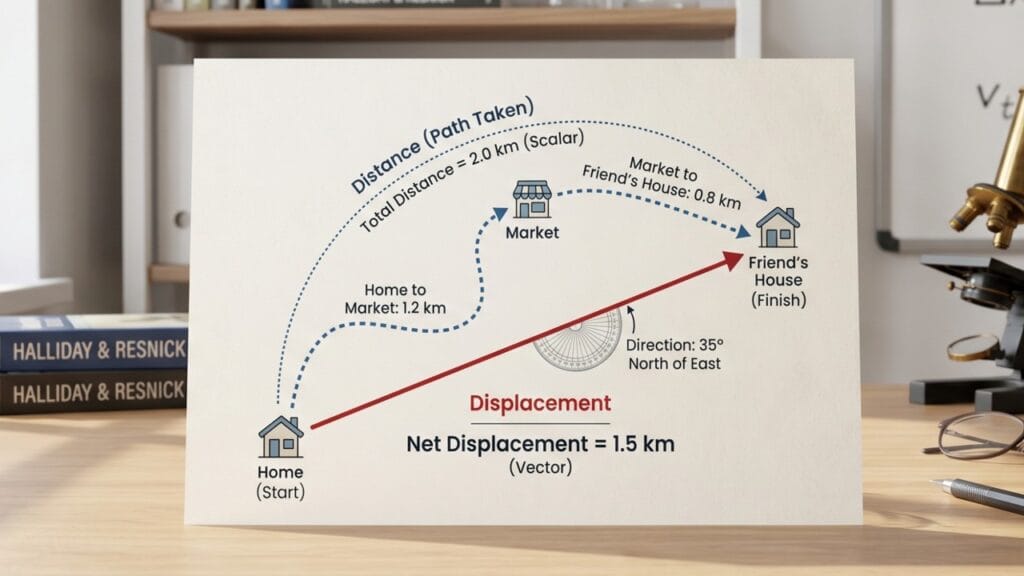
Suppose you walk from your home to a market 500 m north, then 500 m east to a friend’s house. The distance you covered is 1000 m — a scalar, simply the total path length. The displacement is the straight-line distance from home to your friend’s house:
\[ |\vec{d}| = \sqrt{500^2 + 500^2} = 500\sqrt{2} \approx 707 \, \text{m, in the north-east direction} \]
Same journey, completely different values depending on whether you ask for distance or displacement.
Sport: Speed vs Velocity
A sprinter running a 400 m track race completes the race and returns to the starting line. Average speed over the race is distance divided by time — nonzero. Average velocity is displacement divided by time — zero (start and end points are the same).
Coaches care about speed. Physicists working with projectile motion or orbital calculations care about velocity.
Engineering: Force Direction
A crane must lift a beam. The lifting cable exerts a force upward. Gravity pulls the beam downward. To find the net force, you must account for direction — these forces partially or fully cancel depending on their magnitudes. Treating force as a scalar in this context would give a nonsensical result.
Why This Concept Matters
The scalar-vector distinction is not a classification exercise you do once and forget. It shapes every calculation in mechanics.
When you apply Newton’s second law, you are working with vectors — so the direction of net force determines the direction of acceleration. When you calculate work or energy, you are working with scalars — so direction cancels out through the dot product. When you analyze momentum conservation, vectors are central — opposite momenta cancel.
If you treat a vector quantity as a scalar, you will get answers that can be numerically plausible but physically wrong. In examination problems, this is one of the most common sources of error, especially in problems involving two or three dimensions.
Learn more about What Are Units of Measurement? A Complete Beginner’s Guide to Physics
Learn more about SI Units Explained: The 7 Base Units Every Physics Student Must Know
Common Mistakes and Misconceptions
Confusing Speed and Velocity
Speed is a scalar — it tells you how fast. Velocity is a vector — it tells you how fast and in which direction. They have the same unit (\( \text{m s}^{-1} \)), but they are not interchangeable. An object moving in a circle at constant speed has a constantly changing velocity because its direction keeps changing.
Adding Vectors Like Scalars
Two velocities of 3 m/s and 4 m/s do not always combine to give 7 m/s. If they point at right angles, the resultant is:
\[ v = \sqrt{3^2 + 4^2} = \sqrt{9 + 16} = 5 \, \text{m s}^{-1} \]
The direction of those vectors matters.
Assuming Negative Means “Smaller”
A velocity of \( -5 \, \text{m s}^{-1} \) is not smaller than \( +3 \, \text{m s}^{-1} \) in any meaningful sense. The negative sign indicates direction, not size. The speed (magnitude) is 5 m/s, which is greater than 3 m/s.
Thinking Weight and Mass Are the Same Type of Quantity
Both mass (scalar) and weight (vector) are routinely confused — not just in type but in unit too. Mass is a scalar in kilograms; weight is a vector force in Newtons. They are related by \( \vec{W} = m\vec{g} \), where \( \vec{g} \) is the gravitational acceleration vector.
Conclusion
Physical quantities are the building blocks of every measurement and calculation in physics. Whether a quantity is a scalar or a vector is not a minor detail — it determines how you handle it mathematically and what information you need to define it completely.
Scalars carry magnitude only: mass, temperature, speed, energy. Vectors carry magnitude and direction: force, velocity, displacement, momentum. The units can sometimes look identical — metres for distance and displacement, m/s for speed and velocity — but the physical content is different.
Understanding this distinction sets up everything that follows in mechanics: Newton’s laws, projectile motion, circular motion, momentum and beyond. It is one of those foundational ideas that keeps paying off.
Frequently Asked Questions
What is the difference between a scalar and a vector quantity?
A scalar quantity is fully described by a magnitude and a unit — for example, mass (70 kg) or temperature (300 K). A vector quantity requires both a magnitude and a direction — for example, velocity (20 m/s north) or force (50 N at 30° above horizontal). The key test is whether direction is needed to completely define the quantity.
Is speed a scalar or a vector?
Speed is a scalar quantity. It tells you how fast an object is moving but gives no information about direction. Velocity, on the other hand, is a vector — it includes both the rate of motion and the direction. Speed is the magnitude of velocity: \( v = |\vec{v}| \).
Can the same physical unit correspond to both a scalar and a vector?
Yes. For example, the metre (m) is the SI unit of both distance (scalar) and displacement (vector). The unit describes the dimension of the quantity, not whether it has direction. Direction is determined by the definition of the quantity itself, not its unit.
What is the SI unit of force and is force a scalar or vector?
Force is a vector quantity. Its SI unit is the Newton (N), which in base units is \( \text{kg} \cdot \text{m} \cdot \text{s}^{-2} \). Because force is a vector, its complete specification requires both magnitude and direction.
Why is kinetic energy a scalar even though it involves velocity?
Kinetic energy is given by \( KE = \frac{1}{2}mv^2 \). The formula uses \( v^2 \), which is the square of the speed — a scalar quantity. Squaring the magnitude of a vector removes its directional information, producing a scalar result. That is why kinetic energy is always a non-negative scalar regardless of the direction of motion.
How do you add two vector quantities?
Vectors cannot be added by simply summing their magnitudes. You must account for their directions. If the vectors are parallel, add the magnitudes directly. If they are anti-parallel, subtract. For vectors at any other angle \( \theta \), use the parallelogram law or resolve them into components and add component-by-component:
\[ \vec{R} = \vec{A} + \vec{B} \]
The magnitude of the resultant when two vectors are at angle \( \theta \) to each other is:
\[ |\vec{R}| = \sqrt{A^2 + B^2 + 2AB\cos\theta} \]
Is temperature a scalar or a vector?
Temperature is a scalar quantity. It has magnitude (e.g., 300 K) but no directional component. The same is true of related quantities like heat and internal energy — all scalars.