

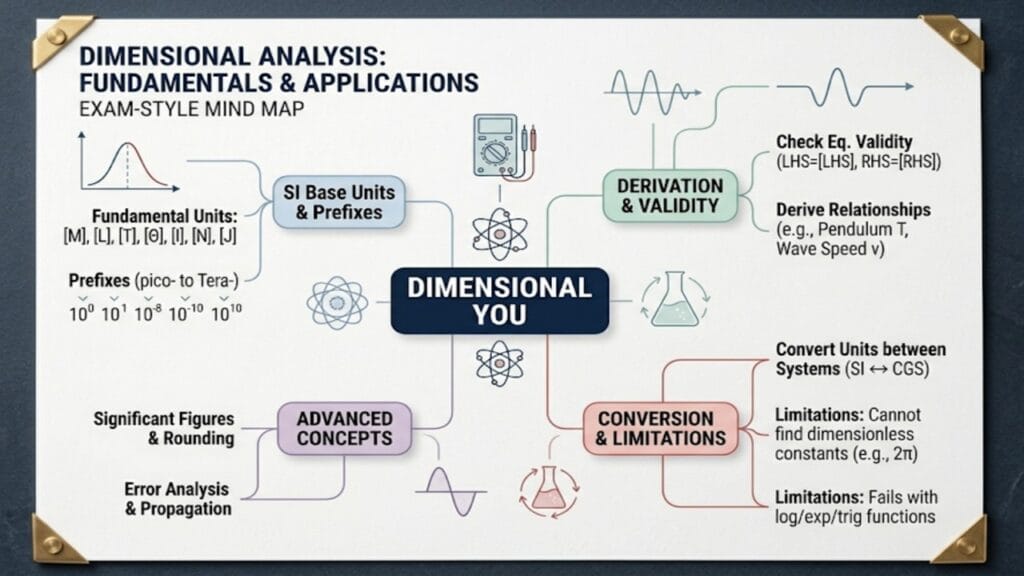
Introduction
Numbers in physics span an extraordinary range. The diameter of a proton is roughly 0.000000000000001 metres. The distance to the nearest star outside our solar system is roughly 40,000,000,000,000,000 metres. Writing either of those numbers in full — let alone doing arithmetic with them — is impractical and error-prone.
SI prefixes solve this problem elegantly. Instead of writing 0.000000001 metres, you write 1 nanometre. Instead of writing 1,000,000,000 hertz, you write 1 gigahertz. The prefix carries the power of ten as part of the unit name, making the number human-readable, typeable and far less likely to gain or lose a zero in transcription.
Every physics student uses SI prefixes constantly, often without consciously thinking about them. This article makes them fully explicit — every prefix from pico to tera, what it means, where it appears in real physics and how to convert between prefixed units without confusion.
What Are SI Prefixes?
An SI prefix is a standardized modifier placed before a unit name to indicate a specific power of ten multiple or sub-multiple of that unit. Prefixes are defined by the International System of Units (SI) and are universally recognised across all scientific disciplines and countries.
The formal definition: an SI prefix multiplies the base unit by \( 10^n \), where \( n \) is a positive or negative integer specific to each prefix.
\[ \text{Prefixed unit} = \text{Prefix factor} \times \text{Base unit} \]
For example: \[ 1 \text{ km} = 10^3 \text{ m} = 1000 \text{ m} \] \[ 1 \text{ nm} = 10^{-9} \text{ m} = 0.000000001 \text{ m} \]
The prefix replaces the explicit power-of-ten notation. The physical quantity is unchanged — only its representation is more convenient.
SI prefixes apply to any SI unit: metre, gram, second, ampere, volt, hertz, joule, watt and so on. The base unit for mass, however, is the kilogram — which already contains the prefix kilo. When applying mass prefixes, the gram is used as the reference unit rather than the kilogram to avoid awkward double-prefixing.
The Complete SI Prefix Table
This is the full official set of SI prefixes, ordered from largest to smallest. The highlighted entries — kilo, centi, milli, micro, nano — are the ones physics students encounter most frequently in everyday problems.
| Prefix | Symbol | Power of Ten | Decimal Equivalent |
| Yotta | Y | \( 10^{24} \) | 1,000,000,000,000,000,000,000,000 |
| Zetta | Z | \( 10^{21} \) | 1,000,000,000,000,000,000,000 |
| Exa | E | \( 10^{18} \) | 1,000,000,000,000,000,000 |
| Peta | P | \( 10^{15} \) | 1,000,000,000,000,000 |
| Tera | T | \( 10^{12} \) | 1,000,000,000,000 |
| Giga | G | \( 10^{9} \) | 1,000,000,000 |
| Mega | M | \( 10^{6} \) | 1,000,000 |
| Kilo | k | \( 10^{3} \) | 1,000 |
| Hecto | h | \( 10^{2} \) | 100 |
| Deca | da | \( 10^{1} \) | 10 |
| (Base unit) | — | \( 10^{0} \) | 1 |
| Deci | d | \( 10^{-1} \) | 0.1 |
| Centi | c | \( 10^{-2} \) | 0.01 |
| Milli | m | \( 10^{-3} \) | 0.001 |
| Micro | μ | \( 10^{-6} \) | 0.000001 |
| Nano | n | \( 10^{-9} \) | 0.000000001 |
| Pico | p | \( 10^{-12} \) | 0.000000000001 |
| Femto | f | \( 10^{-15} \) | 0.000000000000001 |
| Atto | a | \( 10^{-18} \) | 0.000000000000000001 |
| Zepto | z | \( 10^{-21} \) | 0.000000000000000000001 |
| Yocto | y | \( 10^{-24} \) | 0.000000000000000000000001 |
Bold entries are the most commonly tested in school and competitive exam physics.
The Physics-Relevant Range: Pico to Tera
While the full SI prefix table extends from yocto (\( 10^{-24} \)) to yotta (\( 10^{24} \)), the range from pico to tera — covering 24 orders of magnitude — contains the prefixes that appear in almost every physics problem a student will encounter. The sections below cover each prefix in this range with its physical meaning, common usage and representative examples.
Pico — \( 10^{-12} \)
Symbol: p
Full name: picometre, picofarad, picosecond, etc.
Meaning: One trillionth of the base unit
The pico prefix is used for quantities so small that even the nano scale is insufficient.
Where it appears in physics:
- Atomic radii: The radius of a hydrogen atom is approximately 53 pm (picometres). Covalent bond lengths in molecules are typically 100–200 pm.
- Capacitance in electronics: Small capacitors in radio frequency circuits are rated in picofarads (pF). A typical capacitor in a tuning circuit might be 10–100 pF.
- X-ray wavelengths: Hard X-rays have wavelengths in the range of 10–100 pm — shorter than visible light by a factor of roughly \( 10^4 \).
Conversion examples:
\[ 150 \text{ pm} = 150 \times 10^{-12} \text{ m} = 1.50 \times 10^{-10} \text{ m} \] \[ 47 \text{ pF} = 47 \times 10^{-12} \text{ F} \]
Relationship to Angstrom:
The Angstrom (Å), a non-SI unit still widely used in atomic physics and chemistry, equals \( 10^{-10} \) m = 100 pm.
Nano — \( 10^{-9} \)
Symbol: n
Full name: nanometre, nanosecond, nanowatt, etc.
Meaning: One billionth of the base unit
The nano prefix defines the scale of visible light wavelengths and modern semiconductor technology.
Where it appears in physics:
- Visible light: The wavelength of visible light ranges from approximately 380 nm (violet) to 700 nm (red). This is the most commonly memorised use of the nano prefix.
- Semiconductor technology: Modern transistors in microprocessors are manufactured at nodes of a few nanometres. The term “nanotechnology” literally refers to working at this length scale.
- DNA and proteins: The diameter of a DNA double helix is approximately 2 nm. This places nanotechnology in direct overlap with biology.
- Nanoseconds in electronics: Signal propagation times in high-speed digital circuits are measured in nanoseconds.
Conversion examples:
\[ 589 \text{ nm} = 589 \times 10^{-9} \text{ m} = 5.89 \times 10^{-7} \text{ m} \]
This is the wavelength of sodium yellow light — one of the most frequently used values in optics problems.
\[ 1 \text{ ns} = 10^{-9} \text{ s} \]
In 1 nanosecond, light travels approximately 30 cm in vacuum.

Micro — \( 10^{-6} \)
Symbol: μ (Greek letter mu)
Full name: micrometre, microsecond, microfarad, etc.
Meaning: One millionth of the base unit
Where it appears in physics:
- Wavelength of infrared radiation: Infrared light has wavelengths from about 0.7 μm to 1000 μm. Thermal cameras, night-vision equipment and remote controls all operate in this range.
- Cell biology scale: A typical human cell is 10–100 μm in diameter. Red blood cells are approximately 6–8 μm across.
- Micrometre (the instrument): The screw gauge is sometimes called a micrometre — a name reflecting that it measures to 0.01 mm = 10 μm precision. Its least count (0.01 mm) is 10 micrometres.
- Capacitors: Electrolytic capacitors used in power supply filtering are rated in microfarads (μF). A common value is 100 μF or 470 μF.
- Microwaves: Despite the name, microwave radiation has wavelengths in the millimetre-to-centimetre range — not the micrometre range. The “micro” in microwave is a historical usage, not a strict prefix application.
Conversion examples:
\[ 0.7 \text{ μm} = 0.7 \times 10^{-6} \text{ m} = 7 \times 10^{-7} \text{ m} \]
\[ 100 \text{ μF} = 100 \times 10^{-6} \text{ F} = 10^{-4} \text{ F} \]
Important note on the symbol:
The micro symbol is μ (mu), not u or mc. In typed text where Greek characters are unavailable, u is used as an informal substitute. In formal physics writing and exam papers, μ is correct.
Milli — \( 10^{-3} \)
Symbol: m
Full name: millimetre, millisecond, milliampere, milliwatt, etc.
Meaning: One thousandth of the base unit
Where it appears in physics:
- Millimetre (length): The fundamental unit of length for everyday precision measurement. Rulers are graduated in millimetres. The least count of a standard ruler is 1 mm.
- Milliampere (current): Most signal-level electrical measurements in electronics involve milliamperes. A typical LED operates at 10–20 mA.
- Millimetre of mercury (mmHg): Blood pressure is still measured in mmHg (also called torr), where 1 mmHg ≈ 133 Pa.
- Millisecond: Human reaction times are approximately 150–300 ms. EEG brain wave periods are in the millisecond range.
- Milliwatt: LED indicators and laser pointers are rated in milliwatts.
Conversion examples:
\[ 1 \text{ mm} = 10^{-3} \text{ m} \]
\[ 250 \text{ mA} = 250 \times 10^{-3} \text{ A} = 0.25 \text{ A} \]
\[ 1 \text{ ms} = 10^{-3} \text{ s} \]
Common confusion:
Do not confuse the milli prefix symbol m (lowercase) with the mega prefix symbol M (uppercase). In physics notation, capitalisation matters absolutely: mW is milliwatt, MW is megawatt — a factor of \( 10^9 \) difference.
Centi — \( 10^{-2} \)
Symbol: c
Full name: centimetre, centilitre, etc.
Meaning: One hundredth of the base unit
Where it appears in physics:
- Centimetre: The standard unit of length in the CGS system and in everyday measurement across much of the world. Most lab rulers are graduated in centimetres with millimetre subdivisions.
- Centimetres of mercury (cmHg): Sometimes used in pressure measurement as an alternative to mmHg.
- Calorimetry: Specific heat capacity experiments often report volumes in centilitres (cL) or use centimetre cube (cm³) for volume.
Conversion examples:
\[ 1 \text{ cm} = 10^{-2} \text{ m} \]
\[ 1 \text{ cm}^2 = (10^{-2})^2 \text{ m}^2 = 10^{-4} \text{ m}^2 \]
\[ 1 \text{ cm}^3 = (10^{-2})^3 \text{ m}^3 = 10^{-6} \text{ m}^3 \]
The area and volume conversion factors are frequently needed and frequently confused. When converting cm² to m², square the conversion factor. When converting cm³ to m³, cube it.
Kilo — \( 10^{3} \)
Symbol: k (lowercase)
Full name: kilometre, kilogram, kilohertz, kilojoule, kilowatt, etc.
Meaning: One thousand times the base unit
Kilo is the most commonly encountered prefix in everyday life and in introductory physics.
Where it appears in physics:
- Kilogram: The SI base unit of mass. Despite being a base unit, it incorporates the kilo prefix — a historical artefact of the original metric system. This is why mass prefix conversions use the gram as the reference, not the kilogram.
- Kilometre: Standard unit for geographic distances. Highway speeds in km/h are the standard in most countries.
- Kilohertz: Audio frequencies range from about 20 Hz to 20 kHz (20,000 Hz). Radio waves span kHz to GHz.
- Kilojoule: Food energy is measured in kilojoules (kJ) or kilocalories (kcal). The specific heat capacity of water is 4.18 kJ kg⁻¹ K⁻¹.
- Kilowatt and kilowatt-hour: Electrical power consumption is rated in kilowatts. Electricity bills are calculated in kilowatt-hours (kWh).
- Kilopascal: Standard atmospheric pressure is approximately 101.3 kPa.
Conversion examples:
\[ 72 \text{ km/h} = 72 \times \frac{10^3}{3600} \text{ m/s} = 20 \text{ m/s} \]
\[ 4.18 \text{ kJ} = 4180 \text{ J} \]
Important: The kilo symbol is lowercase k. Uppercase K is the symbol for kelvin — an entirely different quantity.
Learn more about How to Convert Units in Physics: Step-by-Step with Solved Examples
Mega — \( 10^{6} \)
Symbol: M (uppercase)
Full name: megametre, megahertz, megawatt, megapascal, megaelectronvolt, etc.
Meaning: One million times the base unit
Where it appears in physics:
- Megahertz (MHz): FM radio broadcasts at 87.5–108 MHz. Processor clock speeds were measured in MHz before reaching the gigahertz range.
- Megajoule (MJ): Energy released by explosives is measured in megajoules. 1 kg of TNT releases approximately 4.2 MJ.
- Megapascal (MPa): Tensile strength and yield stress of materials are measured in MPa. Steel has a yield strength of approximately 250 MPa.
- Megaelectronvolt (MeV): Energy of nuclear particles. The rest mass energy of an electron is 0.511 MeV. Nuclear binding energies per nucleon are a few MeV.
- Megawatt (MW): Output of large power plants. A mid-sized coal power plant produces several hundred MW. A large nuclear reactor produces ~1000 MW = 1 GW.
Conversion examples:
\[ 100 \text{ MHz} = 100 \times 10^{6} \text{ Hz} = 10^{8} \text{ Hz} \]
\[ 8.2 \text{ MeV} = 8.2 \times 10^{6} \times 1.6 \times 10^{-19} \text{ J} = 1.312 \times 10^{-12} \text{ J} \]
Giga — \( 10^{9} \)
Symbol: G
Full name: gigametre, gigahertz, gigajoule, gigabyte, etc.
Meaning: One billion times the base unit
Where it appears in physics:
- Gigahertz (GHz): Modern processor clock speeds — 3.5 GHz, 4.2 GHz. WiFi operates at 2.4 GHz and 5 GHz. Microwave ovens operate at 2.45 GHz.
- Gigajoule (GJ): Energy content of fuels. One litre of petrol contains approximately 34 MJ; a tonne of coal contains approximately 30 GJ.
- Gigapascal (GPa): Young’s modulus (stiffness) of materials is measured in GPa. Steel has E ≈ 200 GPa. Diamond has E ≈ 1000 GPa.
- Gigabyte (GB): Data storage. While byte is not an SI unit, the giga prefix is used in the standard way here.
- Astronomical distances: The Sun is approximately 150 Gm (gigametres) from Earth — 150 × 10⁹ m = 1 AU.
Conversion examples:
\[ 3.5 \text{ GHz} = 3.5 \times 10^{9} \text{ Hz} \]
\[ 200 \text{ GPa} = 200 \times 10^{9} \text{ Pa} = 2 \times 10^{11} \text{ Pa} \]
Tera — \( 10^{12} \)
Symbol: T
Full name: terametre, terahertz, terawatt, terabyte, etc.
Meaning: One trillion times the base unit
Where it appears in physics:
- Terahertz (THz): Terahertz radiation occupies the spectrum between microwave and infrared. It is used in security scanners, medical imaging and spectroscopy of biological molecules.
- Terawatt (TW): Global power consumption of human civilization is approximately 18 TW. The Sun radiates approximately \( 3.8 \times 10^{26} \) W — far beyond the tera scale, but tera is useful for comparing with human-scale energy use.
- Teraelectronvolt (TeV): Energy of particles in the Large Hadron Collider at CERN. Protons are accelerated to energies of up to 6.5 TeV per proton.
Conversion examples:
\[ 1 \text{ THz} = 10^{12} \text{ Hz} \]
\[ \text{Speed of light: } c \approx 3 \times 10^{8} \text{ m/s} = 0.3 \text{ Gm/s} = 0.0003 \text{ Tm/s} \]
Additional Important Prefixes
Two prefixes outside the pico-to-tera range appear frequently enough in physics problems to include here:
Femto — \( 10^{-15} \)
Symbol: f. One femtometre (fm) is also called a fermi — the fundamental length scale of nuclear physics. The diameter of a proton is approximately 1.7 fm. The diameter of an atomic nucleus ranges from roughly 1 fm (hydrogen) to about 15 fm (uranium).
\[ 1 \text{ fm} = 10^{-15} \text{ m} \]
Peta — \( 10^{15} \)
Symbol: P. Used primarily in data storage (petabyte = \( 10^{15} \) bytes) and in the context of global energy budgets. Not commonly tested in school-level physics but appears in advanced contexts.
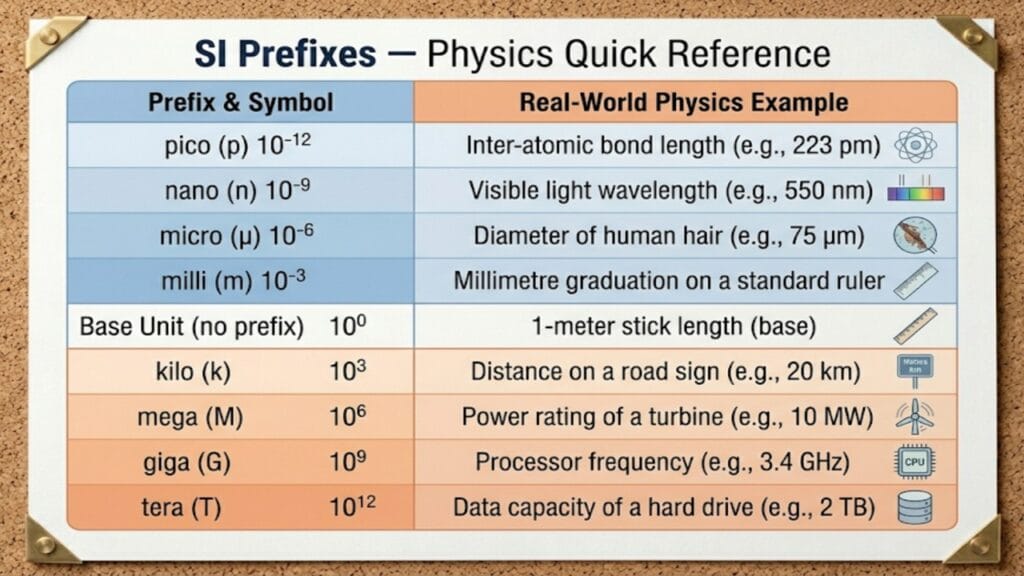
Quick Reference: Physics-Relevant Prefixes Only
This condensed table covers the prefixes a physics student actually needs to know for exams, lab work and problem-solving.
| Prefix | Symbol | Factor | Physics Example |
| Tera | T | \( 10^{12} \) | Terahertz radiation, particle accelerator energies |
| Giga | G | \( 10^{9} \) | GHz processor speeds, GPa material stiffness |
| Mega | M | \( 10^{6} \) | MHz radio frequency, MeV nuclear energy |
| Kilo | k | \( 10^{3} \) | km distance, kJ energy, kPa pressure |
| Hecto | h | \( 10^{2} \) | hPa (hectopascal) in meteorology |
| — | — | \( 10^{0} \) | Base unit (m, kg, s, A, K…) |
| Deci | d | \( 10^{-1} \) | dB (decibel, a logarithmic unit using deci-) |
| Centi | c | \( 10^{-2} \) | cm length, cm³ volume |
| Milli | m | \( 10^{-3} \) | mm length, mA current, mV potential |
| Micro | μ | \( 10^{-6} \) | μm (infrared wavelength), μF capacitance |
| Nano | n | \( 10^{-9} \) | nm (visible light wavelength), ns signal timing |
| Pico | p | \( 10^{-12} \) | pm (atomic radius), pF capacitance |
| Femto | f | \( 10^{-15} \) | fm (nuclear diameter, proton size) |
Converting Between Prefixed Units
This is the skill that makes the prefix table actually useful. Two methods work cleanly.
Method 1 — Convert Through the Base Unit
Always safe. Convert the first prefixed unit back to the base unit, then convert to the target prefix.
Example: Convert 850 nm to μm.
\[ 850 \text{ nm} = 850 \times 10^{-9} \text{ m} \]
\[ = \frac{850 \times 10^{-9}}{10^{-6}} \text{ μm} = 850 \times 10^{-9+6} \text{ μm} = 850 \times 10^{-3} \text{ μm} = 0.850 \text{ μm} \]
Method 2 — Direct Power Arithmetic
Find the difference in powers between the two prefixes. Shift the decimal accordingly.
Example: Convert 3.5 GHz to MHz.
Giga = \( 10^9 \), Mega = \( 10^6 \). Difference = \( 10^{9-6} = 10^3 \).
Going from GHz to MHz, you are dividing by \( 10^3 \) in the prefix factor, so the number multiplies by \( 10^3 \):
\[ 3.5 \text{ GHz} = 3.5 \times 10^3 \text{ MHz} = 3500 \text{ MHz} \]
Example: Convert 470 μF to mF.
Micro = \( 10^{-6} \), Milli = \( 10^{-3} \). Difference = \( 10^{-6-(-3)} = 10^{-3} \).
\[ 470 \text{ μF} = 470 \times 10^{-3} \text{ mF} = 0.470 \text{ mF} \]
Conversion Table for Common Length Prefixes
| From → To | pm | nm | μm | mm | cm | m | km |
| 1 pm = | 1 | \( 10^{-3} \) | \( 10^{-6} \) | \( 10^{-9} \) | \( 10^{-10} \) | \( 10^{-12} \) | \( 10^{-15} \) |
| 1 nm = | \( 10^{3} \) | 1 | \( 10^{-3} \) | \( 10^{-6} \) | \( 10^{-7} \) | \( 10^{-9} \) | \( 10^{-12} \) |
| 1 μm = | \( 10^{6} \) | \( 10^{3} \) | 1 | \( 10^{-3} \) | \( 10^{-4} \) | \( 10^{-6} \) | \( 10^{-9} \) |
| 1 mm = | \( 10^{9} \) | \( 10^{6} \) | \( 10^{3} \) | 1 | \( 10^{-1} \) | \( 10^{-3} \) | \( 10^{-6} \) |
| 1 cm = | \( 10^{10} \) | \( 10^{7} \) | \( 10^{4} \) | 10 | 1 | \( 10^{-2} \) | \( 10^{-5} \) |
| 1 m = | \( 10^{12} \) | \( 10^{9} \) | \( 10^{6} \) | \( 10^{3} \) | 100 | 1 | \( 10^{-3} \) |
| 1 km = | \( 10^{15} \) | \( 10^{12} \) | \( 10^{9} \) | \( 10^{6} \) | \( 10^{5} \) | \( 10^{3} \) | 1 |
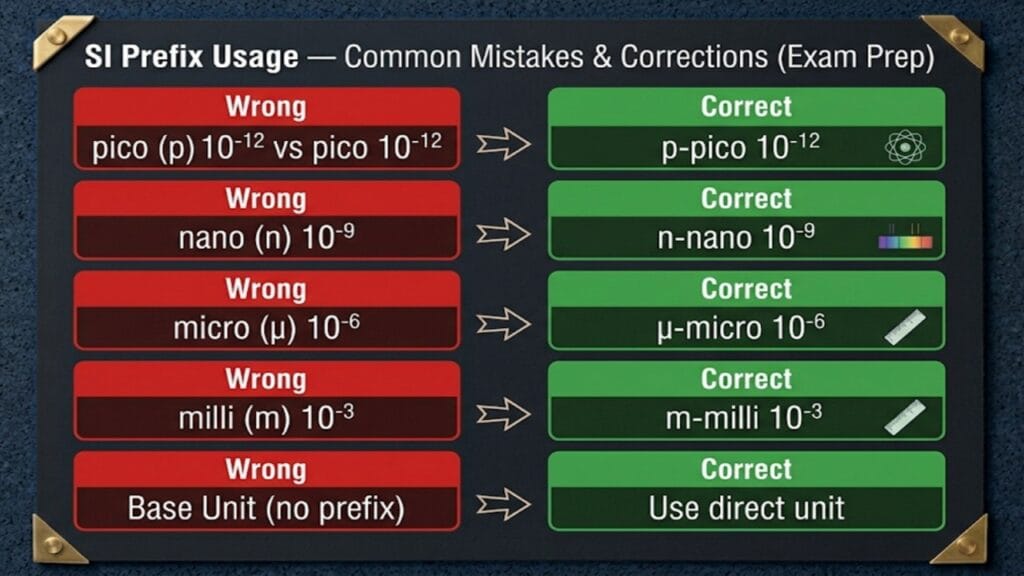
Common Mistakes with SI Prefixes
Mistake 1 — Confusing Uppercase and Lowercase Symbols
SI prefix symbols are case-sensitive. This matters in several specific pairs:
| Prefix | Symbol | Confusion Risk |
| Kilo (10³) | k (lowercase) | K = kelvin (temperature unit) |
| Mega (10⁶) | M (uppercase) | m = milli (10⁻³) |
| Giga (10⁹) | G (uppercase) | g = gram (unit of mass) |
| Tera (10¹²) | T (uppercase) | t = metric tonne |
| Peta (10¹⁵) | P (uppercase) | p = pico (10⁻¹²) |
Writing mW and MW looks similar but represents a factor of \( 10^9 \) difference — milliwatt versus megawatt.
Mistake 2 — Squaring and Cubing Prefix Conversions Incorrectly
When a unit with a prefix is raised to a power, the prefix factor must also be raised to that power.
Wrong: \( 1 \text{ cm}^2 = 10^{-2} \text{ m}^2 \)
Correct: \( 1 \text{ cm}^2 = (10^{-2} \text{ m})^2 = 10^{-4} \text{ m}^2 \)
Wrong: \( 1 \text{ cm}^3 = 10^{-2} \text{ m}^3 \)
Correct: \( 1 \text{ cm}^3 = (10^{-2} \text{ m})^3 = 10^{-6} \text{ m}^3 \)
This is one of the most reliably tested conversion errors in board and competitive exams.
Mistake 3 — Applying Prefixes to the Kilogram
The SI base unit of mass is the kilogram, not the gram. However, the kilogram already contains the kilo prefix. To avoid double-prefixing, all mass prefix conversions use the gram as the reference:
- 1 mg (milligram) = \( 10^{-3} \) g = \( 10^{-6} \) kg
- 1 μg (microgram) = \( 10^{-6} \) g = \( 10^{-9} \) kg
- 1 Mg (megagram) = \( 10^{6} \) g = \( 10^{3} \) kg = 1 tonne
Never write 1 mkg or 1 μkg — these forms are not standard SI notation.
Mistake 4 — Confusing Micro Symbol μ with Other Characters
The micro prefix symbol is μ (Greek mu). In informal contexts, u is used as a substitute when μ is unavailable — for example, um instead of μm for micrometre, or uF instead of μF for microfarad. In formal physics writing and in exam papers, always write μ correctly.
Mistake 5 — Not Converting All Terms Consistently
In a calculation involving multiple quantities with prefixes, every term must be converted to consistent units before arithmetic. Computing \( \frac{500 \text{ mA}}{2.5 \text{ kΩ}} \) without converting to base units first:
Inconsistent (wrong approach): \[ V = 500 \times 2500 = 1{,}250{,}000 \text{ ???} \]
Correct: \[ V = 500 \times 10^{-3} \text{ A} \times 2.5 \times 10^{3} \text{ Ω} = 500 \times 2.5 \times 10^{-3+3} \text{ V} = 1250 \text{ V} \]
Always convert to base units first, compute, then convert the result back to a convenient prefix.
Learn more about How to Find Significant Figures: Rules, Examples & Common Mistakes
SI Prefixes in Physics Across Disciplines
To make the prefix table fully concrete, here is a discipline-by-discipline view of where each prefix appears most naturally in physics problems.
Mechanics and Gravitation
- Distances: km, m, cm, mm
- Forces: kN (kilonewton) in structural engineering, mN (millinewton) in surface tension
- Energy: kJ, MJ in thermodynamics; J in everyday mechanics
- Pressure: kPa (weather), MPa (materials), GPa (bulk modulus)
- Time: s, ms (vibration periods), μs (ultrasound)
Optics and Electromagnetic Spectrum
- Wavelengths: nm (visible light: 380–700 nm), μm (infrared), mm and cm (microwave), pm (X-ray)
- Frequency: GHz (microwave, WiFi), MHz (FM radio), kHz (AM radio), THz (terahertz imaging)
Electricity and Magnetism
- Current: A, mA, μA (signal currents)
- Voltage: V, mV (biosignals like ECG), kV (transmission lines), MV (particle accelerators)
- Resistance: Ω, kΩ, MΩ
- Capacitance: F, mF, μF, nF, pF
- Inductance: H, mH, μH, nH
Atomic and Nuclear Physics
- Atomic radius: pm (picometres)
- Nuclear radius: fm (femtometres)
- Atomic mass: u = \( 1.66 \times 10^{-27} \) kg
- Particle energies: keV, MeV, GeV, TeV
Thermodynamics
- Energy: kJ (heat in calorimetry), MJ (fuel energy), GJ (large-scale energy)
- Power: W, kW, MW (generators), GW (power plants), TW (global energy use)
- Temperature: always in K or °C — no prefix applied to kelvin in standard usage
Learn more about CGS vs MKS vs SI System: Differences, Comparison Table & Uses
Memory Aids for SI Prefixes
For the ordered sequence from pico to tera, several mnemonic strategies help:
The staircase image: Visualize each prefix as a step on a staircase. Each step up multiplies by 1000 (for the main prefixes: milli → base → kilo → mega → giga → tera). Each step down divides by 1000.
Powers at multiples of 3: The “engineering prefixes” — the ones most used in physics — fall at exact multiples of 3 in the exponent:
\[ \cdots \quad 10^{-12} \quad 10^{-9} \quad 10^{-6} \quad 10^{-3} \quad 10^{0} \quad 10^{3} \quad 10^{6} \quad 10^{9} \quad 10^{12} \quad \cdots \]
\[ \cdots \quad \text{p} \quad \text{n} \quad \mu \quad \text{m} \quad \text{base} \quad \text{k} \quad \text{M} \quad \text{G} \quad \text{T} \quad \cdots \]
Simple sentence for the positive prefixes: “Kind Men Generally Treat” → Kilo, Mega, Giga, Tera
Simple sentence for the negative prefixes: “mighty mice nibble peas” → milli, micro, nano, pico
Conclusion
SI prefixes are not merely a notational convenience. They are a communication tool that carries real information — about the scale of a measurement, its relationship to human experience and its place in the physical universe. Writing 589 nm for sodium light wavelength is not just shorthand for \( 589 \times 10^{-9} \) m. It places the measurement immediately in the visible light domain, which carries a whole context: optical experiments, spectroscopy, the eye’s response curve.
Knowing prefixes fluently — not just knowing they exist, but knowing them fast enough to convert without pausing — is what lets you move smoothly through calculations that span multiple scales. A problem that begins with atomic radii in picometres and ends with light wavelengths in nanometres and telescope distances in kilometres requires prefix fluency at every step.
Run through the quick reference table until every prefix from pico to tera is automatic. Practise the conversion examples until the power arithmetic requires no paper. Then go back to whatever physics topic you were working on — you will find the numbers much easier to navigate.
Learn more about What Are Units of Measurement? A Complete Beginner’s Guide to Physics
Frequently Asked Questions
What is the order of SI prefixes from smallest to largest?
From smallest to largest, the physics-relevant SI prefixes are: femto (\( 10^{-15} \)), pico (\( 10^{-12} \)), nano (\( 10^{-9} \)), micro (\( 10^{-6} \)), milli (\( 10^{-3} \)), centi (\( 10^{-2} \)), deci (\( 10^{-1} \)), base unit (\( 10^{0} \)), kilo (\( 10^{3} \)), mega (\( 10^{6} \)), giga (\( 10^{9} \)), tera (\( 10^{12} \)).
What does the prefix nano mean and where is it used in physics?
Nano means one billionth (\( 10^{-9} \)). Its most common use in physics is the nanometre (nm), which is the standard unit for expressing the wavelength of visible light (approximately 380–700 nm). It also appears in nanoseconds for high-speed electronic timing and in nanotechnology for describing structures at the molecular scale.
How do I convert nm to m?
Multiply by \( 10^{-9} \). For example, 650 nm = \( 650 \times 10^{-9} \) m = \( 6.50 \times 10^{-7} \) m. To convert m to nm, multiply by \( 10^{9} \).
Why is the SI prefix symbol case-sensitive?
Because different cases are assigned to different prefixes that differ by large factors. For example, m (lowercase) is milli (\( 10^{-3} \)) and M (uppercase) is mega (\( 10^{6} \)) — a difference of \( 10^{9} \). Similarly, k (kilo) versus K (kelvin), G (giga) versus g (gram). Using the wrong case is not just a typographical error — it changes the quantity by many orders of magnitude.
How do I convert cm² to m²?
Square the conversion factor. Since 1 cm = \( 10^{-2} \) m, it follows that 1 cm² = \( (10^{-2})^2 \) m² = \( 10^{-4} \) m². Similarly, 1 cm³ = \( 10^{-6} \) m³. Never apply the linear conversion factor to area or volume without squaring or cubing it.
Which SI prefix is used for the wavelength of visible light?
Nanometre (nm). Visible light spans approximately 380 nm (violet) to 700 nm (red). The sodium yellow doublet — the most commonly used reference in optics problems — has wavelengths of 589.0 nm and 589.6 nm.
Is the micro symbol μ the same as the letter u?
No. μ is the Greek letter mu, used as the official SI symbol for the micro prefix. The letter u is a Latin character — used informally as a substitute when Greek characters are not available (e.g., in plain-text communication or older typewriters). In formal physics writing, on exam papers and in scientific publications, always use μ.
Leave a Comment