

Introduction
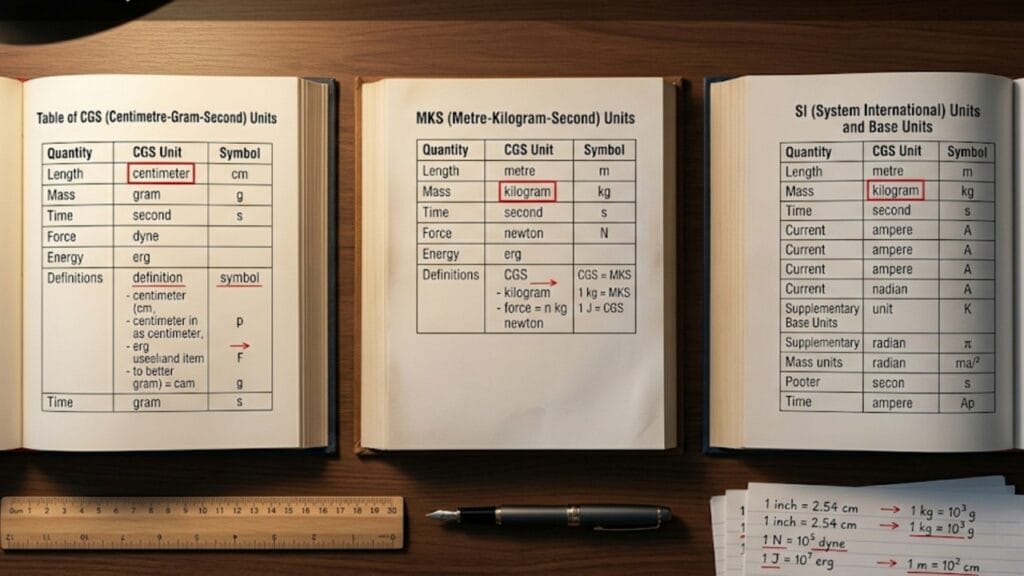
If you have studied physics for more than a few months, you have almost certainly encountered all three of these systems without necessarily thinking about what distinguishes them or why more than one exists. A problem gives you density in g/cm³ and asks for the answer in kg/m³. A textbook states the value of G in CGS units and you need it in SI. A formula sheet lists force in dynes and you need Newtons. Each of these situations requires you to know not just the conversion factors but the underlying structure of the system you are converting between.
The CGS, MKS and SI systems are not arbitrary historical accidents. Each emerged from specific practical needs, was built around specific base units and remains useful in specific contexts. Understanding what each system is — genuinely understanding it, not just memorizing conversion factors — makes unit conversion problems straightforward and builds the kind of physical intuition that pays dividends across the entire subject.
This article explains all three systems from their foundations, compares them directly across every major physical quantity and clarifies when and why each one is used.
A Brief History: Why Three Systems Exist
The multiplicity of unit systems in physics is a consequence of history, not design. Each system was developed independently in response to the measurement needs of its time.
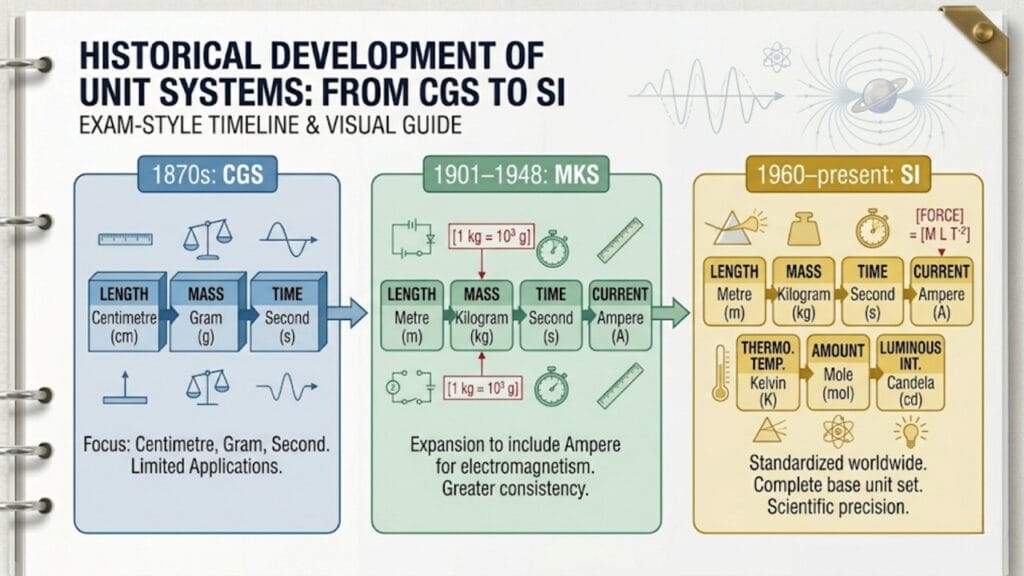
The CGS system (Centimetre-Gram-Second) was formalized in the 1870s by the British Association for the Advancement of Science, largely through the work of James Clerk Maxwell and William Thomson (Lord Kelvin). It built on the existing metric system and was specifically designed for scientific use in the laboratory, where the centimetre and gram are natural scales for the sizes and masses of objects typically studied.
The MKS system (Metre-Kilogram-Second) emerged as a practical alternative for engineering applications in the late 19th and early 20th centuries. Giovanni Giorgi proposed it formally in 1901, arguing that using metre-scale lengths and kilogram-scale masses produced more natural numbers in engineering calculations — bridge loads in kilograms rather than millions of grams, road distances in kilometres rather than millions of centimetres. Giorgi also showed that adding the ampere as a fourth base unit made electrical formulas significantly cleaner.
The SI system (Système International d’Unités) was established by international agreement in 1960 as an extension and formalization of the MKS system. It adopted seven base units, standardized prefixes and established a coherent framework for scientific measurement across all disciplines. In 2019, SI underwent a significant revision, redefining all seven base units in terms of fixed values of fundamental physical constants rather than physical artefacts.
Understanding this history matters because it explains why CGS units still appear in certain textbooks and research papers — not because their authors are being archaic, but because in some domains (particularly Gaussian electromagnetism and certain areas of astrophysics), CGS expressions are genuinely more compact and physically transparent than their SI equivalents.
Learn more about The Revised SI System (2019): How Constants Redefined Our Units of Measurement
The Three Systems: Base Units
The most fundamental difference between the three systems is the choice of base units. Every other difference — different units for force, energy, power and so on — follows automatically from this choice.
CGS System
| Base Quantity | CGS Unit | Symbol |
| Length | centimetre | cm |
| Mass | gram | g |
| Time | second | s |
The CGS system has three mechanical base units. Electrical quantities can be handled in several incompatible sub-systems — Gaussian CGS, ESU CGS (electrostatic units) and EMU CGS (electromagnetic units) — which is one reason the SI system with its single coherent electrical framework eventually became dominant.
MKS System
| Base Quantity | MKS Unit | Symbol |
| Length | metre | m |
| Mass | kilogram | kg |
| Time | second | s |
| Electric Current | ampere | A |
The MKS system extended the three mechanical base units of CGS by adding the ampere, making it capable of handling electrical quantities cleanly and coherently. The Giorgi proposal explicitly included the ampere to resolve the messy situation with CGS electrical sub-systems.
SI System
| Base Quantity | SI Unit | Symbol |
| Length | metre | m |
| Mass | kilogram | kg |
| Time | second | s |
| Electric Current | ampere | A |
| Temperature | kelvin | K |
| Amount of Substance | mole | mol |
| Luminous Intensity | candela | cd |
The SI system extends MKS with three additional base units to cover thermal, chemical and photometric quantities. For mechanical problems, SI and MKS are identical — the same base units, the same derived units, the same numerical values for all quantities.
Learn more about SI Units Explained: The 7 Base Units Every Physics Student Must Know
Derived Units: Where the Systems Diverge
The choice of base units determines all derived units automatically. Once you fix the base, every derived quantity has a fixed unit — and that unit’s numerical size relative to the physical quantity it measures is determined by the base unit choice.
This is where CGS and MKS/SI diverge most visibly and where the conversion factors between systems come from.
Force
In CGS (derived from F = ma):
\[ 1 \text{ dyne} = 1 \text{ g} \cdot \text{cm} \cdot \text{s}^{-2} \]
In MKS/SI:
\[ 1 \text{ Newton} = 1 \text{ kg} \cdot \text{m} \cdot \text{s}^{-2} \]
Conversion:
\[ 1 \text{ N} = 10^3 \text{ g} \times 10^2 \text{ cm} \times \text{s}^{-2} = 10^5 \text{ dyne} \]
\[ \boxed{1 \text{ N} = 10^5 \text{ dyne}} \]
Energy and Work
In CGS:
\[ 1 \text{ erg} = 1 \text{ g} \cdot \text{cm}^2 \cdot \text{s}^{-2} = 1 \text{ dyne} \cdot \text{cm} \]
In MKS/SI:
\[ 1 \text{ Joule} = 1 \text{ kg} \cdot \text{m}^2 \cdot \text{s}^{-2} = 1 \text{ N} \cdot \text{m} \]
Conversion:
\[ 1 \text{ J} = 10^3 \text{ g} \times (10^2 \text{ cm})^2 \times \text{s}^{-2} = 10^3 \times 10^4 \text{ g} \cdot \text{cm}^2 \cdot \text{s}^{-2} = 10^7 \text{ erg} \]
\[ \boxed{1 \text{ J} = 10^7 \text{ erg}} \]
Power
In CGS: erg per second (erg/s)
In MKS/SI: Watt (W) = J/s
\[ 1 \text{ W} = 10^7 \text{ erg/s} \]
Pressure
In CGS: dyne per square centimetre (dyne/cm²), also called barye
In MKS/SI: Pascal (Pa) = N/m²
\[ 1 \text{ Pa} = \frac{10^5 \text{ dyne}}{10^4 \text{ cm}^2} = 10 \text{ dyne/cm}^2 \]
\[ \boxed{1 \text{ Pa} = 10 \text{ dyne/cm}^2} \]
Master Comparison Table: CGS vs MKS vs SI
This table covers every physical quantity that commonly appears in school and competitive exam physics. The conversion factors for force, energy and the gravitational constant appear most frequently in problems.
| Physical Quantity | CGS Unit | MKS / SI Unit | Conversion |
| Base Units | |||
| Length | centimetre (cm) | metre (m) | 1 m = 100 cm |
| Mass | gram (g) | kilogram (kg) | 1 kg = 1000 g |
| Time | second (s) | second (s) | Same |
| Mechanics | |||
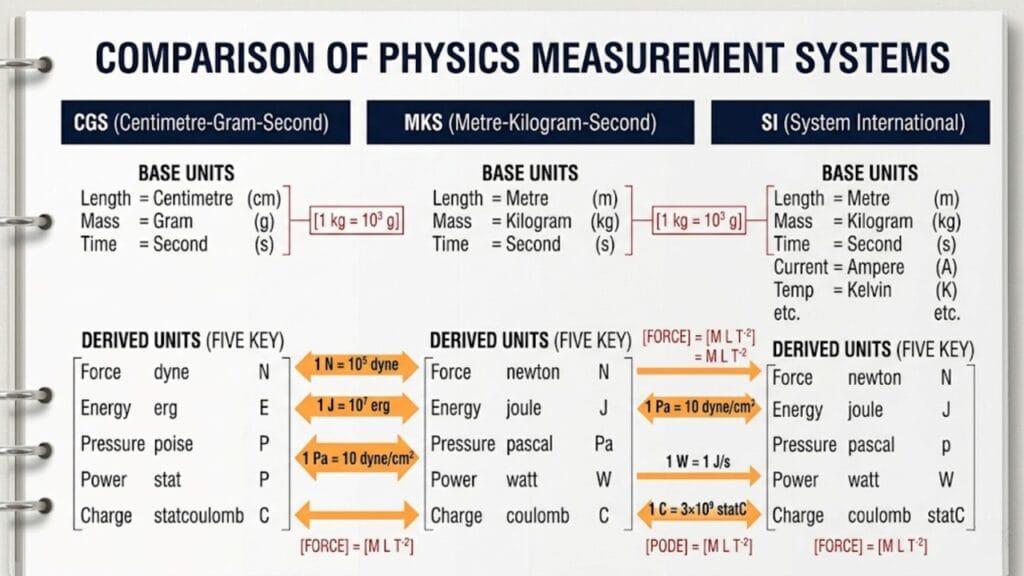
| Force | dyne | Newton (N) | \( 1 \text{ N} = 10^5 \text{ dyne} \) |
| Energy / Work | erg | Joule (J) | \( 1 \text{ J} = 10^7 \text{ erg} \) |
| Power | erg/s | Watt (W) | \( 1 \text{ W} = 10^7 \text{ erg/s} \) |
| Pressure | dyne/cm² (barye) | Pascal (Pa) | \( 1 \text{ Pa} = 10 \text{ dyne/cm}^2 \) |
| Momentum | g·cm/s | kg·m/s | \( 1 \text{ kg·m/s} = 10^5 \text{ g·cm/s} \) |
| Angular Momentum | g·cm²/s | kg·m²/s | \( 1 \text{ kg·m}^2/\text{s} = 10^7 \text{ g·cm}^2/\text{s} \) |
| Viscosity | poise (P) | Pa·s | \( 1 \text{ Pa·s} = 10 \text{ poise} \) |
| Surface Tension | dyne/cm | N/m | \( 1 \text{ N/m} = 10^3 \text{ dyne/cm} \) |
| Density and Volume | |||
| Density | g/cm³ | kg/m³ | \( 1 \text{ g/cm}^3 = 10^3 \text{ kg/m}^3 \) |
| Volume | cm³ | m³ | \( 1 \text{ m}^3 = 10^6 \text{ cm}^3 \) |
| Physical Constants | |||
| Gravitational Constant G | \( 6.67 \times 10^{-8} \) dyne·cm²/g² | \( 6.67 \times 10^{-11} \) N·m²/kg² | — |
| Speed of light c | \( 3 \times 10^{10} \) cm/s | \( 3 \times 10^{8} \) m/s | — |
| Electromagnetism | |||
| Magnetic Field B | Gauss (G) | Tesla (T) | \( 1 \text{ T} = 10^4 \text{ G} \) |
| Magnetic Flux | Maxwell (Mx) | Weber (Wb) | \( 1 \text{ Wb} = 10^8 \text{ Mx} \) |
Conversion Using the Dimensional Method
The most reliable way to convert physical quantities between CGS and SI is the dimensional method — the same technique used across all unit conversion problems:
\[ n_2 = n_1 \left[\frac{M_1}{M_2}\right]^a \left[\frac{L_1}{L_2}\right]^b \left[\frac{T_1}{T_2}\right]^c \]
Where \( a, b, c \) are the dimensional exponents from the dimensional formula of the quantity being converted.
Worked Example 1: Convert G from CGS to SI
Dimensional formula of G: \( [M^{-1}L^3T^{-2}] \), so \( a = -1, b = 3, c = -2 \)
CGS base units: g, cm, s. SI base units: kg, m, s.
\[ n_2 = 6.67 \times 10^{-8} \times \left[\frac{1 \text{ g}}{1 \text{ kg}}\right]^{-1} \times \left[\frac{1 \text{ cm}}{1 \text{ m}}\right]^{3} \times \left[\frac{1 \text{ s}}{1 \text{ s}}\right]^{-2} \]
\[ = 6.67 \times 10^{-8} \times (10^{-3})^{-1} \times (10^{-2})^{3} \times 1 \]
\[ = 6.67 \times 10^{-8} \times 10^{3} \times 10^{-6} = 6.67 \times 10^{-11} \]
Result: \( G = 6.67 \times 10^{-11} \) N·m²·kg⁻² in SI — the standard value confirmed.
Worked Example 2: Convert Density from g/cm³ to kg/m³
Dimensional formula of density: \( [ML^{-3}] \), so \( a = 1, b = -3, c = 0 \)
\[ n_2 = n_1 \times (10^{-3})^{1} \times (10^{-2})^{-3} = n_1 \times 10^{-3} \times 10^{6} = n_1 \times 10^{3} \]
Result: \( 1 \text{ g/cm}^3 = 10^3 \text{ kg/m}^3 \)
Water’s density is both 1 g/cm³ and 1000 kg/m³ — the factor of 1000 is an exact consequence of the base unit difference between CGS and SI.
Worked Example 3: Convert Viscosity from Poise to Pa·s
Dimensional formula of viscosity: \( [ML^{-1}T^{-1}] \), so \( a = 1, b = -1, c = -1 \)
\[ n_2 = 1 \times (10^{-3})^{1} \times (10^{-2})^{-1} \times (1)^{-1} = 10^{-3} \times 10^{2} = 10^{-1} \]
Result: \( 1 \text{ poise} = 0.1 \text{ Pa·s} \)
Learn more about How to Convert Units in Physics: Step-by-Step with Solved Examples
The Electrical Sub-Systems Problem in CGS
One reason the SI system eventually became the dominant standard deserves special attention — the CGS system’s treatment of electromagnetism is genuinely complicated and understanding why helps explain the structure of the SI system.
When Maxwell formalized electromagnetism in the 1860s, the CGS system did not have a dedicated electrical base unit. Electrical quantities had to be defined in terms of the existing mechanical CGS base units — but there were two independent ways to do this, leading to two incompatible CGS electrical sub-systems:
CGS-ESU (Electrostatic Units): Electric charge is defined so that the proportionality constant in Coulomb’s law equals exactly 1. The unit of charge is the statcoulomb.
\[ F = \frac{q_1 q_2}{r^2} \quad \text{(in CGS-ESU, the constant equals 1)} \]
CGS-EMU (Electromagnetic Units): Magnetic quantities are defined so that the proportionality constant in the Biot-Savart law equals exactly 1. The unit of current is the abampere.
The two sub-systems give different numerical values to the same electrical quantities and are mutually incompatible. Gaussian CGS is a hybrid that uses ESU units for electric quantities and EMU units for magnetic quantities. Many classical electrodynamics textbooks — particularly Jackson’s Classical Electrodynamics — use Gaussian CGS.
The SI system resolved all of this by adding the ampere as a fourth independent base unit, making the electrical framework clean, unified and consistent across all contexts.
When Is Each System Used Today?
CGS — Where It Persists and Why
Despite SI’s dominance, CGS continues in specific scientific communities:
Astrophysics and cosmology: Many astrophysics papers express luminosity in ergs per second, magnetic fields in Gauss and energy densities in erg/cm³. The solar luminosity \( L_\odot \approx 3.8 \times 10^{33} \text{ erg/s} \) gives a more compact mantissa in CGS than \( 3.8 \times 10^{26} \text{ W} \) in SI — a practical advantage when dealing with numbers that span many orders of magnitude.
Classical electrodynamics research: Advanced electromagnetic theory in Gaussian CGS has a certain formal elegance — the wave equation and its solutions appear more symmetric and \( c \) appears where physical symmetry demands it.
Older scientific literature: A substantial body of physics literature from the early-to-mid 20th century is written in CGS. Reading original papers by Planck, Bohr, Dirac, Fermi and others requires CGS fluency.
Surface science and fluid mechanics: Surface tension in dyne/cm, viscosity in poise and diffusion coefficients in cm²/s arise naturally at the length scales of surface and thin-film physics.
MKS — Its Role Today
Pure MKS (without the additional SI base units) is used in:
Engineering calculations: Structural engineering, mechanical design and civil engineering operate naturally at the metre and kilogram scale. Force in Newtons, energy in Joules and pressure in Pascals are the natural units for these problems.
Introductory physics courses: Many courses use MKS as a pedagogical simplification — four base units covering all of mechanics and basic electromagnetism, without the full SI framework’s additional complexity.
In practice, MKS and SI are identical for all mechanical and electrical calculations. The distinction only becomes meaningful when thermal, chemical, or photometric quantities enter the problem.
SI — The Universal Standard
SI is the official standard for:
- All peer-reviewed scientific publications
- All engineering and industrial standards worldwide
- All metrological and calibration work
- Physics education at all levels in most countries
For a student working through NCERT, JEE, NEET, or any CBSE board exam — SI is the operating system. CGS appears in problems specifically as a conversion exercise.
Key Conversion Factors: Quick Reference
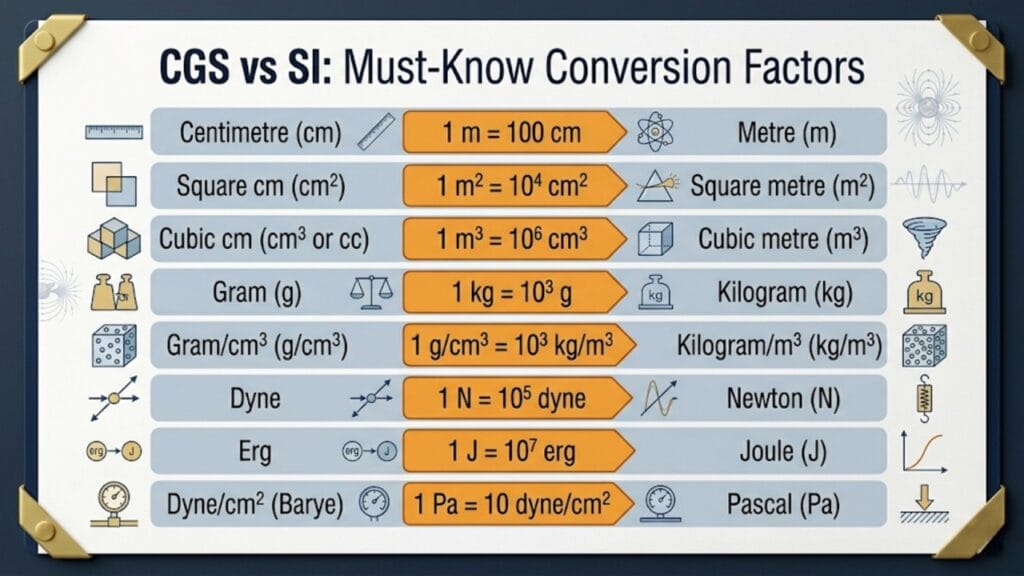
These are the factors that appear most frequently in physics problems and exam questions.
Mechanics
\[ 1 \text{ m} = 100 \text{ cm}, \quad 1 \text{ m}^2 = 10^4 \text{ cm}^2, \quad 1 \text{ m}^3 = 10^6 \text{ cm}^3 \]
\[ 1 \text{ kg} = 10^3 \text{ g} \]
\[ 1 \text{ N} = 10^5 \text{ dyne} \]
\[ 1 \text{ J} = 10^7 \text{ erg} \]
\[ 1 \text{ W} = 10^7 \text{ erg/s} \]
\[ 1 \text{ Pa} = 10 \text{ dyne/cm}^2 \]
\[ 1 \text{ g/cm}^3 = 10^3 \text{ kg/m}^3 \]
Physical Constants in Both Systems
| Constant | CGS Value | SI Value |
| G | \( 6.67 \times 10^{-8} \text{ dyne·cm}^2\text{·g}^{-2} \) | \( 6.67 \times 10^{-11} \text{ N·m}^2\text{·kg}^{-2} \) |
| c | \( 3 \times 10^{10} \text{ cm/s} \) | \( 3 \times 10^{8} \text{ m/s} \) |
| h (Planck) | \( 6.626 \times 10^{-27} \text{ erg·s} \) | \( 6.626 \times 10^{-34} \text{ J·s} \) |
Electromagnetic Units
| Quantity | CGS-Gaussian | SI | Conversion |
| Magnetic field B | Gauss (G) | Tesla (T) | \( 1 \text{ T} = 10^4 \text{ G} \) |
| Magnetic flux | Maxwell (Mx) | Weber (Wb) | \( 1 \text{ Wb} = 10^8 \text{ Mx} \) |
The FPS System: A Brief Note
The FPS system (Foot-Pound-Second) is not part of the metric family but appears in conversion problems and in contexts involving older British and American engineering literature.
| Base Quantity | FPS Unit |
| Length | foot (ft) |
| Mass | pound (lb) or slug |
| Time | second (s) |
| Force | poundal (pdl) or pound-force (lbf) |
Key conversions for reference: \[ 1 \text{ foot} = 0.3048 \text{ m} \] \[ 1 \text{ pound-force} = 4.448 \text{ N} \] \[ 1 \text{ slug} = 14.59 \text{ kg} \]
For all standard Indian physics examinations (CBSE, JEE, NEET), FPS conversions are not tested. CGS-to-SI conversion is the relevant practical skill.
Coherence: Why All Three Systems Work Internally
A property worth naming explicitly is coherence. A unit system is coherent if all derived units are formed by simple multiplication or division of base units, with no extra numerical factors in the defining equations.
SI is coherent: From \( F = ma \), a 1 kg mass accelerating at 1 m/s² experiences a force of exactly 1 N. No extra factor.
CGS is also coherent within itself: From \( F = ma \), a 1 g mass accelerating at 1 cm/s² experiences a force of exactly 1 dyne. No extra factor.
The conversion factors between systems (1 N = 10⁵ dyne) do not reflect incoherence in either system. They arise from the different sizes of the base units. Both systems are internally self-consistent — they are simply calibrated differently.
This is the conceptual insight that makes the dimensional conversion formula work: it systematically accounts for the ratio of base unit sizes, exponent by exponent and produces the correct factor every time.
Learn more about What Is Dimensional Formula? Derivation, Applications & Limitations
Common Exam Questions Involving System Conversion
Board exams and competitive exams test CGS-to-SI conversion in predictable ways:
Type 1 — Convert G from CGS to SI using the dimensional method. Given \( G = 6.67 \times 10^{-8} \text{ dyne·cm}^2\text{·g}^{-2} \), find in SI. A standard 3-mark CBSE question and a JEE practice problem.
Type 2 — Density conversion. Given density in g/cm³, express in kg/m³. The factor \( 10^3 \) comes from \( 10^{-3}/10^{-6} \) — not from a simple base unit ratio, which is why quick mental arithmetic often gives the wrong answer here.
Type 3 — Identify the unit system from a given unit. “In which system is force measured in dynes?” — CGS. “What is the SI equivalent?” — Newton. “Conversion?” — \( 10^5 \).
Type 4 — Work or energy conversion. A problem gives work in ergs and asks for Joules. Divide by \( 10^7 \).
Type 5 — Pressure conversion in context. Atmospheric pressure is \( 1.013 \times 10^6 \text{ dyne/cm}^2 \) in CGS and \( 1.013 \times 10^5 \text{ Pa} \) in SI. Verify the conversion factor is 10.
Learn more about Most Important Formulas in Units & Measurements for Board Exams
Summary: CGS vs MKS vs SI at a Glance
| Feature | CGS | MKS | SI |
| Base length | centimetre (cm) | metre (m) | metre (m) |
| Base mass | gram (g) | kilogram (kg) | kilogram (kg) |
| Base time | second (s) | second (s) | second (s) |
| Extra base units | None | Ampere (A) | A, K, mol, cd |
| Unit of force | dyne | Newton (N) | Newton (N) |
| Unit of energy | erg | Joule (J) | Joule (J) |
| Unit of power | erg/s | Watt (W) | Watt (W) |
| Unit of pressure | dyne/cm² | Pascal (Pa) | Pascal (Pa) |
| Electrical framework | Multiple sub-systems | Clean via ampere | Clean via ampere |
| International standard? | No | Partially | Yes |
| Coherent? | Yes | Yes | Yes |
| G value | \( 6.67 \times 10^{-8} \) | \( 6.67 \times 10^{-11} \) | \( 6.67 \times 10^{-11} \) |
| Density of water | 1 g/cm³ | 1000 kg/m³ | 1000 kg/m³ |
| Primary use today | Astrophysics, advanced EM, old literature | Engineering, teaching | All science and engineering |
Conclusion
The CGS, MKS and SI systems are not different physics — they are different languages for the same physics. The force on a 1 kg mass accelerating at 1 m/s² is 1 Newton in SI and 100,000 dynes in CGS. The physical reality is identical. The numbers differ because the yardsticks differ.
Understanding this is what makes system conversion intuitive rather than mechanical. When you convert G from \( 6.67 \times 10^{-8} \) in CGS to \( 6.67 \times 10^{-11} \) in SI, you are not changing the gravitational constant — you are re-expressing the same constant in a language whose base units are \( 10^3 \) times heavier and \( 10^2 \) times longer. The dimensional method traces that translation, exponent by exponent and gives the correct conversion factor every time.
For day-to-day physics, SI is the operating standard. For reading historical literature, certain astrophysics papers, or advanced classical electrodynamics, CGS fluency matters. Knowing both — and knowing how to move reliably between them — is a mark of complete physics education.
Learn more about All SI Prefixes from Pico to Tera: Quick Reference Chart with Examples
Frequently Asked Questions
What is the main difference between the CGS and SI systems?
The main difference is the base units. CGS uses centimetre, gram and second. SI uses metre, kilogram, second and four additional base units (ampere, kelvin, mole, candela). This difference in base unit size generates different derived units — dyne versus Newton for force, erg versus Joule for energy — with specific conversion factors determined by the ratios of the base unit sizes.
Why is 1 g/cm³ equal to 1000 kg/m³?
The density conversion factor combines both mass and volume unit changes. Going from g to kg multiplies by \( 10^{-3} \). Going from cm³ to m³: since \( 1 \text{ m}^3 = 10^6 \text{ cm}^3 \), dividing by \( 10^6 \) in the denominator means the density multiplies by \( 10^6 \) for the volume part. Combined: \( 10^{-3} \times 10^{6} = 10^{3} \). So \( 1 \text{ g/cm}^3 = 10^3 \text{ kg/m}^3 \).
Is MKS the same as SI?
For mechanical and basic electrical calculations, MKS and SI are identical — same base units, same derived units, same numerical values. SI adds three more base units: kelvin (temperature), mole (amount of substance) and candela (luminous intensity). Any problem involving only mechanics and electromagnetism can be solved using MKS or SI interchangeably.
Why did CGS develop multiple electrical sub-systems?
Because CGS had no dedicated electrical base unit. Electrical quantities had to be derived entirely from the mechanical base units (g, cm, s), but there were two physically independent ways to do this — through electrostatic forces or electromagnetic forces. These two approaches give incompatible numerical values to electrical quantities. SI resolved this permanently by introducing the ampere as an independent electrical base unit.
What is the CGS unit of pressure and its SI equivalent?
The CGS unit of pressure is the dyne per square centimetre (dyne/cm²), also called the barye. Its SI equivalent is the Pascal (Pa). Conversion: 1 Pa = 10 dyne/cm². This follows from 1 N = 10⁵ dyne and 1 m² = 10⁴ cm², so \( 1 \text{ N/m}^2 = 10^5/(10^4) \text{ dyne/cm}^2 = 10 \text{ dyne/cm}^2 \).
Which system should students use for JEE and NEET?
Always SI. All standard physics problems in JEE Main, JEE Advanced, NEET and CBSE board exams use SI units. When a problem provides data in CGS units, convert to SI before calculating, compute the answer in SI, then convert back if the question specifically asks for a CGS answer.
What is the conversion between erg and Joule?
1 Joule = 10⁷ erg. Equivalently, 1 erg = 10⁻⁷ Joule. Derived from first principles: 1 J = 1 kg·m²·s⁻² and 1 erg = 1 g·cm²·s⁻² = \( 10^{-3} \text{ kg} \times (10^{-2})^2 \text{ m}^2 \times \text{s}^{-2} \) = \( 10^{-3} \times 10^{-4} \) J = \( 10^{-7} \) J.
Leave a Comment