

Introduction: The Agreement That Made Modern Science Possible
Imagine two physicists — one working in Mumbai, another in Berlin — conducting the same experiment independently. They measure the same physical quantities, write up their results and compare notes. For that comparison to mean anything at all, both of them must be using the same reference system for measurement. Otherwise, “5 units of force” in one lab means something entirely different in the other.
This is not a hypothetical problem. For most of human history, it was exactly the reality. Units of measurement varied by region, by trade, by tradition. A “foot” was literally the length of a king’s foot. A “pound” differed across countries. Science could not scale under those conditions.
The International System of Units — universally known as the SI system — is the solution the world agreed on. It is the common language of measurement, used today in every branch of physics, chemistry, engineering and medicine across virtually every country on Earth. Understanding its history, its structure and why it is designed the way it is will give you a much clearer picture of what measurement actually means in physics.
A Brief History of Measurement: From Chaos to Consensus
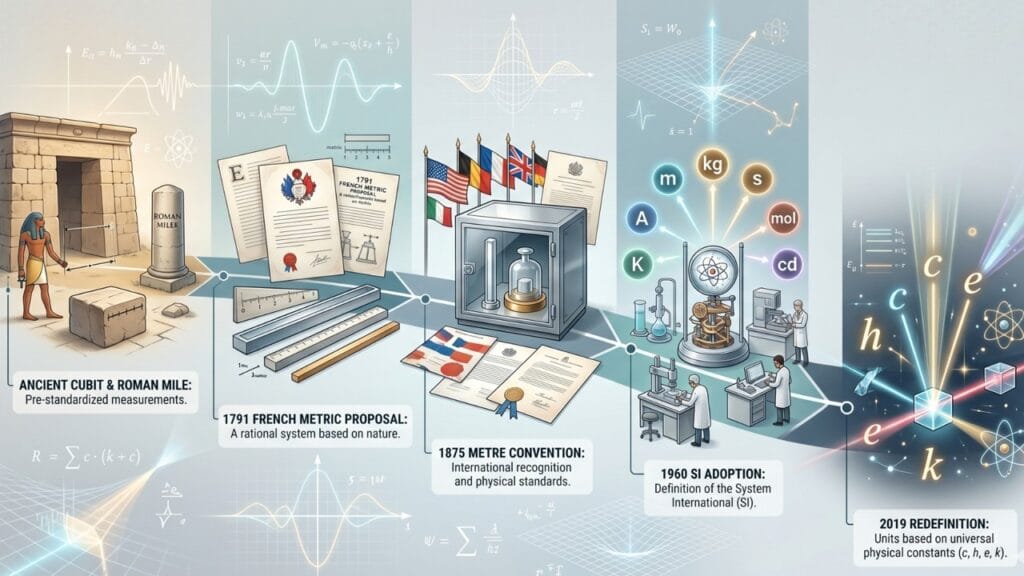
Measurement is as old as civilization. The ancient Egyptians used the cubit — roughly the distance from the elbow to the tip of the middle finger. Romans used the mile, derived from one thousand paces of a marching soldier. Medieval Europe had a patchwork of local units that made trade between towns genuinely complicated.
The problem came into sharp focus during the scientific revolution of the 16th and 17th centuries. As Galileo, Newton and their contemporaries began building a quantitative science of nature, the inconsistency of measurement systems became a serious obstacle. You cannot have a universal law of gravitation if everyone is measuring force in different units.
The first major step toward standardisation came from revolutionary France. In 1791, the French Academy of Sciences proposed a coherent system of units based on natural references — specifically, the metre, defined as one ten-millionth of the distance from the North Pole to the equator. This metric system spread across Europe through the 19th century, though adoption was uneven and competing systems persisted.
The General Conference on Weights and Measures (CGPM) — an international body established by the Metre Convention of 1875 — took on the task of formalising a global standard. After decades of refinement, the International System of Units was formally adopted in 1960 at the 11th CGPM.
The system has been updated several times since. The most significant revision came in 2019, when all seven base units were redefined using fixed numerical values of fundamental physical constants — making the SI entirely independent of any physical artefact for the first time in its history.
The Structure of the SI System
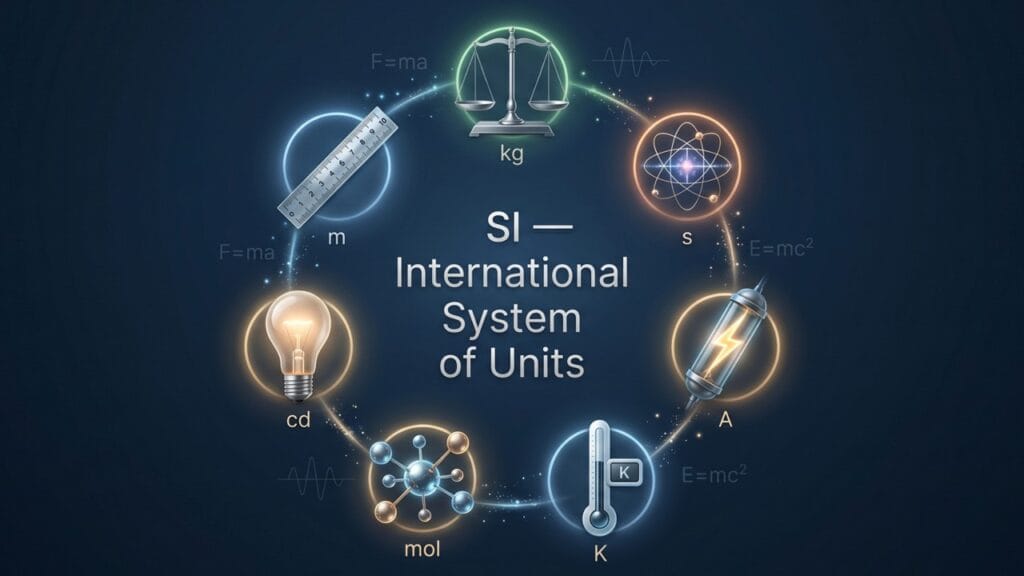
The SI system is built on a foundation of seven base units, each corresponding to an independently defined physical quantity. Every other unit used in physics and engineering is a derived unit — a combination of these seven base units, assembled through the formulas that define physical quantities.
The Seven SI Base Units
| Physical Quantity | Base Unit | Symbol | Defining Constant |
| Length | Metre | m | Speed of light \( c \) |
| Mass | Kilogram | kg | Planck constant \( h \) |
| Time | Second | s | Caesium hyperfine frequency \( \Delta\nu_{Cs} \) |
| Electric Current | Ampere | A | Elementary charge \( e \) |
| Thermodynamic Temperature | Kelvin | K | Boltzmann constant \( k_B \) |
| Amount of Substance | Mole | mol | Avogadro constant \( N_A \) |
| Luminous Intensity | Candela | cd | Luminous efficacy \( K_{cd} \) |
These seven quantities are chosen because they are mutually independent — none of them can be defined in terms of the others. Together, they are sufficient to express every measurable physical quantity in science.
Learn more about SI Units Explained: The 7 Base Units Every Physics Student Must Know
Derived Units: Building on the Foundation
Derived units are constructed by combining base units through multiplication and division. Some derived units occur so frequently that they are given special names.
| Derived Quantity | Unit Name | Symbol | In Base Units |
| Force | Newton | N | \( \text{kg} \cdot \text{m} \cdot \text{s}^{-2} \) |
| Energy / Work | Joule | J | \( \text{kg} \cdot \text{m}^2 \cdot \text{s}^{-2} \) |
| Power | Watt | W | \( \text{kg} \cdot \text{m}^2 \cdot \text{s}^{-3} \) |
| Pressure | Pascal | Pa | \( \text{kg} \cdot \text{m}^{-1} \cdot \text{s}^{-2} \) |
| Electric Charge | Coulomb | C | \( \text{A} \cdot \text{s} \) |
| Frequency | Hertz | Hz | \( \text{s}^{-1} \) |
The ability to trace any derived unit back to base units is one of the most powerful features of the SI system. It underpins dimensional analysis — the method of checking whether physics equations are consistent by verifying that both sides carry the same combination of base units.
Learn more about Fundamental vs Derived Units: Key Differences with Examples
The SI Prefix System
The SI system uses a standardised set of prefixes to express quantities that are very large or very small, without resorting to unwieldy strings of zeros.
| Prefix | Symbol | Power of 10 | Example |
| Tera | T | \( 10^{12} \) | 1 THz (terahertz, used in spectroscopy) |
| Giga | G | \( 10^{9} \) | 1 GW (gigawatt, power output of large plants) |
| Mega | M | \( 10^{6} \) | 1 MHz (megahertz, radio frequency range) |
| Kilo | k | \( 10^{3} \) | 1 km (kilometre) |
| Centi | c | \( 10^{-2} \) | 1 cm (centimetre) |
| Milli | m | \( 10^{-3} \) | 1 ms (millisecond) |
| Micro | μ | \( 10^{-6} \) | 1 μm (micrometre, cell biology scale) |
| Nano | n | \( 10^{-9} \) | 1 nm (nanometre, wavelength of light, atomic scale) |
| Pico | p | \( 10^{-12} \) | 1 ps (picosecond, ultrafast laser pulses) |
This prefix structure is one of the most practical features of the metric system and it is something the FPS (foot-pound-second) system never had — which is a significant part of why the metric system ultimately won globally.
The 2019 Redefinition: A Landmark Moment in Science
The 2019 revision of the SI system was not just an administrative update. It was a conceptual shift in how the world defines measurement.
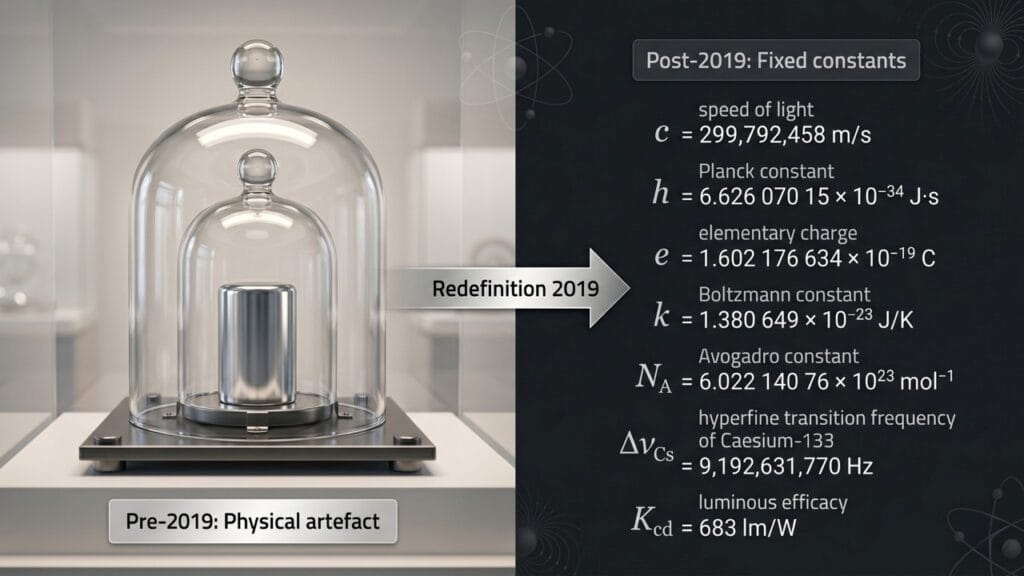
Before 2019, the kilogram was defined by a physical object — the International Prototype Kilogram (IPK), a platinum-iridium cylinder kept at the International Bureau of Weights and Measures near Paris. Every kilogram measurement on Earth was traceable to that one object. The problem? Any physical object can change over time. The IPK had been measured against its official copies and discrepancies had grown over decades.
The 2019 redefinition solved this permanently. All seven base units are now defined by fixing the numerical values of seven fundamental physical constants:
- \( c = 299{,}792{,}458 \, \text{m/s} \) (speed of light in vacuum) → defines the metre
- \( h = 6.626 \times 10^{-34} \, \text{J·s} \) (Planck constant) → defines the kilogram
- \( e = 1.602 \times 10^{-19} \, \text{C} \) (elementary charge) → defines the ampere
- \( k_B = 1.381 \times 10^{-23} \, \text{J/K} \) (Boltzmann constant) → defines the kelvin
- \( N_A = 6.022 \times 10^{23} \, \text{mol}^{-1} \) (Avogadro constant) → defines the mole
- \( K_{cd} = 683 \, \text{lm/W} \) (luminous efficacy) → defines the candela
- \( \Delta\nu_{Cs} = 9{,}192{,}631{,}770 \, \text{Hz} \) (caesium hyperfine frequency) → defines the second
Physical constants do not drift, degrade, or need to be stored in a vault in France. They are the same everywhere in the universe. The SI system is now, in the most fundamental sense, truly universal.
Real-World Importance of the SI System
In Scientific Research
Every peer-reviewed physics paper in the world reports results in SI units. This is not optional — it is required by virtually every journal. Without a common unit system, comparing results across laboratories or replicating experiments would require layers of conversion that introduce error and ambiguity.
In Engineering and Technology
When the Mars Climate Orbiter was lost in 1999, the cause was a unit mismatch — one team used metric units, another used imperial. The spacecraft missed its orbital insertion and burned up in the Martian atmosphere. A \$327 million mission, destroyed by a failure to maintain a consistent unit system. The SI system exists precisely to prevent this.
In Medicine and Pharmacy
Drug dosages, blood test results and medical imaging parameters are all expressed in SI-derived units. A milligram is a milligram everywhere. In healthcare, where a factor-of-ten error in a drug dose can be fatal, this consistency is not merely convenient — it is a matter of patient safety.
In Education
For students, the SI system provides a consistent framework within which all of physics makes sense. Dimensional analysis — the practice of verifying equations by checking that units match — is only possible because SI units form a coherent, internally consistent system.
Learn more about Physical Quantities in Physics: Scalars, Vectors and Their Units

Why This Concept Matters for Physics Students
You might be tempted to think of the SI system as bureaucratic background information — something teachers cover in Chapter 1 so they can move on to the interesting stuff. That would be a mistake.
Every formula you use in physics is implicitly defined within the SI system. When you write \( F = ma \) and get a force in Newtons, that result only makes sense because mass is in kilograms and acceleration is in m/s² — both SI units. If you mix in a measurement from another system without converting, the formula gives you a number that means nothing.
More concretely: in competitive examinations like JEE and NEET, questions based on units, dimensional analysis and unit conversion are routine. Understanding the SI structure — which quantities are base, which are derived, how prefixes work — is directly testable knowledge.
And in the long run, physics is a quantitative discipline. Every experimental result, every theoretical prediction, every engineering calculation requires measurement. The SI system is the grammar of that language. You cannot do serious physics without it.
Common Mistakes and Misconceptions
Thinking the Metric System and SI Are the Same Thing
They are related but not identical. The metric system is an older umbrella term referring to systems based on the metre and gram. The SI system is a specific, formally defined modern standard. For example, the CGS metric system (centimetre-gram-second) is metric but not SI.
Confusing Celsius and Kelvin
Both are used to measure temperature, but only Kelvin is the SI base unit. Celsius is acceptable for everyday use but cannot be substituted into physics formulas involving absolute temperature — such as the ideal gas law \( PV = nRT \) — without converting to Kelvin first.
Believing That SI Units Are Just Metric Units with Different Names
SI units are defined by fundamental physical constants, not by arbitrary references to physical objects or human-scale quantities. The 2019 redefinition made this explicit. SI is not a naming convention — it is a measurement system grounded in the constants of nature.
Treating Non-SI Units as Equivalent Without Converting
Electronvolts, calories, atmospheres, light-years — these are not SI units, though they are widely used in specific fields. In physics calculations using SI formulas, non-SI units must be explicitly converted. Failing to do this is one of the most common sources of error in quantitative problems.
Conclusion
The International System of Units is more than a list of units and prefixes. It is the outcome of centuries of effort to bring consistency, reproducibility and universality to measurement — the activity that lies at the heart of all empirical science.
Its structure — seven mutually independent base units, an unlimited set of derived units and a consistent prefix system — gives it the flexibility to describe everything from the diameter of an atomic nucleus to the distance between galaxies. Its 2019 redefinition tied it permanently to the constants of nature, removing the last dependency on any physical object.
For physics students, understanding the SI system is not optional. It is the foundation on which every measurement, every formula and every calculation rests.
Frequently Asked Questions
What does SI stand for in physics?
SI stands for Système International d’Unités, which is French for “International System of Units.” It is the modern, globally adopted standard system of measurement used in science, engineering and medicine worldwide.
When was the SI system established?
The SI system was formally adopted in 1960 at the 11th General Conference on Weights and Measures (CGPM). It was built on the earlier metric system developed in France in the late 18th century and has been revised several times since, most significantly in 2019.
How many base units are in the SI system?
There are exactly seven base units in the SI system: the metre (length), kilogram (mass), second (time), ampere (electric current), kelvin (temperature), mole (amount of substance) and candela (luminous intensity).
What is the difference between SI and metric systems?
The metric system is a broad term for decimal-based measurement systems using units like the metre and gram. The SI system is a specific, formally defined modern standard that includes seven base units and is defined in terms of fundamental physical constants. All SI units are metric, but not all metric systems are SI — the CGS system (centimetre-gram-second), for example, is metric but not SI.
Why was the SI system redefined in 2019?
The 2019 redefinition replaced all physical-artefact-based unit definitions with definitions based on fixed values of fundamental physical constants. This made SI units universally reproducible in any well-equipped laboratory without reference to any single physical object — solving the long-standing problem of units drifting over time as physical standards aged or changed.
Is the Celsius scale part of the SI system?
The Celsius scale is accepted alongside SI for everyday temperature measurement, but the SI base unit of temperature is the kelvin (K), not Celsius. Physics formulas involving absolute temperature — such as the ideal gas law — require Kelvin. The conversion is: \( T(K) = T(°C) + 273.15 \).
Do all countries use the SI system?
Almost all countries use the SI system for scientific and official purposes. The United States is the notable exception in everyday life, where the imperial system (feet, pounds, Fahrenheit) remains common. However, even in the US, all scientific research and most engineering uses SI units.